
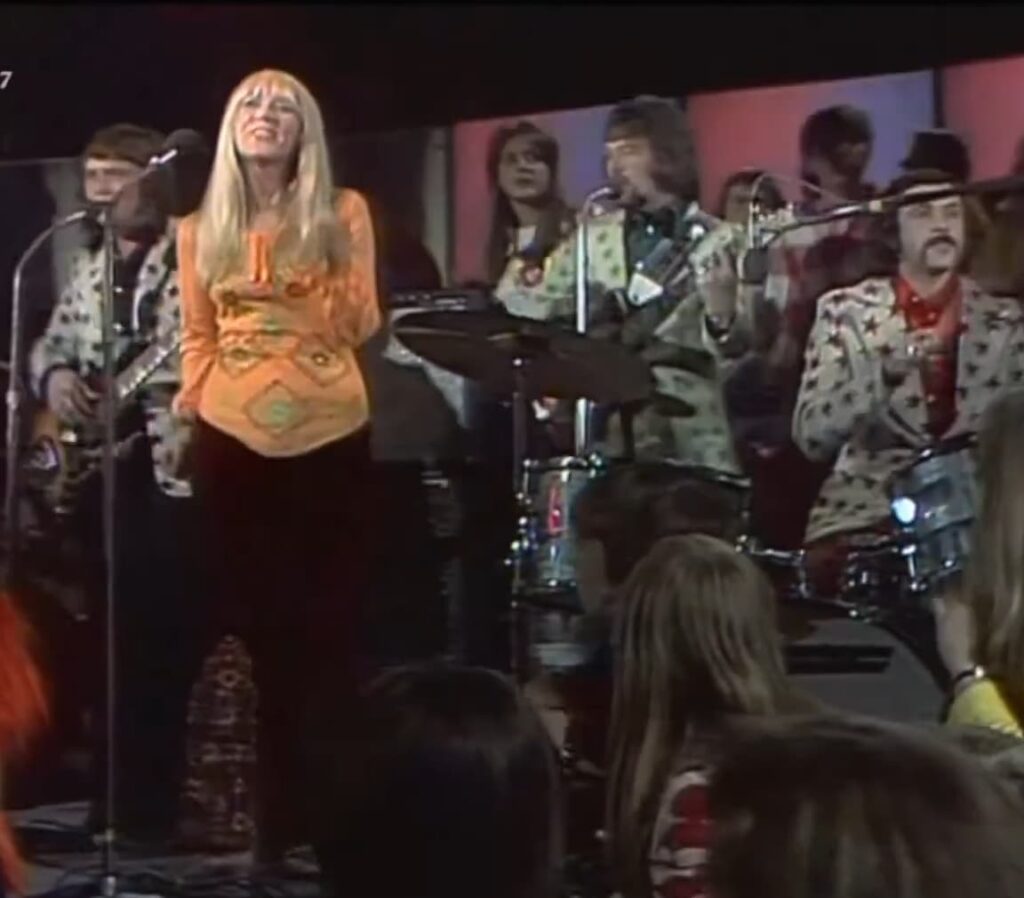
A buoyant pop anthem that carried a Scottish band across the Atlantic in spirit—“Talk Of All The USA” captures the optimism, curiosity, and musical sparkle of the early 1970s.
When listeners revisit the catalog of the Scottish pop group Middle Of The Road, they usually remember the irresistible sing-along charm of “Chirpy Chirpy Cheep Cheep.” Yet tucked among the band’s early-1970s singles is another delightful gem: “Talk Of All The USA.” Released in 1972 on the album Acceleration, the song stands as a bright, rhythmic snapshot of a time when pop music was still carried by melody, optimism, and the thrill of imagining distant places.
By the early seventies, Middle Of The Road—fronted by the warm and expressive voice of Sally Carr—had already established themselves as a major presence on European pop charts. The group, which also included Ken Andrew, Eric McCredie, and Ian McCredie, built a reputation for upbeat melodies, crisp harmonies, and arrangements that were simple yet instantly memorable. Their sound lived somewhere between bubblegum pop and the melodic rock of the era, making their songs easy companions on radio playlists across the continent.
“Talk Of All The USA” continued that tradition. Though it did not reach the towering chart success of some of their earlier hits, the single still resonated strongly with audiences, particularly in Europe and Japan where the band maintained a loyal following. In several European territories the song charted modestly during 1972, benefiting from the group’s already strong popularity at the time. While it never cracked the U.S. Billboard Hot 100, the irony of the title only adds to its charm: a song celebrating the cultural magnetism of America while being embraced mostly outside its borders.
Musically, “Talk Of All The USA” is a perfect example of the polished pop craftsmanship that defined Middle Of The Road. The arrangement moves briskly, carried by buoyant guitar rhythms, bright keyboard accents, and a driving beat that feels almost like a road trip in motion. Over this lively foundation, Sally Carr delivers the lyrics with a cheerful clarity that gives the song its inviting personality.
But beneath its lighthearted exterior lies a subtle cultural story. In the early 1970s, the United States remained a powerful symbol in the imagination of people around the world. American music, films, and lifestyle had become a global language. For many European musicians, America represented both a dream destination and a musical homeland—the birthplace of rock and roll, folk, country, and blues.
“Talk Of All The USA” taps into that fascination. The song reflects a sense of wonder about the vastness and excitement of America, almost as if the singer is hearing stories from travelers returning from across the ocean. It is not a political song or a deep social commentary. Instead, it celebrates the mythology of America—the highways, the cities, the music, the promise of adventure. Listening to it today feels like opening an old postcard from a time when the world seemed both larger and more hopeful.
There is also something deeply nostalgic in the way Middle Of The Road approached pop music. Their recordings were crafted in an era before digital production and endless studio manipulation. The warmth of analog recording, the clarity of the band’s harmonies, and the straightforward instrumentation give “Talk Of All The USA” a timeless quality. It feels human, spontaneous, and sincere.
For many listeners who first heard the song on radio broadcasts in the early seventies, it carried the sound of everyday life: car radios humming on long drives, family living rooms filled with music on a Sunday afternoon, or jukeboxes glowing in neighborhood cafés. Songs like this were not always revolutionary—but they were companions to ordinary moments that eventually became treasured memories.
Looking back now, “Talk Of All The USA” reminds us of a particular spirit in popular music—a moment when bands like Middle Of The Road could capture joy and curiosity in three minutes of melody. The song may not be the group’s most famous recording, but it remains a charming piece of their musical story, echoing the optimism of an era when the world of pop music still felt like an open road stretching far beyond the horizon.
 Oldies Songs