
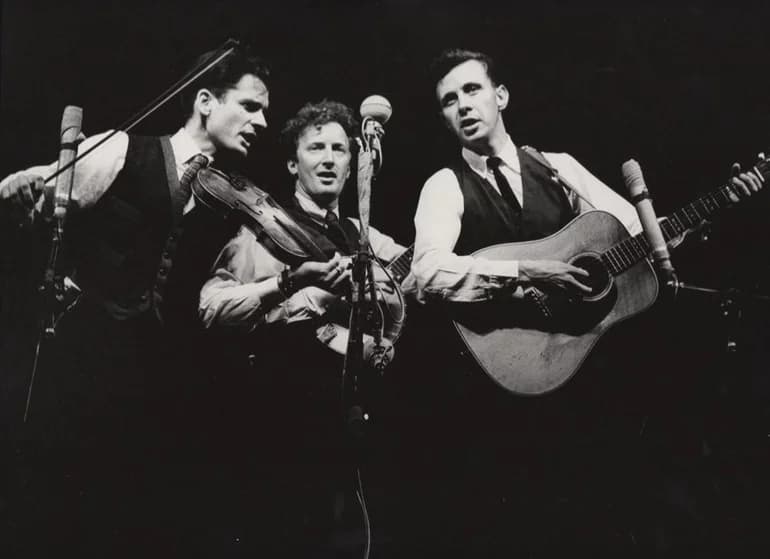
A Gentle Revival of America’s Old-Time Spirit: “Bowling Green” and the Living Memory of Folk Tradition
When The New Lost City Ramblers recorded “Bowling Green,” they were not simply performing another folk tune—they were helping preserve a living fragment of America’s musical memory. Released during the folk revival era of the late 1950s and early 1960s, their version of “Bowling Green” captured the spirit of traditional Appalachian string band music at a time when younger audiences were rediscovering the roots of American folk culture. Although the recording did not enter the major commercial charts such as the Billboard Hot 100, its influence ran far deeper than chart numbers might suggest. Within the folk community and among scholars of traditional music, the performance became part of a movement that reshaped how people understood early American country and old-time music.
The group behind the recording, The New Lost City Ramblers, was formed in 1958 by Mike Seeger, John Cohen, and Tom Paley. Their mission was remarkably clear: to revive and faithfully interpret the rural string band music that had flourished in the United States during the 1920s and 1930s. While many folk revival performers polished old songs into modern arrangements, the Ramblers did the opposite. They studied the recordings of early artists, traveled through the Appalachian South to meet surviving musicians, and tried to recreate the authentic sound of that era—banjo, fiddle, guitar, and voices that felt raw and direct.
Their rendition of “Bowling Green” appeared in the repertoire they developed in the early years of the group and can be heard on several collections and performances tied to their early recordings, including material connected to albums such as The New Lost City Ramblers (1958) and later archival releases that preserved their interpretation of traditional tunes. The song itself is older than any modern recording. Like many folk standards, it traveled through oral tradition long before it was written down. The lyrics reference Bowling Green, Kentucky, a place name that became a symbol of longing, travel, and home in many traditional American songs.
In essence, “Bowling Green” belongs to a family of old-time fiddle tunes and folk songs that celebrate movement—both literal and emotional. In the American folk tradition, cities and towns often served as markers of memory: a place where someone once loved, worked, or departed from. The Ramblers’ version carries that gentle sense of wandering. The melody moves lightly, almost like a traveler walking down a quiet road at dusk, and the rhythm has the relaxed pulse of a front-porch gathering rather than a stage performance.
One of the most remarkable aspects of the recording is its simplicity. Mike Seeger’s banjo playing and the ensemble’s loose, unpolished harmony deliberately echo the style of early Appalachian musicians such as those who recorded for labels like Victor and Columbia in the late 1920s. This authenticity was not accidental—it was carefully studied. The Ramblers believed that the beauty of old-time music lay in its imperfections: the slightly uneven rhythm, the conversational singing style, and the sense that the music belonged to everyday life rather than the entertainment industry.
Behind this approach was a deeper philosophy. During the late 1950s and early 1960s, American popular music was rapidly changing, dominated by polished pop productions and the early waves of rock and roll. Yet at the same moment, a parallel cultural movement was unfolding in coffeehouses, college campuses, and small folk festivals. Listeners were rediscovering the earlier voices of American music—songs that had once echoed through rural communities and small towns.
“Bowling Green,” as interpreted by The New Lost City Ramblers, became part of that rediscovery. It reminded audiences that long before modern country radio or Nashville studios, American music had been shaped by ordinary people—farmers, miners, fiddlers, and banjo players who passed songs from generation to generation. The Ramblers treated those songs not as museum artifacts but as living traditions.
The emotional weight of the song lies precisely in that feeling of continuity. Listening to “Bowling Green” today is a bit like opening an old photograph album. The voices sound distant, yet strangely familiar. The melody carries a sense of roads traveled and stories half remembered. It is music that seems to exist outside of time—simple, reflective, and quietly enduring.
Over the decades, The New Lost City Ramblers would become one of the most respected groups in the preservation of traditional American music. Their work influenced countless folk musicians and scholars, and their recordings remain essential listening for anyone interested in the roots of bluegrass, country, and old-time string band music.
And so “Bowling Green” stands not merely as a song, but as a reminder of a musical heritage that might easily have faded away. In the hands of The New Lost City Ramblers, it becomes something more enduring—a gentle echo of the past, carried forward by voices that understood the quiet power of remembering.