
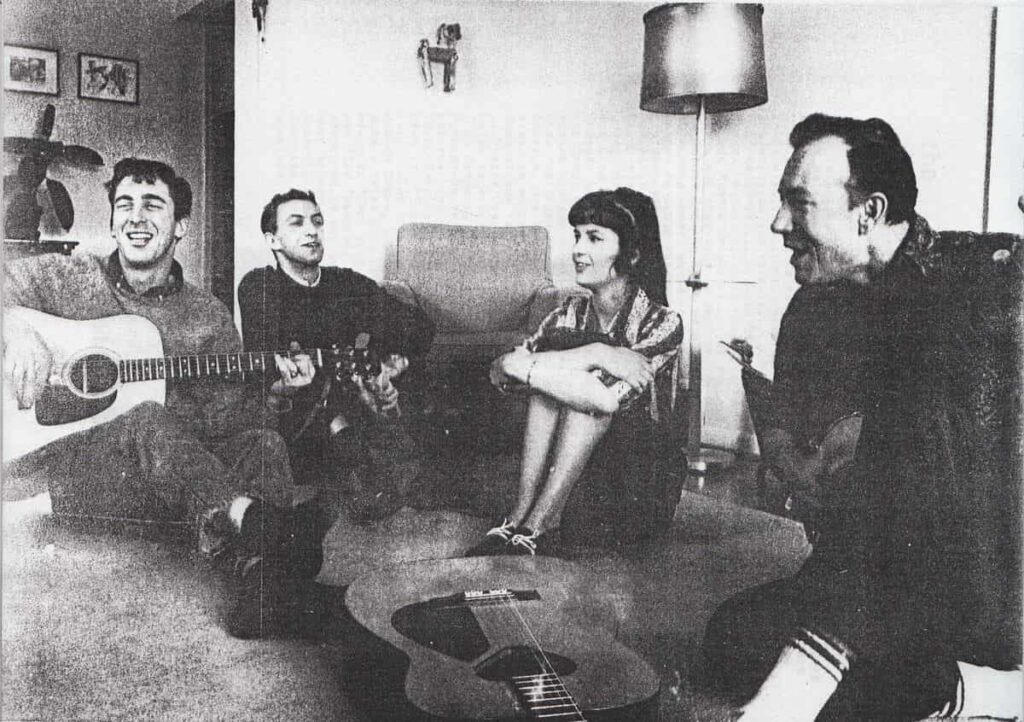
A tender portrait of longing and regret, “Nancy Whiskey” lingers like a fading memory of love lost to time and drink.
When one speaks of the early 1960s folk revival, the names that often come to mind are those of Greenwich Village icons and protest singers. Yet quietly, with a grace that never demanded attention but always deserved it, Ian & Sylvia carved their own space in that era’s musical landscape. Their rendition of “Nancy Whiskey”, featured on their self-titled debut album Ian & Sylvia (1962), stands as one of those understated gems—less about chart dominance and more about emotional permanence.
Unlike many commercial hits of the time, “Nancy Whiskey” did not storm the major charts such as the Billboard Hot 100. Its roots were far older, drawn from a traditional Irish folk ballad that had traveled across generations before finding its way into the careful hands of Ian Tyson and Sylvia Tyson. Their interpretation, however, brought the song to a North American audience during a period when folk music was rediscovering its voice and relevance. While it may not have charted in a conventional sense, its impact was felt deeply within the folk community, becoming a staple among enthusiasts and collectors of traditional ballads.
The story behind “Nancy Whiskey” is as timeworn as it is haunting. At its core, the song tells the tale of a man who falls hopelessly in love with Nancy—a woman who symbolizes not only romance but also the intoxicating pull of whiskey itself. In many traditional readings, Nancy is not merely a person but a metaphor, a personification of addiction. The narrator’s descent into ruin—losing his health, wealth, and dignity—is conveyed not through grand declarations, but through a quiet resignation that feels all too real. There is no dramatic climax here, only the slow, inevitable realization that some loves are destructive by nature.
What makes Ian & Sylvia’s version so enduring is the restraint in their delivery. Their voices, blending with a natural ease, never overpower the narrative. Instead, they allow the song’s melancholy to breathe. The arrangement is sparse—acoustic guitar, gentle phrasing—leaving space for the listener to reflect. In an age where production often seeks to fill every silence, this simplicity feels almost radical.
It is worth remembering that Ian & Sylvia were among the early pioneers who helped introduce traditional British and Irish folk songs to a broader North American audience. Their work predated the commercial explosion of artists like Bob Dylan and Joan Baez, yet they shared that same devotion to authenticity. “Nancy Whiskey” fits perfectly within that mission—preserving the past while gently reshaping it for a new generation.
There is also something deeply human in the song’s enduring appeal. Many listeners, especially those who have lived long enough to understand the weight of choices and the passage of time, find themselves returning to “Nancy Whiskey” not for entertainment, but for recognition. It is a song that does not judge; it simply observes. It understands the quiet tragedies that unfold not in headlines, but in the private corners of a life.
In retrospect, “Nancy Whiskey” may never have been a chart-topping success, but it achieved something perhaps more meaningful. It became a vessel for memory—a reminder of an era when songs were not just written, but lived. Through Ian & Sylvia’s tender interpretation, the old ballad continues to echo, carrying with it the voices of the past and the timeless truths they dared to sing.
And perhaps that is the song’s greatest gift: it does not ask to be admired, only to be remembered.