
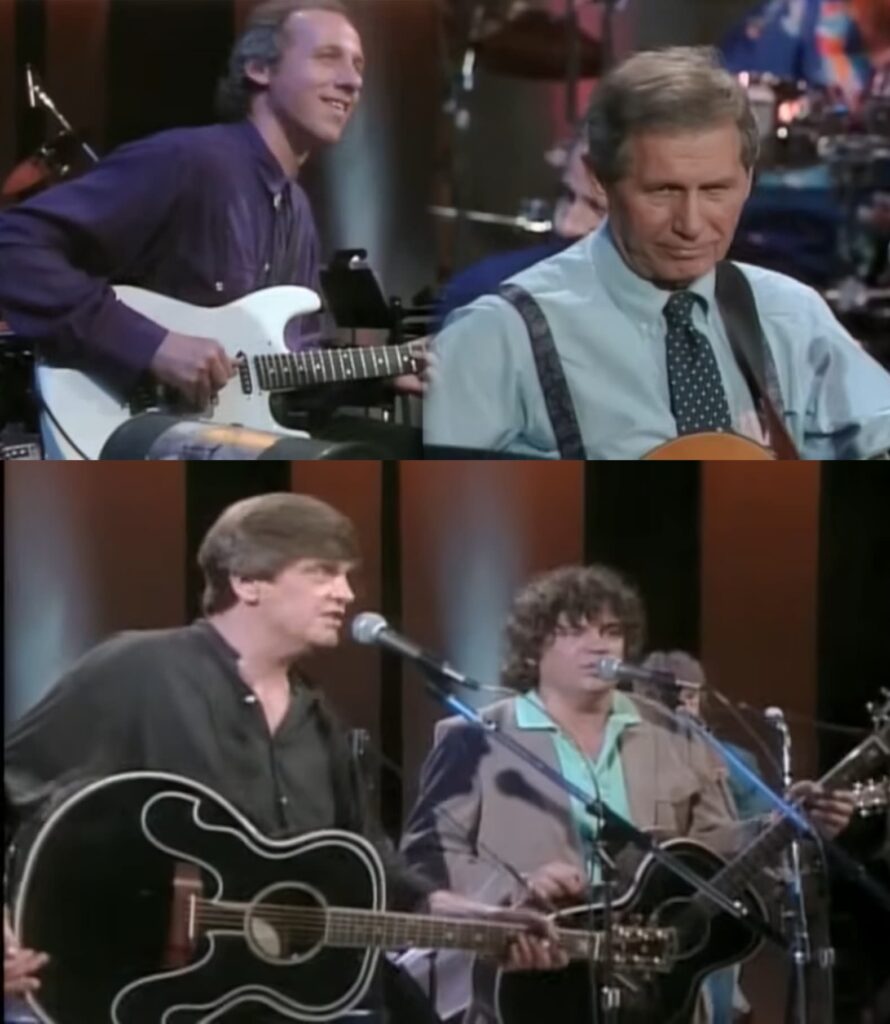
A Gentle Anthem of Reassurance, Where Worry Fades into Melody and Memory Finds Its Way Home
In a rare and quietly remarkable collaboration, “Why Worry” brought together three pillars of musical elegance: Chet Atkins, Mark Knopfler, and The Everly Brothers. The performance, rooted in the spirit of their 1990 album “Neck and Neck,” stands as a testament to restraint, craftsmanship, and emotional clarity. Originally written by Mark Knopfler for Dire Straits, the song found new life here, softened and deepened by the delicate interplay of guitar and harmony.
From the opening notes, Chet Atkins does not simply play the guitar, he converses with it. His fingerstyle technique, precise yet unforced, wraps gently around Knopfler’s understated phrasing. There is no urgency in their delivery. Instead, the tempo breathes, allowing each note to settle like dust in late afternoon light. When The Everly Brothers enter, their harmonies arrive with a familiarity that feels almost like memory itself. Their voices, seasoned yet unwavering, transform the refrain into something deeply human.
The performance avoids spectacle. There are no dramatic crescendos or grand gestures. What remains is something far more enduring: a quiet assurance. The lyric, simple in structure, carries a weight that only time can give. In this setting, “Why worry, there should be laughter after pain” becomes less a line and more a lived truth, shaped by years behind microphones and miles on the road.
What makes this moment linger is its honesty. Chet Atkins, nearing the twilight of his career, plays with a calm authority that needs no validation. Mark Knopfler, ever the storyteller, allows space to do the talking. And The Everly Brothers, whose harmonies once defined an era, remind listeners that some sounds never truly fade.
There is a stillness in this performance that resists the passing of time. It does not ask to be noticed loudly. It simply stays, like a familiar tune carried quietly through the years, waiting for the right moment to be heard again.