
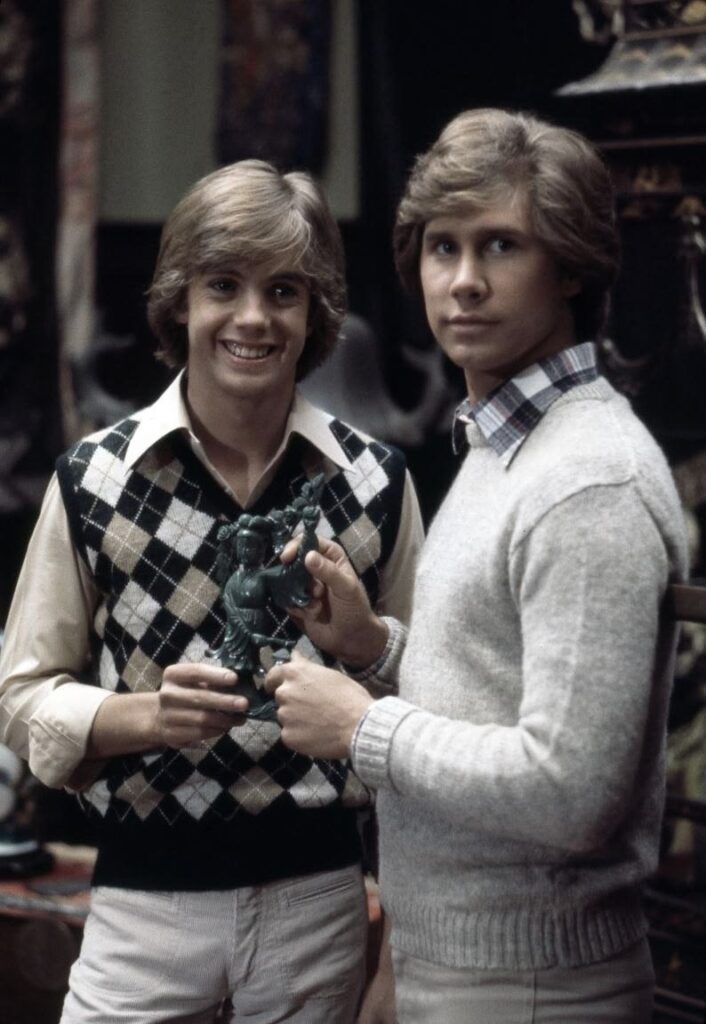
A Tender Teen Anthem of Innocent Love and Fleeting Youth in Late-1970s Television
Few songs capture the gentle ache of young affection quite like “Hey Deanie”, performed on screen by Shaun Cassidy in his role as Joe Hardy in The Hardy Boys/Nancy Drew Mysteries. Released as a single in 1978, the song quickly found its place on the charts, reaching No. 7 on the Billboard Hot 100—a notable achievement that confirmed Cassidy’s appeal not only as a television idol but as a legitimate pop voice of his generation. It was also included on his album “Born Late” (1977), further strengthening the connection between his music career and his on-screen persona.
What makes this performance particularly memorable is the seamless blending of fiction and reality. As Joe Hardy, Cassidy was already a familiar face to television audiences, embodying youthful courage and sincerity. When he sings “Hey Deanie” within the context of The Hardy Boys/Nancy Drew Mysteries, the boundaries between character and artist seem to dissolve. Viewers were not merely watching a scripted moment—they were witnessing a young performer expressing something that felt deeply personal, almost confessional.
The song itself was written by Eric Carmen, a master craftsman of melodic pop and former member of Raspberries. Carmen had a remarkable gift for writing songs that balanced catchy hooks with emotional vulnerability, and “Hey Deanie” is no exception. Its melody is immediately inviting, yet beneath that accessibility lies a subtle melancholy—a recognition that youthful love, however pure, is often fleeting.
Lyrically, “Hey Deanie” speaks to a kind of love that is uncomplicated yet profound. It is the voice of someone who may not fully understand the depth of their feelings but senses their importance all the same. This emotional honesty is precisely what gives the song its enduring charm. There is no grand drama, no elaborate metaphor—just a simple, heartfelt declaration that resonates across generations.
The late 1970s were a unique moment in popular culture, where television and music frequently intersected. Teen idols like Shaun Cassidy carried a dual presence, shaping both the visual and auditory landscape of the era. In that context, “Hey Deanie” stands as more than just a hit single; it is a cultural snapshot. It reminds us of a time when songs were discovered not only on the radio but also through weekly television programs that families gathered around to watch.
There is also something quietly poignant about revisiting this performance today. The innocence it conveys feels almost like a relic from another world—one where emotions were expressed more simply, yet perhaps more sincerely. Cassidy’s voice, youthful and unguarded, carries a vulnerability that cannot be manufactured. It invites the listener to remember their own moments of first love, of uncertainty, of hope.
In retrospect, “Hey Deanie” may not be the most complex composition of its time, but its significance lies elsewhere. It is a song that understands the power of simplicity. It does not try to overwhelm; instead, it gently lingers, much like a memory that refuses to fade.
And perhaps that is why it continues to matter. Because in its quiet way, “Hey Deanie” reminds us that even the briefest chapters of our lives—those filled with youthful longing and unspoken dreams—can leave the deepest impressions.