
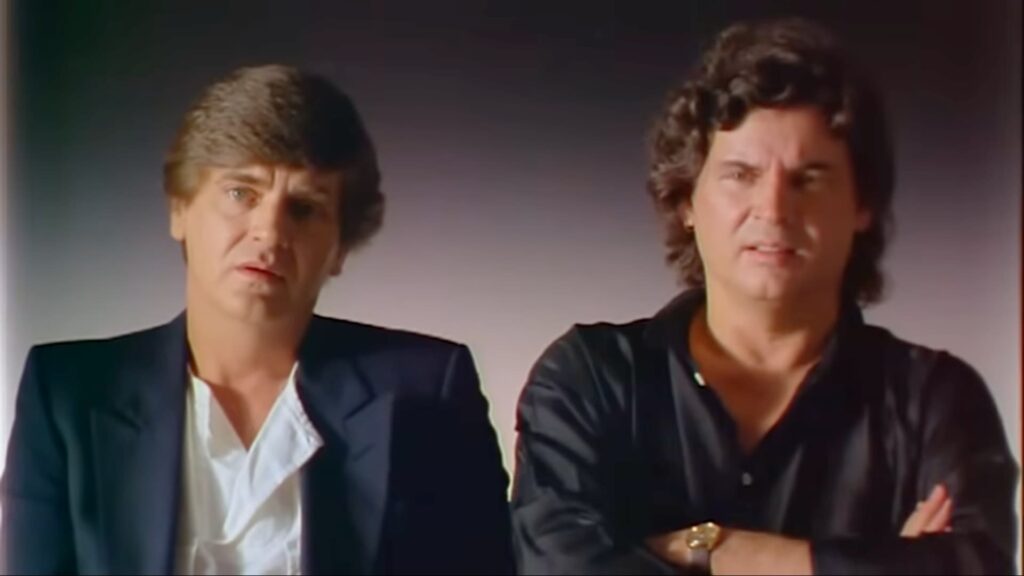
When Harmony Became History: The Everly Brothers Reflect on the Birth of Rock and Roll
In 1986, nearly three decades after their rise to prominence, The Everly Brothers sat down for a revealing and deeply reflective interview with filmmaker Taylor Hackford, offering a rare window into the formative years of rock and roll. By that time, Don and Phil Everly were no longer just chart-toppers of the late 1950s. They had become living witnesses to a cultural shift that forever altered American music. What makes this conversation so enduring is not only its historical value, but the clarity with which the brothers articulate their place in that transformation.
Rather than viewing rock and roll as a fleeting trend, the Everlys described it as a natural evolution. In their words, it was a fusion, a meeting point where white country blues traditions intertwined with the emotional depth and rhythmic vitality of Black rhythm and blues. This was not theory to them. It was lived experience. Raised in a musical family, they saw themselves as part of a lineage, much like the brotherly harmonies of the Louvin Brothers, yet they brought something unmistakably new. Their sound carried the pulse of artists like Bo Diddley and Chuck Berry, whose influence could be felt in the rhythmic drive beneath their smooth vocal blend.
Listening to them recall those early touring days feels almost like opening a time capsule. They spoke of a golden age when the road was shared with names that would soon become legends. Buddy Holly, Little Richard, and Eddie Cochran were not distant icons yet. They were fellow travelers, sharing buses, stages, and the uncertainty of something that had never quite existed before. There is a warmth in the way Don and Phil remember those moments, a sense of camaraderie born from long miles and louder nights.
They even laughed at their own beginnings, recalling the ducttail haircuts they wore before fame found them. But beneath the humor lies something more profound. They remembered the electricity of Alan Freed’s shows, where audiences were so alive with excitement that balconies would tremble under the weight of collective energy. It was not just music. It was movement, both literal and cultural.
Perhaps the most striking moment comes when they reflect on the skepticism they faced. Many believed rock and roll would fade quickly, dismissed as a passing phase. But the Everlys understood something deeper. As Phil Everly quietly put it, music does not lie. It flows like a river, and anyone can step in and drink from it.
That simple metaphor carries the weight of their entire legacy. Their harmonies were not just part of rock and roll’s beginning. They were part of its truth, steady, undeniable, and still echoing long after the first wave had passed.