
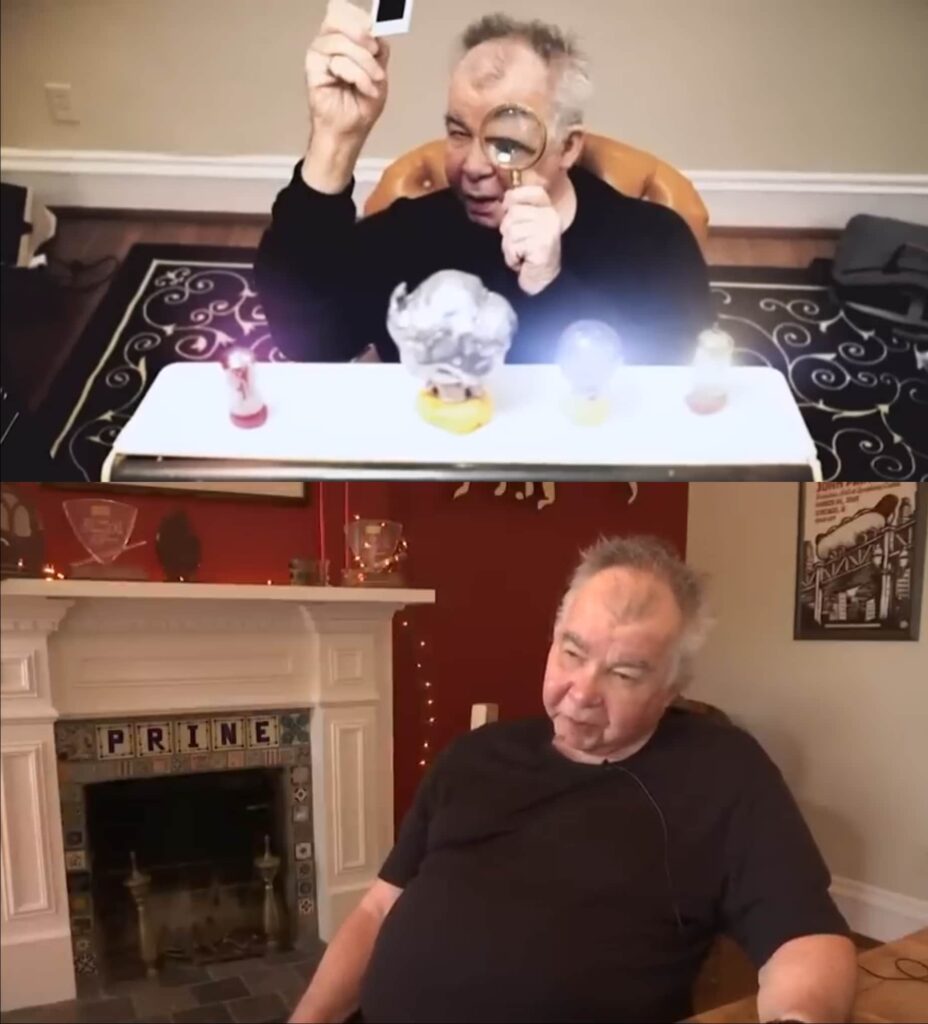
A Voice Weathered by Time: How John Prine Found New Life in Old Songs
In his seventies, at a stage when many artists begin to look backward, John Prine chose instead to revisit his life’s work with fresh eyes and a quieter, deeper voice. Around the time of this interview, he was preparing to release his first-ever songbook, a carefully assembled collection of his most beloved compositions, accompanied by family photographs and handwritten lyrics. For a songwriter long revered as one of America’s finest storytellers and a Grammy-winning craftsman, this was not merely a publication. It was a kind of personal archive, a bridge between memory and music.
What stands out immediately in Prine’s reflections is his disarming humility. He describes his songs as simple, built on three or four chords, written with the expectation that ordinary people might one day sit down and play them. Yet within that simplicity lies his genius. Songs like “She Don’t Like Her Eggs All Runny” and “In Spite of Ourselves” carry an ease that feels almost conversational, but beneath that surface lives a sharp wit and a deep understanding of human quirks and contradictions. Prine never wrote to impress. He wrote to connect.
There is also a quiet honesty in the way he speaks about songwriting itself. He admits that his most vivid characters are rarely drawn from a single person. Instead, they are composites, stitched together from fragments of real lives. It is a practical approach, but also a revealing one. Prine understood that truth in songwriting does not always come from accuracy, but from emotional authenticity. By blending personalities, he created figures that felt real enough to recognize, yet distant enough to protect.
Perhaps the most moving part of his reflection comes when he discusses the changes in his voice. After undergoing radiation treatment for cancer, his vocal range dropped noticeably. For many singers, this would be a devastating loss. For Prine, it became an unexpected gift. Forced to change the keys of his songs, he found that even his oldest material began to feel new again. Familiar melodies took on different colors, and lyrics he had sung for decades revealed fresh emotional shades. It is a reminder that limitation, in the right hands, can become reinvention.
Prine also touches gently on the evolution of country music, expressing a quiet dissatisfaction with its modern direction while still acknowledging its place within a larger tradition. He speaks like a man who has seen cycles come and go, confident that the genre will eventually return to its roots. There is no bitterness in his tone, only patience and a kind of faith in the enduring heart of the music.
In the end, what lingers is not just his wisdom, but his spirit. Even after illness, even after decades in the industry, John Prine remained curious, grounded, and open to change. His songs may be simple in structure, but they carry the weight of lived experience, gently reminding us that sometimes, the quietest voices leave the deepest echoes.