
A Quiet Flight Through Memory and Myth, Where One Voice Carries the Weight of the Sky
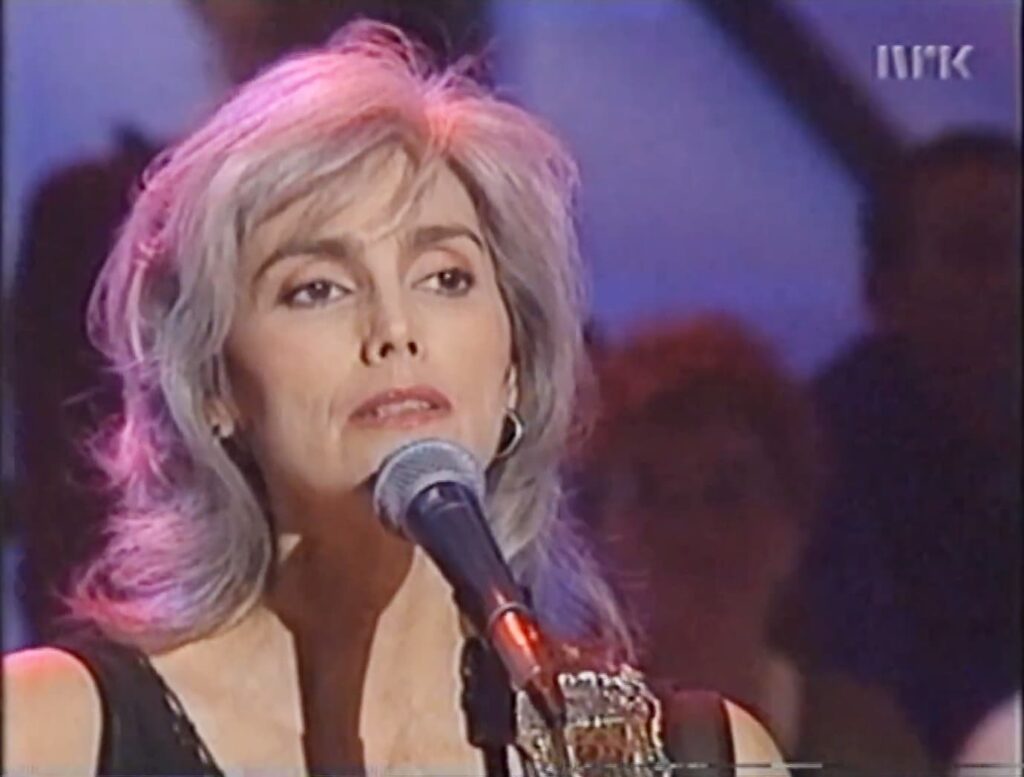
In 1995, appearing on Norwegian television, Emmylou Harris delivered a strikingly intimate performance of Blackhawk, a piece drawn from her evocative album Wrecking Ball. Far removed from the grand stages of American concert halls, this setting allowed the song to unfold in a more restrained and contemplative atmosphere, where every note seemed to carry a deeper resonance.
From the opening moments, there is a sense of stillness. Harris does not rush into the song. Instead, she lets it emerge slowly, as though it were being remembered rather than performed. Her voice, ethereal yet grounded, moves with a quiet assurance, guiding the listener through a landscape that feels both physical and symbolic. “Blackhawk” is not a straightforward narrative. It drifts between imagery and emotion, suggesting journeys that are as much internal as they are real.
The song’s central motif, the black hawk itself, becomes a powerful symbol. It represents freedom, distance, and perhaps even escape. In Harris’s interpretation, it also carries a sense of longing, a desire to rise above the weight of memory while never fully leaving it behind. That duality defines the performance. There is movement, yet also stillness. There is release, yet also attachment.
Musically, the arrangement is minimal, allowing space for atmosphere to take shape. The instrumentation never overwhelms. Instead, it creates a subtle backdrop against which Harris’s voice can fully expand. This approach reflects the aesthetic of Wrecking Ball, where texture and mood often take precedence over traditional structure. In a live television setting, that intimacy becomes even more pronounced.
What makes this 1995 performance particularly memorable is its emotional clarity. Harris does not overstate the song’s meaning. She trusts the listener to find their own path through it. Each phrase feels open ended, inviting reflection rather than dictating interpretation. It is this openness that gives the performance its lasting impact.
As the final notes fade, there is a lingering sense of quiet wonder. Not a dramatic conclusion, but a gentle return to silence. In that space, the song continues to live, carried not just by sound, but by feeling.
Through Emmylou Harris, “Blackhawk” becomes more than a composition. It becomes a moment suspended in time, where music, memory, and imagination meet somewhere just beyond reach.