
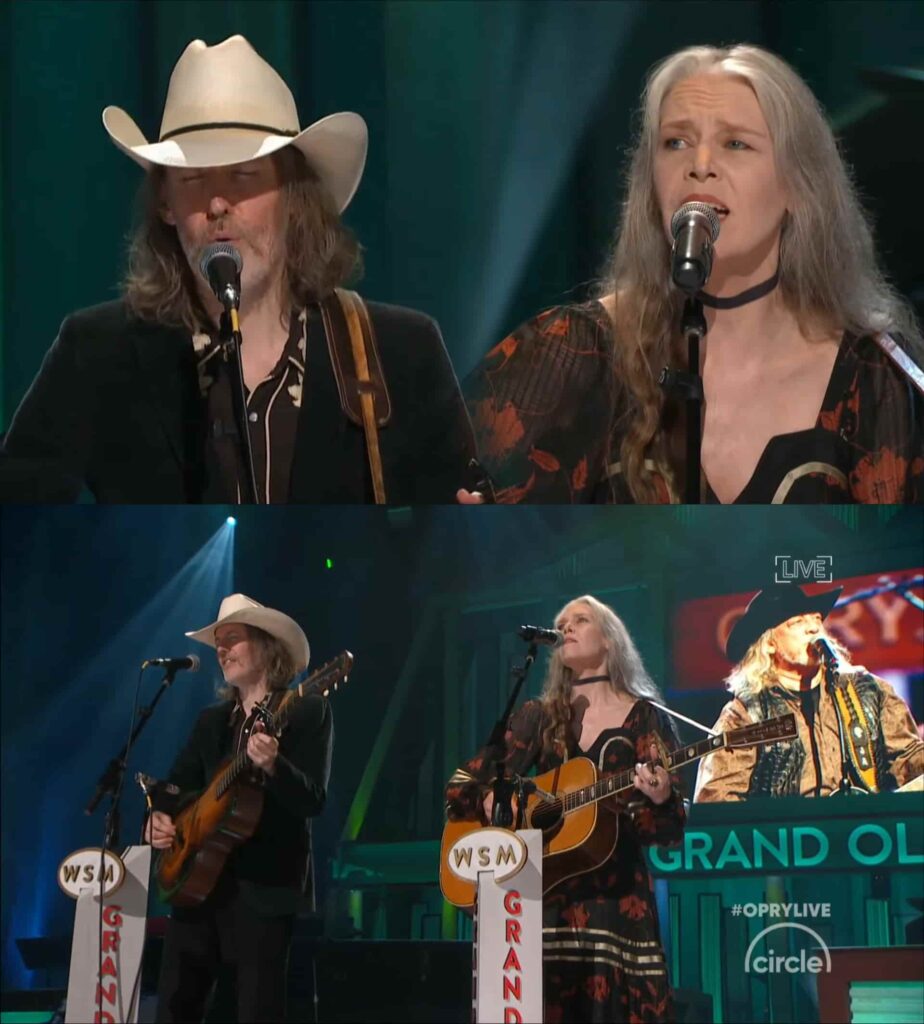
WHEN GILLIAN WELCH SANG “LONG BLACK VEIL,” THE GRAND OLE OPRY FELL SILENT LIKE AN OLD MOUNTAIN CHURCH
In August 2022, during a special Opry Live celebration honoring John Anderson’s album Something Borrowed, Something New, the stage of the Grand Ole Opry briefly stopped feeling like a television set or concert hall. As Gillian Welch and David Rawlings stepped into the famous wooden circle to perform “Long Black Veil,” something older seemed to drift into the room. The noise of the modern world disappeared. Suddenly, it felt like the audience had wandered into a lonely Appalachian valley sometime before midnight, where secrets still mattered and sorrow moved slowly through the trees.
From the opening lines, Welch sang with the kind of restraint that only deepens heartbreak. Her voice did not dramatize the tragedy inside the song. It carried it quietly, almost like someone remembering an old wound they never fully spoke about aloud. That is what made the performance so devastating.
Originally written in 1959 by Danny Dill and Marijohn Wilkin, “Long Black Veil” has long stood among the greatest narrative ballads in American music. Over the decades it has been recorded by everyone from Lefty Frizzell to Johnny Cash, The Band, and Joan Baez. Yet the song has always demanded a certain kind of singer, someone capable of understanding silence as much as melody.
Gillian Welch possesses that rare gift.
When she sings about the condemned man refusing to reveal his alibi because it would destroy the reputation of the woman he loved, every word feels heavy with moral exhaustion. There is no theatrical villain in the story. No grand courtroom scene. Just sacrifice, secrecy, and loneliness stretching across decades.
Meanwhile, David Rawlings works beside her with astonishing subtlety. His guitar playing does not merely accompany the song. It breathes around it like cold wind slipping through mountain pines. Few modern duos understand musical space the way Welch and Rawlings do. They allow pauses to ache. They trust stillness. In an age where so much music feels crowded and overproduced, their restraint feels almost radical.
What makes this Opry performance especially moving is the context surrounding it.
They were there to honor John Anderson, one of country music’s great surviving traditionalists, whose own career has always balanced raw humanity with timeless songwriting. By choosing “Long Black Veil,” Welch and Rawlings were not simply performing an old standard. They were paying tribute to an entire lineage of American storytelling music. Songs where guilt, loyalty, death, and love lived side by side without easy resolution.
And the audience understood it immediately.
Throughout the performance, the room remains almost unnaturally quiet. No drunken shouting. No restless movement. Just reverence. Older listeners especially recognize that kind of silence. It is the silence of people listening not only to music, but to memory itself.
There is also something haunting about hearing Gillian Welch sing this song in 2022, because her artistry has always seemed slightly detached from time. Even when she first emerged in the 1990s, she sounded less like a contemporary folk singer and more like someone transmitting voices from another century. Her music has always carried dust, shadows, railroad tracks, old church pews, and fading photographs within it.
So when she sings, “Nobody knows but me,” the line lands with unusual force.
By the final verse, the performance no longer feels like a cover version at all. It feels inhabited. As if Welch and Rawlings had briefly reopened a door to the old America that created songs like this in the first place.
And perhaps that is why the performance lingered so powerfully after the applause faded.
Because “Long Black Veil” is not really about death. It is about devotion carried in silence for so long that it becomes part of the landscape itself. Few artists today understand how to communicate that kind of emotional patience.
But for one unforgettable night at the Grand Ole Opry, Gillian Welch and David Rawlings reminded everyone that the old ghosts are still singing if the right voices call them home.
 Oldies Songs