
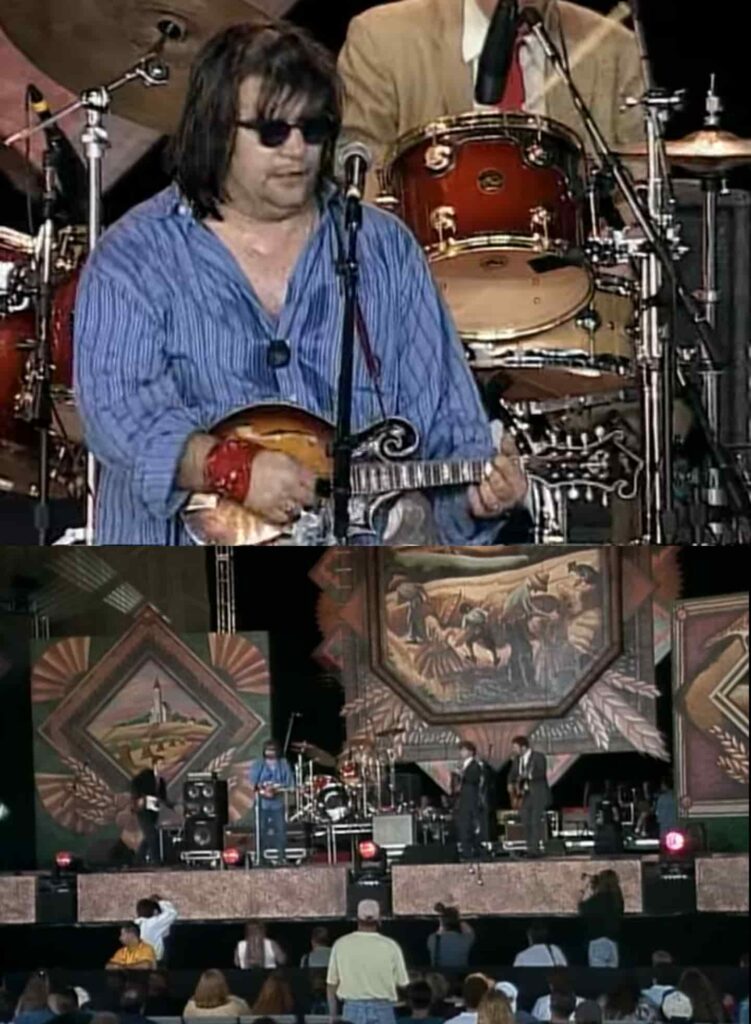
WHEN “COPPERHEAD ROAD” HIT FARM AID IN 1997, IT SOUNDED LIKE THE SOUTH REFUSING TO APOLOGIZE
On October 4, 1997, the stage at Farm Aid in Tinley Park, Illinois became something far louder and far more dangerous than a charity concert platform. The moment Steve Earle and The V-Roys launched into “Copperhead Road,” the atmosphere shifted instantly. What had been a gathering built around farmers, family land, and American resilience suddenly exploded into a roaring collision of outlaw country, heartland rock, and Appalachian rebellion.
Even before the drums arrived, the audience knew what was coming.
That opening mandolin riff remains one of the most recognizable intros ever written in country-rock history. Slow. Menacing. Coiled with tension. It does not ease listeners into the song so much as warn them to brace themselves. And in this 1997 Farm Aid performance, the riff cuts through the night air with almost cinematic force, sounding less like bluegrass and more like an approaching storm moving across Tennessee hills.
Then Steve Earle steps in.
By this stage of his career, Steve Earle was already a survivor carrying the scars of hard living, addiction, political controversy, and near self-destruction. Unlike polished Nashville performers carefully protecting an image, Earle always sounded like a man who had lived inside the songs he wrote. That authenticity gave “Copperhead Road” its lasting power. He was not pretending to understand working-class anger, military trauma, or rural desperation. He came from it.
And nowhere did that truth hit harder than at Farm Aid.
Founded by Willie Nelson, Neil Young, and John Mellencamp, Farm Aid had always represented more than music. It stood for forgotten communities, struggling farmers, and the dignity of rural America. So when Earle roared through the story of a moonshining family legacy transformed by Vietnam and marijuana trafficking, the audience understood every ounce of the tension inside it.
Because “Copperhead Road” is not merely a rebel anthem.
It is a song about inheritance.
Generation after generation, the men in the story are trapped inside cycles of poverty, survival, and violence. Grandfather runs whiskey. Father runs moonshine. The son returns from Vietnam carrying skills learned in war and applies them to another underground economy. The song captures something uncomfortable but deeply American: how isolated rural communities often survive by operating outside systems that have already abandoned them.
That complexity is exactly why the song still feels so explosive decades later.
Musically, the performance with The V-Roys adds tremendous firepower. Their harmonies and aggressive instrumentation push the song toward something almost primal. When the full band crashes in behind Earle, the sound becomes enormous, somewhere between hard rock, mountain music, and barroom fury. The Farm Aid crowd responds immediately because this was music built not for polite listening, but for release.
Older fans especially remember how shocking “Copperhead Road” sounded when it first appeared in 1988. Country radio had certainly embraced outlaw attitudes before, but Earle fused Irish folk textures, Southern rock aggression, Vietnam trauma, and blue-collar storytelling into something entirely its own. It was country music with dirt under its fingernails and rage still boiling beneath the surface.
Watching this 1997 performance now, there is something almost nostalgic about its lack of compromise.
No choreographed stage moves. No polished arena theatrics. Just musicians attacking a song with complete conviction. Steve Earle stands there with his guitar, growling through the verses like a man defending family history itself. And by the final chorus, the crowd is no longer simply listening. They are participating in a shared release of memory, pride, anger, and survival.
That is why “Copperhead Road” never faded into classic-rock nostalgia.
It still feels dangerous.
Because beneath the thunderous riff and singalong chorus lies a truth many Americans still recognize: when communities are cornered long enough, they create their own ways of surviving, whether the rest of the country approves or not.