
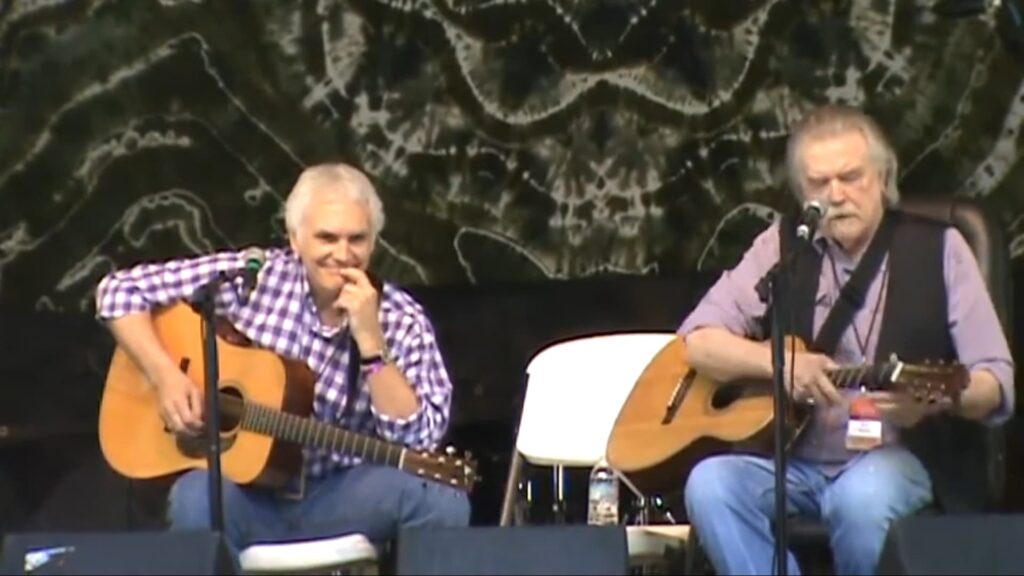
A Song About Friendship, Time, and the Quiet Grace of Growing Old Together
Some performances do not feel like concerts at all. They feel like conversations overheard at the end of a long life well lived. When Guy Clark and Verlon Thompson performed “Old Friends” at Suwannee Springfest in 2012, the moment carried that rare kind of intimacy. There were no dramatic stage effects, no grand gestures, no attempt to impress anyone. Just two old companions standing beneath soft festival lights, singing with the kind of honesty that only comes from years of shared roads, shared losses, and shared songs.
By 2012, Guy Clark was already regarded as one of the greatest songwriters in the history of Texas country and Americana music. His influence stretched across generations through artists like Steve Earle, Townes Van Zandt, Lyle Lovett, and later voices such as Jason Isbell. Yet Clark never carried himself like a celebrity. He remained deeply connected to the working-class storytelling tradition that shaped his music from the beginning. His songs were built from ordinary details: old boots, kitchen tables, broken hearts, faded photographs, and friendships that survived long after youth disappeared.
That spirit lived quietly inside “Old Friends.”
The song itself was originally written by Guy Clark, Richard Dobson, and Susanna Clark, and first appeared during the early 1980s period of Clark’s songwriting life. Unlike many country songs centered around heartbreak or regret, “Old Friends” speaks with tenderness about companionship and endurance. It understands something that youth rarely notices: as life moves forward, friendships become sacred landmarks. The older we grow, the more precious those surviving connections become.
At Suwannee Springfest, that truth became visible before a single lyric was even sung.
Verlon Thompson was far more than a backing musician beside Guy Clark. He had been Clark’s guitarist, collaborator, musical partner, and trusted friend for decades. Their relationship carried the quiet familiarity of family. Verlon understood Guy’s phrasing instinctively. He knew where Clark would pause, where the emotion lived inside certain words, where silence itself mattered more than technique.
That chemistry gave the performance extraordinary emotional depth.
The setting itself contributed to the atmosphere. Suwannee Springfest, held at the Spirit of the Suwannee Music Park in Florida, has long been known for its intimate Americana and roots-music spirit. Unlike massive commercial festivals, Springfest often feels deeply personal, almost communal. The audience listens differently there. The songs are allowed to breathe. On that particular night in 2012, the soft darkness surrounding the stage seemed perfectly suited for a song like “Old Friends.”
Clark’s voice by then carried the weathering of time. The smoothness of youth had long disappeared, replaced by something far more affecting: experience. Every line sounded lived in. Every phrase carried the slow gravity of memory. Some singers lose power as they age. Guy Clark gained truth.
And beside him, Verlon Thompson’s harmonies arrived not as decoration, but as emotional support. His voice wrapped around Clark’s with remarkable gentleness, almost like someone protecting a fragile photograph from the wind. Together, they sounded less like performers entertaining a crowd and more like two men remembering their lives out loud.
That is what made Guy Clark such a singular figure in American songwriting. He understood restraint. He understood that the strongest emotions rarely announce themselves loudly. In songs like “Desperados Waiting for a Train,” “The Randall Knife,” “Dublin Blues,” and “Old Friends,” he allowed ordinary human moments to reveal enormous emotional weight naturally.
There is a line often associated with Clark’s songwriting philosophy: “The art is in the details.” Few artists ever embodied that idea more completely.
Watching the 2012 performance now carries additional emotional resonance because both the era and the men themselves feel increasingly distant. Guy Clark passed away in 2016, leaving behind one of the most respected catalogs in American roots music. Yet performances like this remain deeply alive because they captured something timeless. Not youth. Not fame. Not perfection. Something rarer.
Trust.
You can hear it in the way Guy glances toward Verlon between lines. You can hear it in the relaxed pacing, the absence of ego, the complete lack of performance tricks. Nothing needed embellishment because the emotional history between them already filled the room.
In many ways, “Old Friends” belongs to a long Southern storytelling tradition where memory itself becomes sacred territory. The song recognizes that life eventually strips away illusions. Careers fade. Crowds disappear. The years move quickly. But a true friend who remains beside you through decades of change becomes one of life’s greatest blessings.
That understanding hangs over the entire Suwannee Springfest performance like evening air settling over a porch after sunset.
There is something profoundly moving about hearing older musicians sing without trying to sound young. Guy Clark never fought against age in his music. He leaned into it. He allowed the cracks in his voice to become part of the story. That honesty gave songs like “Old Friends” enormous emotional credibility.
And perhaps that is why the performance still lingers so powerfully years later. It reminds listeners of a world becoming increasingly rare. A world where songs were not manufactured for attention spans or trends, but shaped slowly through lived experience. A world where friendship lasted decades. A world where two men with acoustic guitars could still silence a crowd simply by telling the truth.
Sometimes the most beautiful country songs really do sound like two old friends talking after sunset.
And on that night in 2012, beneath the quiet Florida sky, Guy Clark and Verlon Thompson gave listeners one of the most honest conversations country music has ever known.