
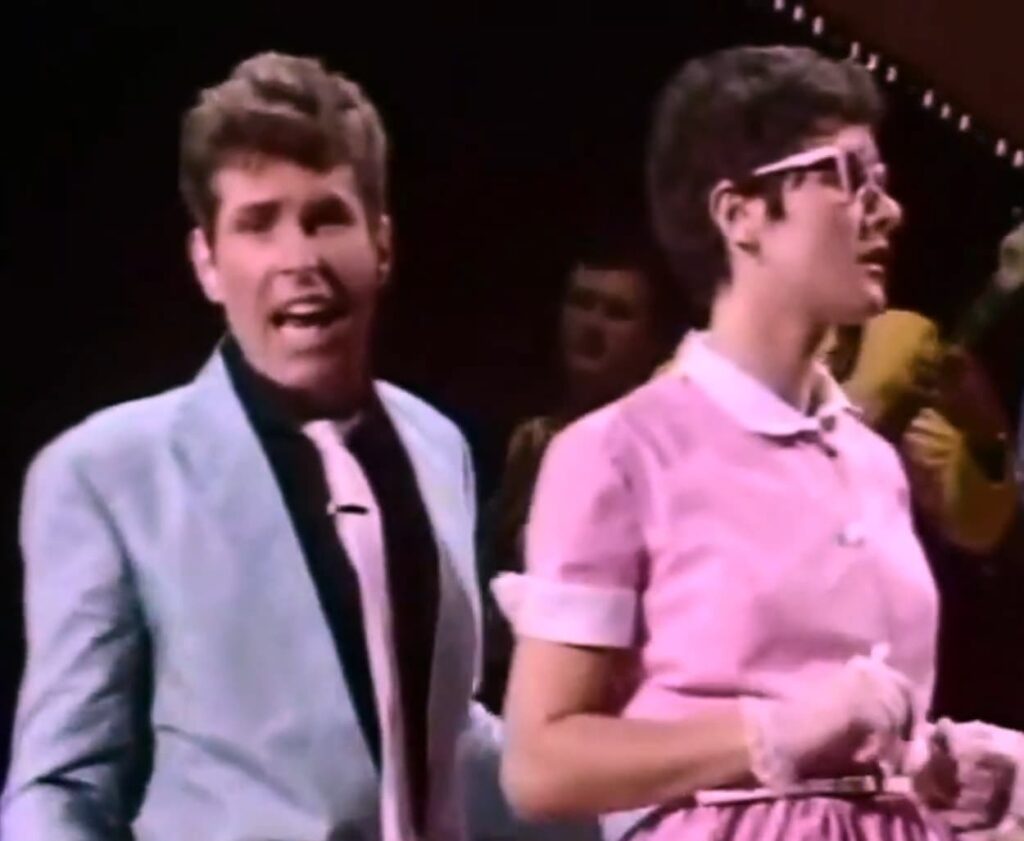
A Few Seconds of Dancing Could Say More Than an Entire Career of Singing
When Les Gray moved across a movie screen with that unmistakable grin and restless energy, it reminded audiences that some performers never really stop being entertainers — even when the spotlight changes shape.
There was always something wonderfully unpolished yet magnetic about Les Gray, the unmistakable voice of Mud. While many glam-era frontmen leaned heavily into theatrical excess, Gray carried something different into every performance: warmth. He looked like the kind of man who genuinely loved making people smile. That quality became especially noticeable whenever he appeared outside the usual concert stage — including those memorable moments when he danced in films and television appearances that captured the playful spirit of the 1970s.
By the time audiences saw Les Gray dancing on screen, he was already deeply associated with the golden run of hits that made Mud one of Britain’s defining glam-pop groups. Songs like “Tiger Feet,” “Lonely This Christmas,” “Oh Boy!” and “Dyna-Mite” had already turned the band into household names throughout the UK. In particular, “Tiger Feet” became a phenomenon in 1974, spending four weeks at No. 1 on the UK Singles Chart and eventually becoming the best-selling single in Britain that year. The success was enormous, but what truly separated Mud from many of their contemporaries was their personality. They looked like stars, but they still felt approachable.
That approachable charm translated beautifully whenever Gray danced on camera. Unlike trained Hollywood dancers polished to technical perfection, Les danced the way many rock-and-roll singers moved in the early days — naturally, instinctively, almost recklessly. His movements carried echoes of old-school rockabilly, pub-stage swagger, and the carefree looseness of working-class British pop culture. Watching him move was never about precision. It was about joy.
And perhaps that is why those clips still resonate decades later.
There is something deeply nostalgic about seeing musicians from that era stepping into movies or variety productions. The line between music and entertainment was far more fluid then. A singer could appear in a television comedy, dance in a film sequence, joke with the audience, and still return to the charts the next week. Performers were expected to be personalities as much as vocalists. Les Gray excelled at that balance because he never seemed trapped by image-conscious seriousness. Even when dressed in glam-rock fashion — platform boots, bright jackets, exaggerated hairstyles — there was always humor in his expression, almost as if he understood the absurdity and beauty of pop stardom at the same time.
What makes those dance moments especially poignant today is the contrast between the playful image and the complicated reality behind it. By the late 1970s, glam rock had faded from dominance, and like many artists tied closely to a specific musical era, Mud struggled to maintain the same chart power. Trends changed rapidly. Punk arrived. New Wave reshaped British music. Yet audiences who grew up with Mud never forgot the feeling their music carried. Their songs represented a very specific kind of optimism — loud, melodic, uncomplicated, and alive.
That emotional connection explains why even brief footage of Les Gray dancing in movies still sparks such affection among longtime music lovers. It is not simply nostalgia for a celebrity. It is nostalgia for an atmosphere. For crowded living rooms with the television glowing late at night. For variety shows watched with family. For a period when pop music felt colorful without irony.
There is also a bittersweet layer when revisiting Les Gray today. He passed away in 2004 at the age of 57 after suffering a heart attack, far too young for a man whose public image was built around vitality and laughter. Looking back now, those dance sequences almost feel frozen in time — small fragments of an era when entertainers radiated a kind of carefree spirit that modern pop culture often struggles to recreate.
Musically, Mud were sometimes underestimated by critics because their songs sounded fun and accessible. But beneath the catchy choruses was a group with remarkable timing, tight musicianship, and a strong understanding of classic American rock-and-roll traditions. Les Gray’s voice itself carried tremendous character — rough-edged, slightly mischievous, and instantly recognizable. That same personality appeared in his dancing. Nothing about him felt artificial.
And perhaps that is the real reason those scenes endure.
When Les Gray danced in movies, audiences were not watching choreography alone. They were watching a performer whose entire identity was rooted in entertaining people with sincerity. In an industry increasingly shaped by polish and calculation, that kind of natural charisma now feels almost rare enough to belong to another world entirely.