
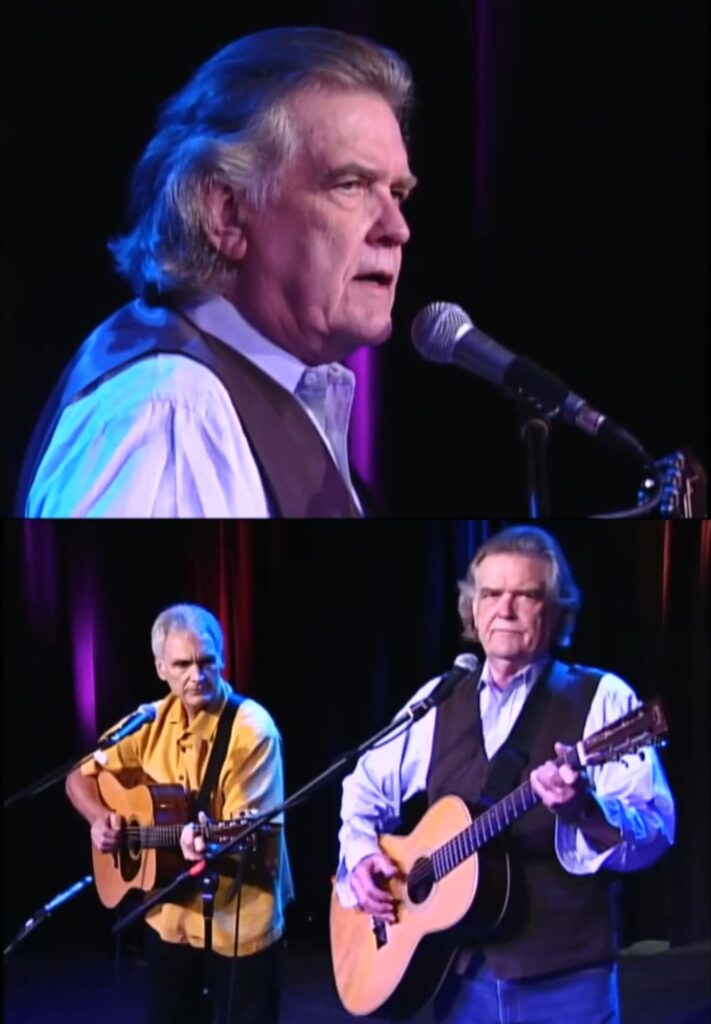
A Simple Song About A Boy Wearing A Flour Sack Cape Became One Of Guy Clark’s Most Beautiful Lessons About Courage And Growing Older
When Guy Clark performed “The Cape” alongside his longtime friend Verlon Thompson, the room always seemed to grow quieter.
There was nothing flashy about the performance. No dramatic production. No overwhelming instrumentation. Just two old friends seated with guitars, sharing a song that carried decades of hard-earned wisdom inside a deceptively simple story.
Yet by the end, audiences often sat completely still, absorbing every word.
Originally released on Clark’s 1995 album Dublin Blues, “The Cape” became one of the most beloved songs of his career because it captured something universal about human hope. The song tells the story of a young boy who ties a flour sack around his neck like a superhero cape and leaps fearlessly into the unknown, believing completely that he can fly.
Of course, he crashes to the ground.
But the miracle of the song is that he keeps jumping anyway.
That small childhood image slowly unfolds into a profound meditation on aging, risk, creativity, disappointment, and survival. Guy Clark understood that life eventually knocks everyone down. Dreams fail. Love disappears. Bodies grow older. But somewhere deep inside, the people who continue living fully are often the same ones still willing to leap despite knowing the fall may hurt.
Clark delivered that message with remarkable gentleness.
His weathered Texas voice never sounded polished in the traditional sense, but it carried authenticity impossible to imitate. Every lyric felt lived in. When he sang about “packing up his dishes and going,” the line carried the weight of an entire lifetime spent moving through heartbreak, uncertainty, friendship, and music.
Beside him, Verlon Thompson provided beautifully restrained accompaniment, his intricate flatpicking guitar work weaving naturally around Clark’s storytelling. The chemistry between the two musicians was extraordinary because it came from genuine friendship rather than performance technique. Thompson instinctively knew when to support the melody and when to leave silence untouched.
That intimacy gave the performance enormous emotional power.
Watching the clip today feels less like attending a concert and more like listening to wisdom passed carefully from one generation to another. Clark never forced meaning onto the audience. He trusted the story itself. A little boy jumping from a barn wearing a homemade cape somehow became a reflection of every person who ever dared to dream beyond practicality.
And perhaps that is why the song resonates more deeply with age.
Young listeners often hear adventure inside “The Cape.” Older listeners hear survival.
By the time Guy Clark recorded the song, he had already become one of the most respected songwriters in American music. Though never driven by commercial stardom, his influence reached artists like Lyle Lovett, Steve Earle, Townes Van Zandt, and countless younger writers who admired his ability to make ordinary details feel timeless.
What separated Clark from many songwriters was his understanding that wisdom rarely arrives loudly. It appears quietly through small observations, old memories, roadside conversations, and stories told slowly enough for people to truly hear them.
“The Cape” embodies that philosophy perfectly.
The song never pretends life becomes easy. In fact, it openly acknowledges pain, failure, and disappointment. But hidden beneath the realism remains one stubborn, beautiful belief: that continuing to leap anyway may be the most important thing a person can do.
As Guy Clark and Verlon Thompson reached the song’s final moments, the audience seemed suspended between sadness and inspiration.
Because deep down, almost everyone remembers being that child once.
Certain they could fly.
And hoping, despite everything life has taught them since, that maybe part of them still can.