
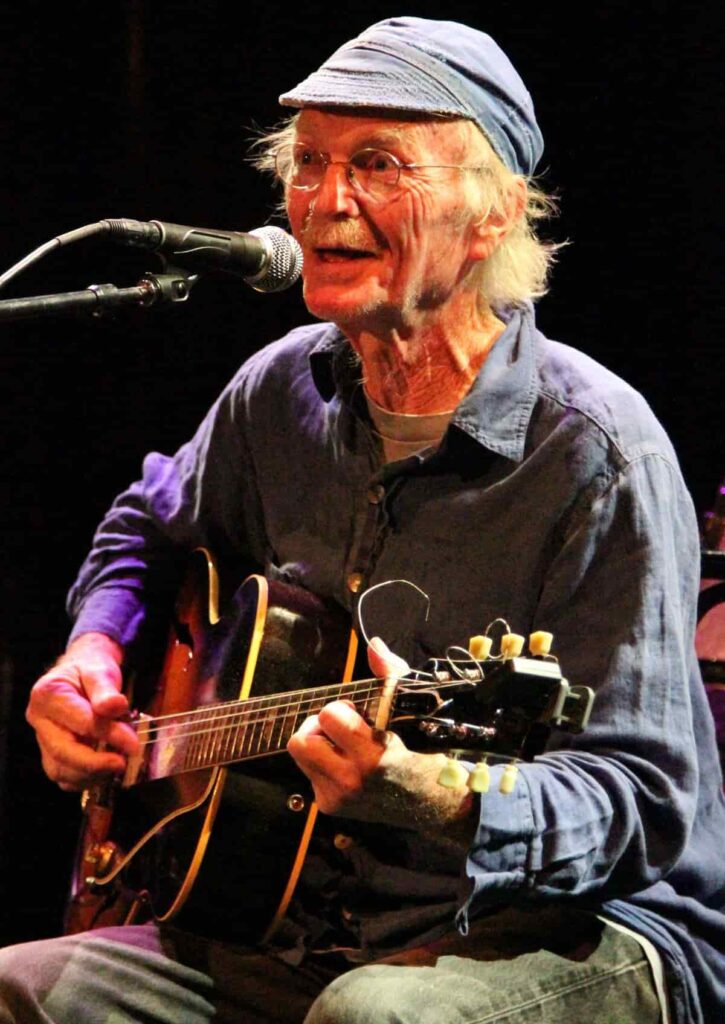
A Quiet Hymn for Lost Souls and Gentle Wanderers
There is something almost timeless about “In the Garden” by Michael Hurley — a song that does not simply play, but lingers like woodsmoke in the evening air, carrying memories, loneliness, humor, and peace all at once.
Among the many overlooked treasures hidden inside the catalog of Michael Hurley, “In the Garden” remains one of the most intimate reflections of his strange and beautiful artistic world. Hurley was never a chart-dominating performer in the traditional sense. Unlike the polished folk stars who found commercial success during the 1960s and 1970s, he walked a quieter road entirely his own. Because of that, the song never entered the major Billboard charts upon release, nor was it designed to. Its value was never measured by radio positions or sales figures. Instead, it became part of the deeply respected underground folk tradition that musicians and devoted listeners carried from one generation to another like a carefully protected secret.
Released during the years when Hurley was shaping his reputation as one of America’s most eccentric and authentic folk poets, “In the Garden” captures the spirit that made him beloved among musicians even when mainstream audiences barely knew his name. Artists from the alternative folk and indie world would later speak of Hurley with almost reverent admiration. To them, he represented artistic freedom untouched by commercial pressure.
Listening to the song feels less like hearing a performance and more like sitting beside an old friend who has spent decades wandering through forgotten towns, broken relationships, smoky bars, and quiet countryside roads. Hurley’s voice was never technically grand or dramatic. In fact, its fragile, conversational quality became its greatest strength. He sang as ordinary people speak when they are alone with their thoughts. That honesty gave songs like “In the Garden” extraordinary emotional weight.
The beauty of the song lies in its simplicity. There are no grand orchestral arrangements, no desperate attempts to impress the listener. Instead, the music drifts gently with acoustic warmth, allowing every line to breathe naturally. Hurley understood something many artists forget: silence and restraint can often carry more truth than spectacle.
Lyrically, “In the Garden” feels deeply reflective, almost spiritual without belonging to any formal religion. The “garden” itself becomes more than a physical place. It feels symbolic — a private refuge where memory, regret, aging, love, and solitude quietly meet. Hurley often wrote in ways that blurred dream and reality together, and this song carries that same mysterious atmosphere. One moment it feels comforting, and the next it carries a subtle ache beneath the surface, like remembering people who are no longer around yet somehow still present in familiar places.
That emotional duality was central to Hurley’s artistry. He possessed a rare ability to make sadness feel strangely peaceful. His songs rarely begged for attention. Instead, they invited listeners to slow down and sit with their own memories. In a noisy world increasingly obsessed with speed and spectacle, Hurley’s music felt almost defiantly human.
Part of what makes Michael Hurley such an enduring cult figure is the unusual life he lived outside the machinery of fame. Born in Pennsylvania in 1941, he became associated with the American folk revival yet never fully belonged to any movement. While many contemporaries pursued commercial careers, Hurley remained fiercely independent, often living modestly and releasing music on small labels. His album artwork, much of it drawn by Hurley himself, reflected the same quirky, homespun imagination found in his songs.
There is also a deeply American quality to “In the Garden.” Not the America of bright cities or celebrity culture, but the quieter America of back porches, old radios, forgotten highways, rural nights, and conversations that stretch long after midnight. Hurley captured people living on the edges of ordinary life — drifters, dreamers, lonely souls, gentle eccentrics. He treated them with tenderness rather than judgment.
Over the years, the song has grown in stature precisely because it was never overexposed. It survived through recommendation, rediscovery, and emotional connection. Younger generations of folk musicians eventually embraced Hurley as a foundational influence, admiring the emotional honesty and freedom within his work. That quiet legacy may ultimately prove more lasting than many chart-topping hits of the same era.
What makes “In the Garden” so moving today is how untouched it feels by time. The song still sounds intimate, fragile, and deeply personal, as though Hurley recorded it yesterday for a small room of trusted friends. It reminds listeners that music does not always need grandeur to endure. Sometimes the songs that stay with us longest are the quiet ones — the songs that understand loneliness, memory, and the strange comfort of growing older.
And perhaps that is why Michael Hurley remains such a cherished figure among devoted folk listeners. He never chased immortality through fame. Yet somehow, through songs like “In the Garden,” he found it anyway.