
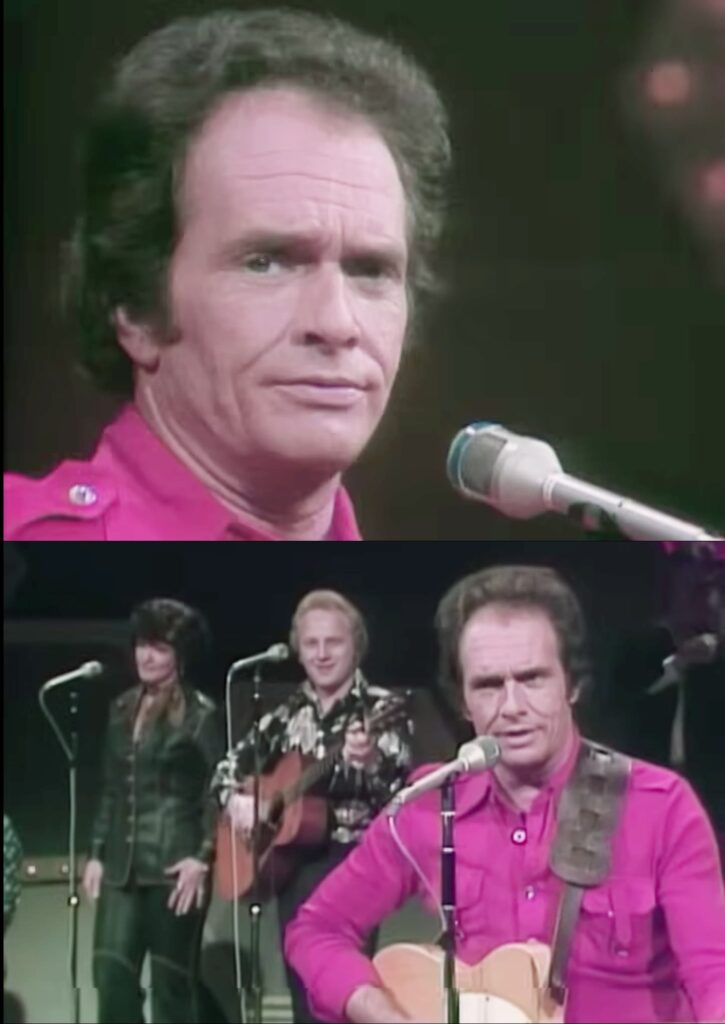
HE WASN’T ACTING A ROLE. HE WAS SINGING THE STORY OF THE ONLY LIFE HE EVER KNEW.
When Merle Haggard stepped onto the stage of Pop! Goes the Country in 1977 to perform Ramblin’ Fever, audiences weren’t watching a polished television performance. They were watching a man describe himself with startling honesty.
By 1977, Haggard had already become one of country music’s most respected voices. Yet despite the success, the awards, and the string of No. 1 hits, there was still something restless behind his eyes. That restlessness is exactly what makes “Ramblin’ Fever” feel less like a song and more like an autobiography set to music.
The character in the lyric cannot stay still. He loves the road more than routine, freedom more than comfort, and the promise of the next horizon more than the safety of home. For Merle Haggard, those weren’t abstract ideas. They were the themes that shaped his entire life.
What gives this performance an extra layer of meaning is Haggard’s past. Before he became a country legend, he spent time inside San Quentin State Prison. Few artists understood the value of freedom more deeply. So when he sings about being unable to settle down, the words carry the weight of lived experience rather than romantic fantasy.
The simplicity of the television appearance is part of its power. No elaborate production. No distractions. Just Haggard, his band, and a song that perfectly captured the spirit of millions of Americans who felt most alive when they were moving toward something unknown.
Looking back today, the performance feels almost prophetic. The audience in 1977 could not know that Haggard would continue touring and performing for nearly the rest of his life. Music remained his highway. The road never truly ended.
That is why “Ramblin’ Fever” has endured long after many other hits of the era faded away. Some listeners hear a celebration of freedom. Others hear a warning about a life spent chasing the next destination. Perhaps both interpretations are correct.
More than four decades later, one question still follows every performance of the song:
Was Merle Haggard singing about America… or was he simply singing about himself?