
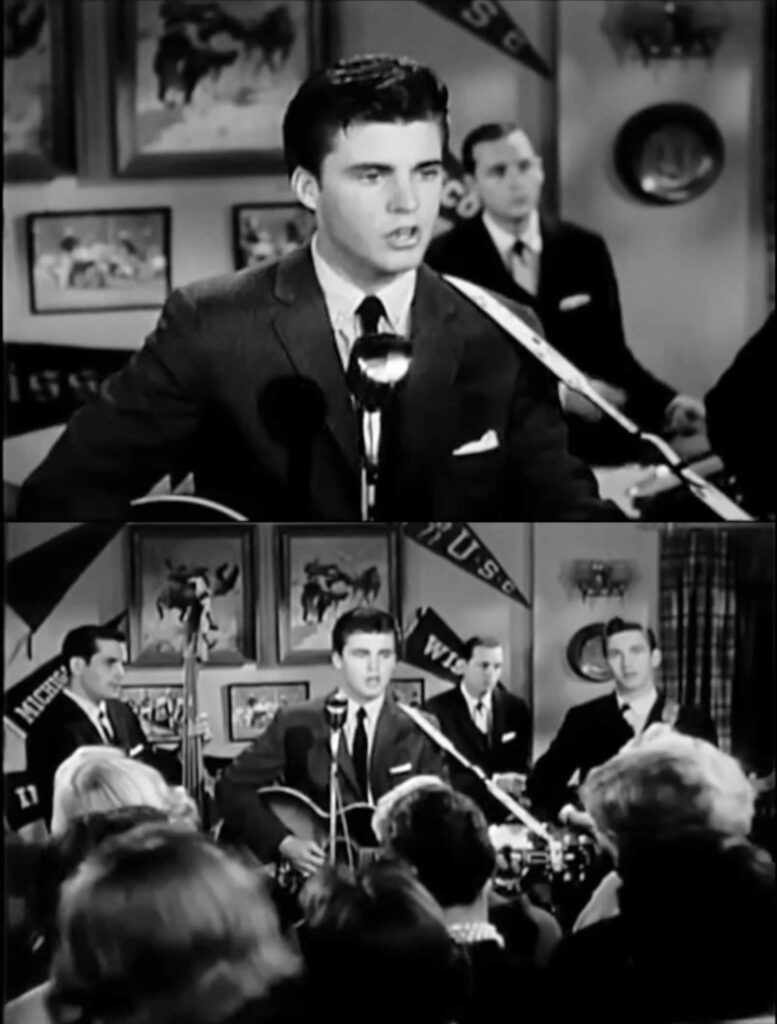
A teenager sang of broken hearts and lonely dreams, unknowingly creating one of the most timeless portraits of youthful heartbreak in American music
When Ricky Nelson performed “Lonesome Town” on The Adventures of Ozzie and Harriet in 1958, viewers were not simply watching a young singer promote a new song. They were witnessing a young man grow up before the eyes of an entire nation. Few artists in popular music history experienced fame quite like Ricky. Week after week, America welcomed him into their living rooms through a television series that featured his real family. His father was Ozzie Nelson, his mother was Harriet Nelson, and his brother was David Nelson. The family audiences watched on screen was not fiction. It was real life.
That unique connection made moments like this especially powerful.
At just eighteen years old, Ricky stood at the center of America’s youth culture. Handsome, successful, and adored by millions, he could easily have continued recording lighthearted rock and roll hits aimed at teenage audiences. Instead, “Lonesome Town” revealed something unexpected. Beneath the clean-cut image and television fame was a young artist capable of expressing loneliness, vulnerability, and emotional depth far beyond his years.
The song itself is remarkably simple. It tells the story of an imaginary place where broken hearts gather, where dreams fade, and where people go to cry their troubles away. Yet that simplicity is exactly what gives the song its lasting power. There is no complicated storyline. No dramatic twist. Just a universal feeling that almost everyone recognizes.
There is no actual Lonesome Town on any map.
Yet countless listeners have visited it.
The lyrics describe a place “where the broken hearts stay” and where someone hopes they might finally learn to forget. Nearly seven decades later, those words still resonate because they speak to an experience that transcends generations. Whether the heartbreak comes from lost love, missed opportunities, or the passage of time itself, the destination remains familiar.
What makes Ricky’s performance so memorable is that he does not sing like someone looking back on decades of disappointment. He sings like someone discovering heartbreak for the first time. There is a tenderness in his voice, a quiet uncertainty, that gives the song an authenticity many older performers might not have captured. Youth and sadness rarely meet with such perfect balance.
For many viewers in 1958, this performance marked an important turning point. Until then, Ricky was often viewed primarily as the charming television star and teenage idol who happened to sing. “Lonesome Town” helped change that perception. It demonstrated that he possessed genuine artistic instincts and could communicate emotions that reached beyond the boundaries of a television sitcom.
In many ways, the song became one of the recordings that helped establish Ricky Nelson as a serious recording artist rather than simply a celebrity with hit records.
Looking back today, the performance carries an emotional weight that audiences in 1958 could never have anticipated. At the time, Ricky appeared to have an endless future ahead of him. Success seemed almost inevitable. Yet modern viewers know the rest of the story. They know he would become one of the defining voices of his generation. They know he would influence future country-rock and folk-rock artists. And they know that his life would end tragically in a plane crash in 1985 at only forty-five years old.
That knowledge changes the experience of watching this young performer.
The bright-faced teenager standing before the camera has no idea what triumphs and hardships await him. He simply sings about loneliness, lost dreams, and a place where heartache lives. Yet viewers today cannot help seeing something more. They see a young man at the very beginning of a journey whose ending is already known.
Perhaps that is why this performance continues to endure.
“Lonesome Town” was never just a song about romantic disappointment. It became a reminder that every life, no matter how promising, contains chapters of joy and sorrow. Watching Ricky Nelson sing it in 1958 feels like opening an old family photo album. The face is young, the future unwritten, and the moment frozen forever. But time has already told the rest of the story, making every note feel a little more precious than it did the day it was first sung.
 Oldies Songs