
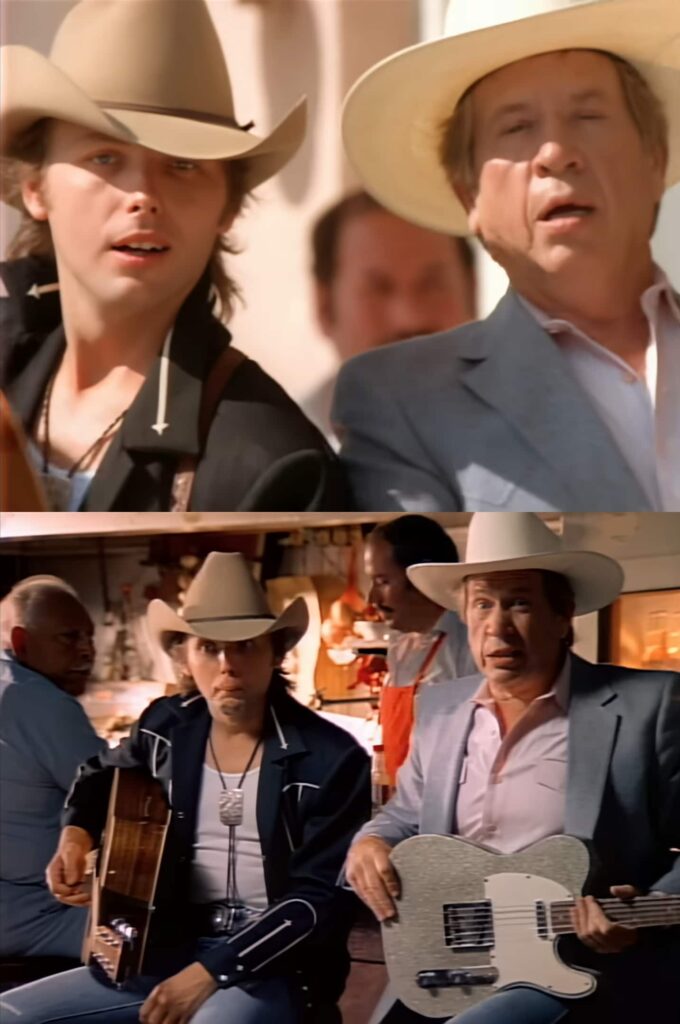
More than a song about a California town, “Streets of Bakersfield” became a declaration that outsiders still belong
When Dwight Yoakam and Buck Owens stood side by side to perform “Streets of Bakersfield,” they were not simply recording a country music duet. They were bringing together two generations of the same musical tradition. One had helped create the legendary Bakersfield Sound. The other had spent years fighting to keep it alive when much of the country music industry believed it no longer mattered.
That is why this performance remains one of the most meaningful collaborations in modern country music history.
At the time, Buck Owens was widely respected as a legend, but many assumed his greatest days were behind him. He had not enjoyed a No. 1 country hit since 1972. Nashville had moved toward a smoother, more polished sound, and the rough-edged spirit of Bakersfield seemed increasingly distant. Yet Dwight Yoakam never forgot the records that shaped his youth. Long before he became a star himself, he was one of Buck’s biggest admirers.
Instead of distancing himself from the past, Dwight used his rising popularity to bring his hero back into the spotlight. He invited Buck to revisit “Streets of Bakersfield,” a song that Buck had recorded years earlier without major success. What happened next surprised almost everyone. The song climbed to No. 1 on the Billboard Country chart, giving Buck Owens his first chart-topping hit in sixteen years.
Few comeback stories in country music have felt so satisfying.
The song itself carries an authenticity that cannot be manufactured. Written by songwriter Homer Joy, “Streets of Bakersfield” was inspired by real experiences. Joy arrived in Bakersfield hoping to break into the music business, only to face rejection after rejection. He wandered the city, exhausted and discouraged. His boots rubbed painful blisters onto his feet. Out of that frustration came one of the song’s most memorable lines about having “worn blisters on my heels.”
Those were not poetic inventions. They were scars turned into lyrics.
That sense of lived experience is reflected throughout the performance. The video feels less like a traditional music video and more like a documentary about working people trying to find their place in the world. There are no flashy effects, elaborate storylines, or glamorous distractions. Instead, viewers see dusty streets, classic cars, bars, and everyday life in California’s Central Valley.
The setting perfectly captures the philosophy behind the Bakersfield Sound. It was music that favored honesty over polish, Telecaster guitars over orchestras, and ordinary people’s stories over fantasy.
Many listeners have also noticed how closely the song mirrors Dwight Yoakam’s own journey. Before finding success, Dwight struggled to gain acceptance in Nashville. Industry insiders often told him that his traditional honky-tonk style belonged to another era. Rather than change who he was, he moved west and built his career on the very sound others dismissed.
When he sings, “I came here looking for something I couldn’t find anywhere else,” it is easy to hear more than just the song’s narrator. It sounds like Dwight himself searching for a place where he could remain true to his musical identity.
The song’s most debated lyric may be the confession about taking fifteen dollars from a stranger while leaving behind a watch and house key. Is the narrator a thief? A desperate man making excuses? Or simply someone trapped in circumstances where right and wrong are no longer easy to separate? The ambiguity gives the song a depth that continues to spark discussion decades later.
Perhaps the most charming moment arrives near the end of the video. Buck and Dwight joke about a car bearing Buck’s name. Dwight playfully suggests his own name should be added as well. The exchange lasts only a few seconds, but it reveals something beautiful. Behind the legends, behind the records and awards, stands a devoted student sharing a laugh with the artist he once idolized.
Viewed today, “Streets of Bakersfield” feels larger than a song about one California city. It became an anthem for anyone who has ever been underestimated, dismissed, or told they did not belong. Both Buck Owens and Dwight Yoakam knew what it felt like to be judged for refusing to follow trends. Together, they transformed that experience into music.
And in doing so, they reminded the world that Bakersfield was never just a place on a map. It was an idea. A belief that authenticity matters, that roots matter, and that sometimes the most enduring victories belong to those who stay true to themselves.