
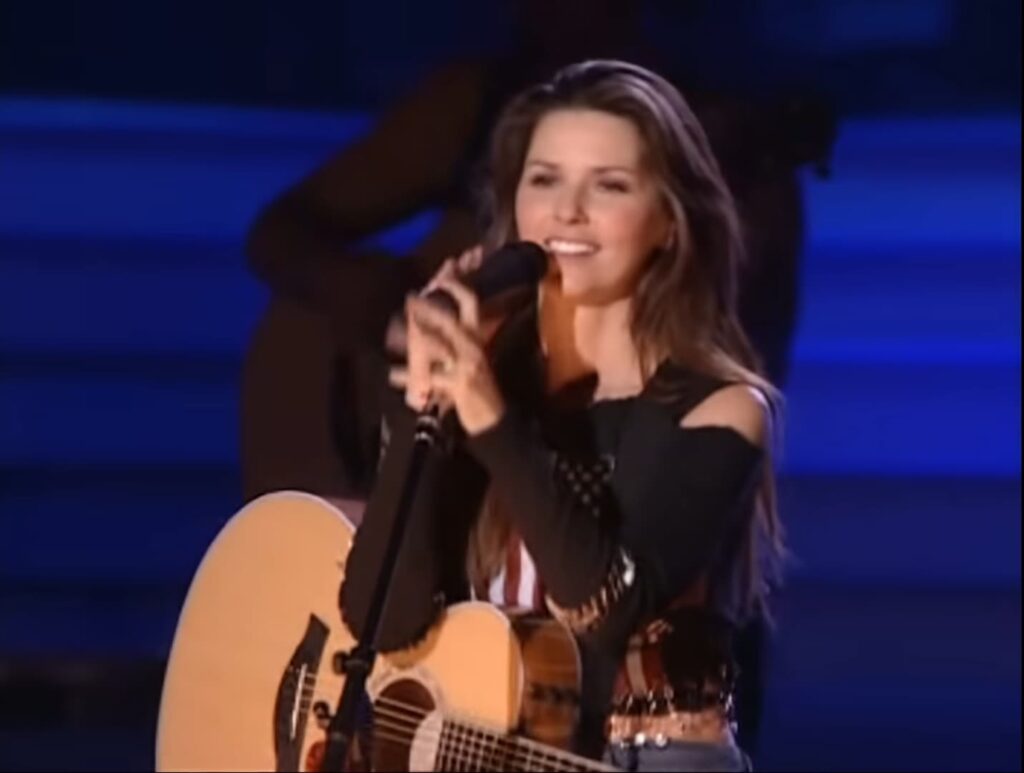
In Chicago, Shania Twain Didn’t Have to Sing Alone. Tens of Thousands Already Knew Every Word to “You’re Still the One.”
By the time Shania Twain stepped onto the stage in Grant Park, Chicago during her Up! Tour in 2003, “You’re Still the One” had become much more than a hit single. As the opening lines echoed across the crowd, something remarkable happened. Thousands of voices joined in almost immediately, singing nearly every lyric from memory. For a few unforgettable minutes, it no longer felt like a performance by one artist. It became a shared memory, carried by an audience that had made the song part of its own lives.
That moment says as much about the song’s legacy as any award or chart position ever could.
Released in 1998 from the record-breaking album Come On Over, “You’re Still the One” helped transform Shania Twain from a country superstar into a global music icon. The single reached No. 2 on the Billboard Hot 100, earned two Grammy Awards, and introduced country music to millions of listeners who rarely explored the genre. It proved that a deeply personal love song could resonate far beyond Nashville.
The Chicago concert captured Twain at the absolute height of her career. Come On Over had already become the best-selling studio album ever released by a female artist, while Up! continued her extraordinary international success. Few country performers had ever commanded audiences of that size, and even fewer inspired entire stadiums to sing along with such confidence.
One of the performance’s most memorable qualities is Twain’s willingness to step back and let the audience become part of the song. Rather than treating every chorus as a vocal showcase, she repeatedly points the microphone toward the crowd, smiling as thousands of voices complete the lyrics. It creates the feeling that she is not performing for the audience but celebrating with them. The connection feels effortless, and that warmth is one reason the concert continues to be revisited years later.
Unlike many live performances designed to impress with dramatic vocal changes, Twain remains remarkably faithful to the original recording. She avoids unnecessary embellishments, preserving the gentle intimacy that made the song so beloved in the first place. The focus stays exactly where it belongs: on the lyrics and the emotions they carry.
Those lyrics were deeply personal from the beginning.
Twain wrote “You’re Still the One” with her husband and producer, Robert John “Mutt” Lange, as a response to those who believed their marriage would never survive. Lines such as “They said, ‘I bet they’ll never make it'” were not fictional storytelling. They reflected the criticism the couple had faced throughout their relationship. At the time, the song stood as a quiet declaration that love had outlasted doubt.
Looking back today, however, the performance carries a poignancy that no one in Chicago could have anticipated.
Years later, Twain’s marriage to Lange ended following one of the most painful chapters of her personal life. Because of that history, modern audiences inevitably hear “You’re Still the One” differently than they did in 2003. What was once celebrated as a victory song has also become a reminder that even the most sincere promises cannot always overcome life’s unexpected turns.
Yet that knowledge does not diminish the performance. If anything, it makes it more moving.
Watching the concert now means witnessing a moment suspended in time. The Shania Twain standing before those thousands of fans believed every word she was singing. The audience today knows what the future would bring, but she did not. That contrast gives the performance an emotional depth that could never have been planned.
Perhaps that is why this concert continues to resonate. It preserves not only one of country music’s greatest crossover hits but also an artist at the peak of her confidence, surrounded by a sea of voices singing with her. It reminds us that songs often outlive the circumstances that inspired them, taking on new meanings as life unfolds.
More than two decades later, “You’re Still the One” remains a timeless celebration of commitment, hope, and memory. Whether listeners hear it as a love song, a snapshot of a remarkable chapter in Shania Twain’s life, or a reminder of relationships that once seemed unbreakable, one truth remains unchanged. Sometimes the most enduring songs are not those with perfect endings, but those that preserve a beautiful moment exactly as it was, allowing every generation to return and remember.
 Oldies Songs