
Dwight Yoakam Didn’t Choose Willie Nelson’s Biggest Hit. He Chose the Song That Changed Willie Nelson’s Life.
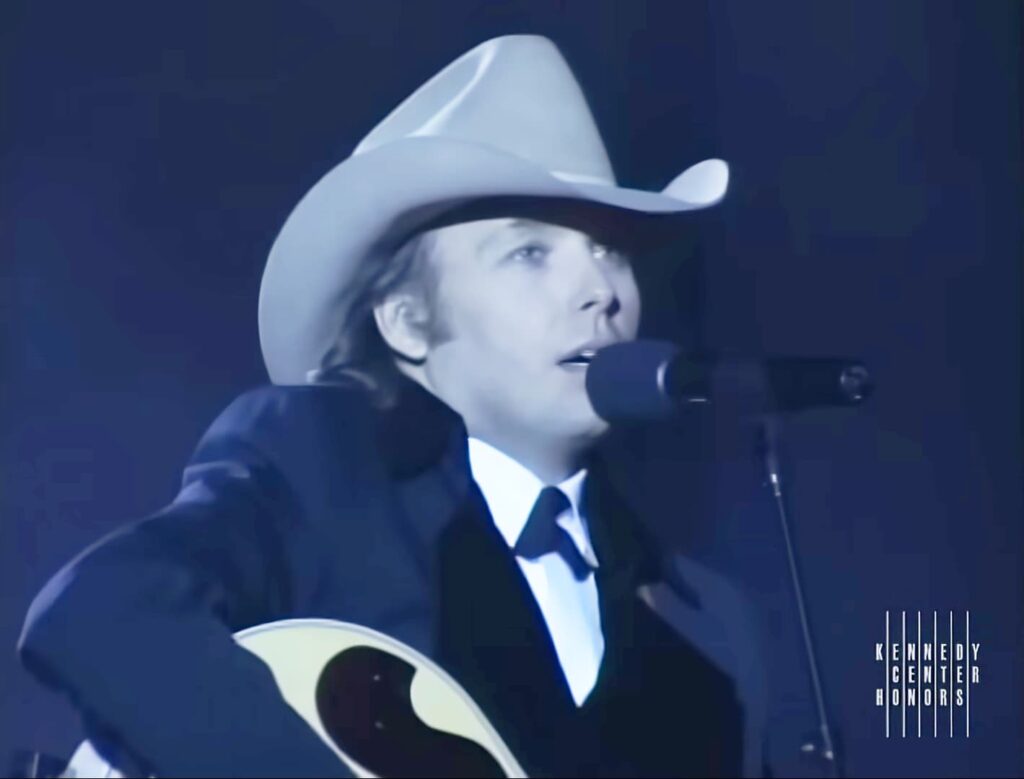
Tribute performances often celebrate an artist’s most recognizable songs. When Dwight Yoakam took the stage during the 1998 Kennedy Center Honors to salute Willie Nelson, he made a more meaningful choice. Rather than reaching for an uptempo crowd favorite, he performed “Blue Eyes Crying in the Rain,” the quiet ballad that transformed Nelson from a respected songwriter into one of country music’s greatest recording artists.
Written by Fred Rose in 1947, “Blue Eyes Crying in the Rain” had existed for nearly three decades before Willie Nelson recorded it for his landmark 1975 concept album Red Headed Stranger. That recording changed everything. It became Nelson’s first No. 1 hit as a singer, earned him his first Grammy Award, and revived a performing career that had long lived in the shadow of his reputation as one of Nashville’s finest songwriters. In many ways, this was the song that created the Willie Nelson the world came to know.
That history made Yoakam’s selection especially powerful. As one of the leading voices of the Bakersfield Sound, Dwight Yoakam built his career by rejecting polished Nashville conventions in favor of raw honky tonk traditions. Willie Nelson, meanwhile, became the defining figure of the Outlaw Country movement, fighting for artistic independence and creative freedom. Their musical styles were different, yet both artists shared the same belief that country music should answer to the artist rather than the industry.
On the Kennedy Center stage, Yoakam resisted every temptation to reinvent the song. There were no dramatic vocal runs, no flashy guitar flourishes, and no attempt to make the performance sound unmistakably “Dwight.” Instead, he sang with remarkable restraint, allowing the melody and lyrics to carry the emotion. It felt less like an interpretation than a heartfelt expression of gratitude toward one of country music’s greatest pioneers.
The contrast made the performance even more memorable. Audiences had long associated Dwight Yoakam with energetic Bakersfield rhythms, sharp Telecaster guitar lines, and the electrifying stage presence that drew comparisons to Elvis Presley. Yet here he stood almost motionless, delivering one of the quietest performances of his career. That stillness reflected the spirit of Willie Nelson himself, whose greatest recordings have often relied on simplicity rather than spectacle.
Perhaps the most touching image of the evening was not on the stage but in the audience. Willie Nelson listened as another generation’s country star sang the very song that had altered the course of his life. This was more than hearing an old hit performed once again. It was watching a defining chapter of his own story retold before a room gathered to celebrate an extraordinary lifetime of contributions to American culture.
The setting made the choice even more symbolic. The Kennedy Center Honors does not celebrate a single album or one successful year. It recognizes a lifetime of artistic achievement. By choosing “Blue Eyes Crying in the Rain,” Yoakam honored not simply one beloved recording but the courage behind Red Headed Stranger, an album many record executives initially dismissed as too sparse, too unconventional, and unlikely to succeed. Willie Nelson trusted his instincts, refused to compromise, and created one of country music’s greatest masterpieces.
Nearly a quarter century after that tribute, the performance continues to resonate because it understood the true purpose of honoring a legend. Sometimes the greatest tribute is not trying to sing a song better than the artist who made it famous. It is stepping aside, serving the song with humility, and allowing its remarkable history to speak for itself. On that unforgettable night, Dwight Yoakam did exactly that.