
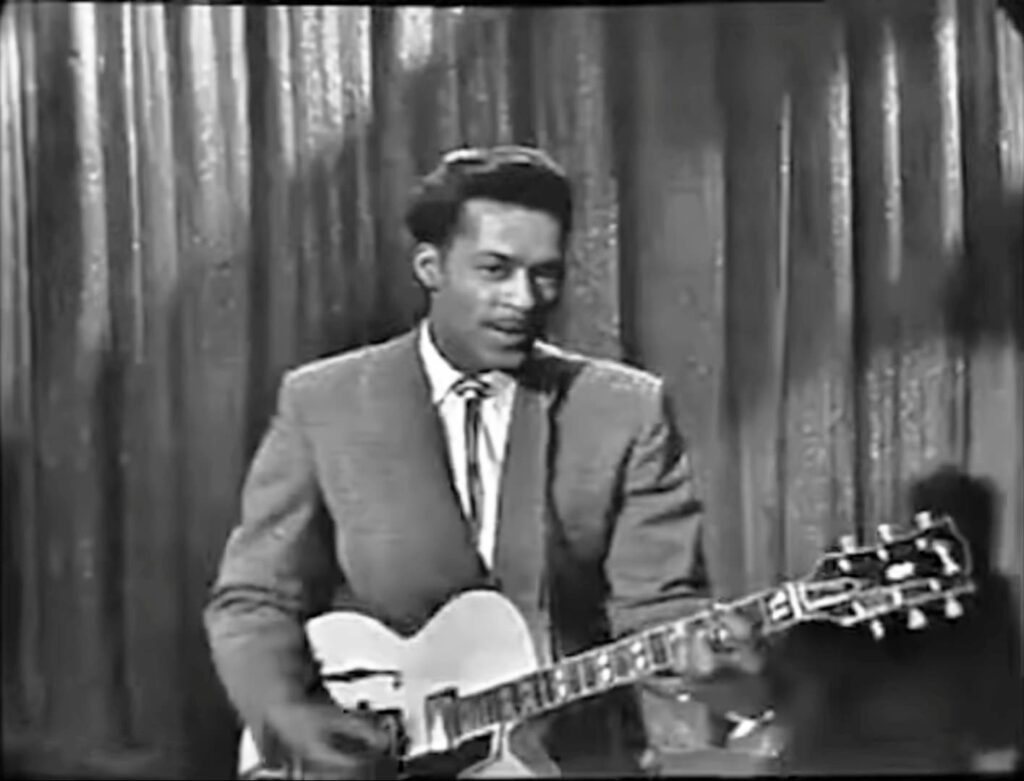
“Sweet Little Sixteen” Captured the Birth of Teenage Culture and Confirmed Chuck Berry as Rock and Roll’s Greatest Storyteller
When Chuck Berry performed “Sweet Little Sixteen” on the Saturday Night Beech-Nut Show on February 22, 1958, he wasn’t simply singing another rock and roll hit. He was documenting an entire generation discovering its own identity through music, records, concerts, and youthful dreams.
By early 1958, Chuck Berry had already become one of the defining architects of rock and roll. Hits such as “Maybellene,” “Roll Over Beethoven,” and “School Day” had established him as a songwriter with an unmatched ability to transform everyday American life into unforgettable songs. With “Sweet Little Sixteen,” he shifted his attention to a new cultural phenomenon: the rise of the teenage music fan.
The television performance radiates the excitement that made Berry one of the era’s most magnetic entertainers. His confident smile, unmistakable guitar style, and effortless stage presence immediately command attention. Even within the limitations of 1950s television, his energy feels contagious. Every guitar lick and every playful lyric reminds viewers why he was unlike anyone else performing at the time.
Released in January 1958, “Sweet Little Sixteen” quickly became one of Berry’s biggest successes, reaching No. 2 on the Billboard Top 100. The song paints a vivid portrait of a sixteen-year-old girl whose world revolves around concerts, fan magazines, photographs, and collecting autographs from her favorite stars. Berry understood something that few songwriters had fully recognized: teenagers were no longer simply children waiting to become adults. They had created an entirely new culture centered around popular music.
One of the song’s most memorable features is its whirlwind tour across America. Berry sings about audiences rocking in Boston, Pittsburgh, Philadelphia, the heart of Texas, the Frisco Bay, St. Louis, and New Orleans. Those city names are more than clever rhymes. They reflect how rapidly rock and roll was spreading across the country, connecting young listeners regardless of geography. Music had become a shared language, and Berry captured that national excitement better than almost anyone.
Behind the joyful rhythm lies a surprisingly observant piece of storytelling. The young girl at the center of the song wears fashionable dresses, proudly carries photographs of her musical heroes, and dreams of seeing every show she can. Yet Berry ends with a gentle reminder that tomorrow morning she must return to school. In just a few lines, he balances youthful fantasy with everyday reality, making the character feel authentic rather than idealized.
The influence of “Sweet Little Sixteen” would extend far beyond its initial success. Its infectious melody later inspired The Beach Boys’ classic “Surfin’ U.S.A.”, whose musical structure closely echoed Berry’s composition. The connection eventually led to Berry receiving songwriting credit, reinforcing the enormous impact his work had on the next generation of rock musicians. Few songs illustrate his influence on popular music more clearly.
Looking back today, the Saturday Night Beech-Nut Show performance remains a remarkable snapshot of rock and roll in its formative years. There were no elaborate productions or overwhelming visual effects. There was simply Chuck Berry, his guitar, and a song that perfectly captured the excitement of youth at a moment when popular music was changing forever. More than six decades later, “Sweet Little Sixteen” continues to celebrate the joy, innocence, and boundless enthusiasm that helped define the very first generation of rock and roll fans.
 Oldies Songs