
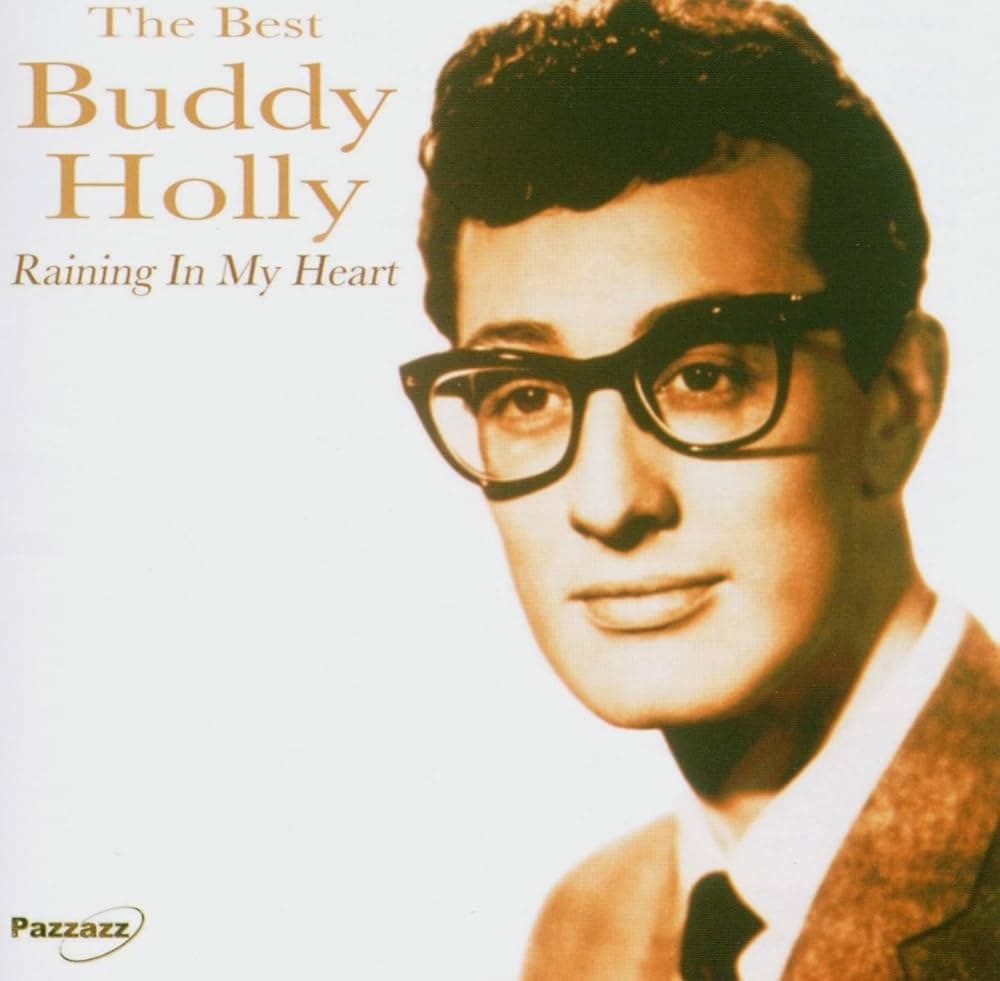
The Sky Is Blue, Yet the Heart Is Breaking: Buddy Holly’s “Raining in My Heart” Turned Ordinary Weather into Extraordinary Heartache
Among the final songs Buddy Holly recorded before his tragic death in 1959, “Raining in My Heart” remains one of the most quietly devastating. Recorded on October 21, 1958, at Pythian Temple Studio in New York City, the song revealed a softer, more mature side of the young rock and roll pioneer. While Holly had already become famous for energetic hits like “Peggy Sue” and “That’ll Be the Day,” this recording demonstrated that his greatest strength also lay in expressing heartbreak with remarkable simplicity.
Written by the legendary songwriting team Felice and Boudleaux Bryant, “Raining in My Heart” was built around a striking contradiction. The opening lines describe a perfect day: the sun is shining, the sky is blue, and not a single cloud is in sight. Yet inside the narrator, an entirely different storm is unfolding. The weather forecast may promise clear skies, but it cannot predict the pain left behind by someone who has gone away.
That simple contrast gives the song its timeless appeal. Rather than relying on dramatic language or elaborate metaphors, the lyrics transform everyday weather into a portrait of private grief. Everyone else sees sunshine, while one heart continues to live beneath invisible rain. It is an image so universal that listeners across generations have found themselves inside the song’s quiet sorrow.
The recording also marked an important moment in Buddy Holly’s artistic evolution. During his final recording sessions in New York, Holly experimented with richer orchestration and more sophisticated pop arrangements, moving beyond the raw rock and roll sound that had first made him famous. “Raining in My Heart” blends gentle strings, smooth backing vocals, and Holly’s understated delivery into a performance that feels intimate rather than theatrical. It hinted at new musical directions he might have explored had his career not been cut tragically short.
What makes Holly’s vocal performance so moving is its restraint. He never raises his voice or exaggerates the emotion. Instead, he sings with quiet acceptance, allowing the sadness to emerge naturally. When he asks, “What’s gonna become of me?” the question sounds less like despair than honest uncertainty. That vulnerability gives the song an authenticity that remains deeply affecting more than six decades later.
Looking back, it is impossible to separate “Raining in My Heart” from the knowledge of what followed. Just a few months after recording the song, Buddy Holly was killed in the plane crash on February 3, 1959, alongside Ritchie Valens and J. P. “The Big Bopper” Richardson, a tragedy remembered as “The Day the Music Died.” Because of that history, many listeners hear an added layer of melancholy in these recordings, even though the song itself is about romantic loss rather than mortality.
Perhaps that is why “Raining in My Heart” has continued to resonate with generations of music lovers. It reminds us that the deepest sadness is often invisible. Life may appear unchanged to everyone else, but personal heartbreak can transform even the brightest afternoon into a storm no one else can see.
Today, the song stands as one of the most elegant performances in Buddy Holly’s remarkable catalog. It captures an artist whose songwriting choices and vocal maturity were evolving rapidly, suggesting an even greater future that would never come. More than a beautiful ballad, “Raining in My Heart” is a lasting reminder that some of the most powerful emotions are expressed not through grand declarations, but through the quiet realization that even beneath clear blue skies, it can still be raining inside the heart.