
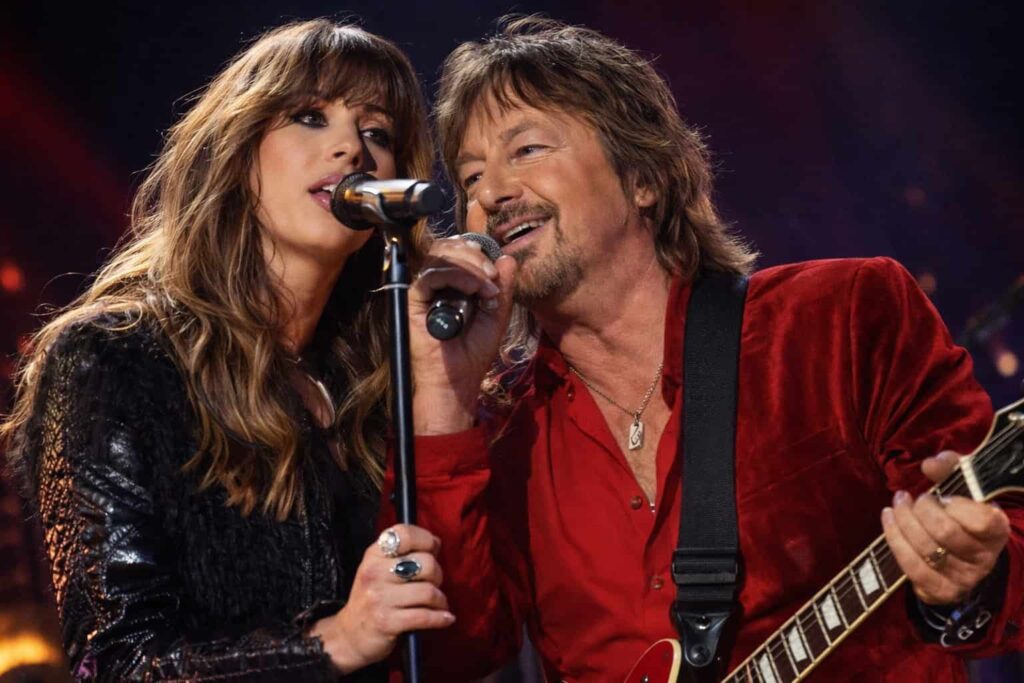
A Gentle Reflection on Love’s Afterglow and the Quiet Strength of Letting Go
Few songs arrive quietly and yet linger so deeply in the heart as “After All the Love” by Chris Norman and Elli Luha. Released in 2004 as part of Norman’s album “Break Away”, the track did not storm international charts in the way his earlier hits once did during his years with Smokie. However, in several European adult contemporary circles, it found a modest but meaningful presence, particularly in Germany where Norman has long enjoyed a loyal audience. Though it did not achieve a major chart ranking comparable to classics like “Midnight Lady”, its impact has proven to be of a more enduring, intimate kind—one that cannot be measured solely by numbers.
The story behind “After All the Love” is one of artistic continuity and emotional maturity. By the early 2000s, Chris Norman had already transitioned from his youthful rock image into a seasoned storyteller of love, loss, and reflection. Teaming up with Elli Luha, whose soft yet expressive voice brings a delicate contrast, the song becomes less of a performance and more of a conversation—two voices gently revisiting what once was, without bitterness, without regret.
There is something profoundly human in the way the song unfolds. It does not dramatize heartbreak. Instead, it lingers in that quiet space after love has faded—where memories remain, softened by time. The lyrics speak not of anger or longing, but of acceptance. That is perhaps what makes the song so resonant: it acknowledges that love, even when it ends, leaves something behind worth cherishing.
Musically, the arrangement is understated. A gentle acoustic foundation, subtle keyboard textures, and restrained percussion allow the vocals to carry the emotional weight. Chris Norman’s familiar raspy tone—once the voice of youthful yearning—now carries a sense of lived experience. In contrast, Elli Luha offers a clarity and tenderness that feels almost like a memory answering back. Together, they create a balance that mirrors the song’s theme: two perspectives, once united, now reflecting from a distance.
What gives “After All the Love” its lasting significance is its emotional honesty. It does not try to reclaim the past, nor does it mourn it excessively. Instead, it asks a simple, almost philosophical question: what remains after love has run its course? And the answer, as the song suggests, is not emptiness—but gratitude, understanding, and a quiet peace.
For listeners who have followed Chris Norman’s journey from the vibrant days of Smokie through his solo career, this song feels like a natural evolution. It is the voice of someone who has seen love in all its forms—its beginnings, its heights, and its inevitable transformations. There is a sense of closure here, but also of continuity, as if love never truly disappears—it merely changes shape.
In many ways, “After All the Love” is less about endings and more about what endures. It reminds us that even when relationships fade, the emotions they once held do not vanish entirely. They become part of who we are—quietly shaping our understanding of life, of connection, and of ourselves.
And perhaps that is why the song continues to resonate so deeply. Not because it was a chart-topping success, but because it speaks to something timeless. Something familiar. Something that, after all the years, still feels very close to the heart.