
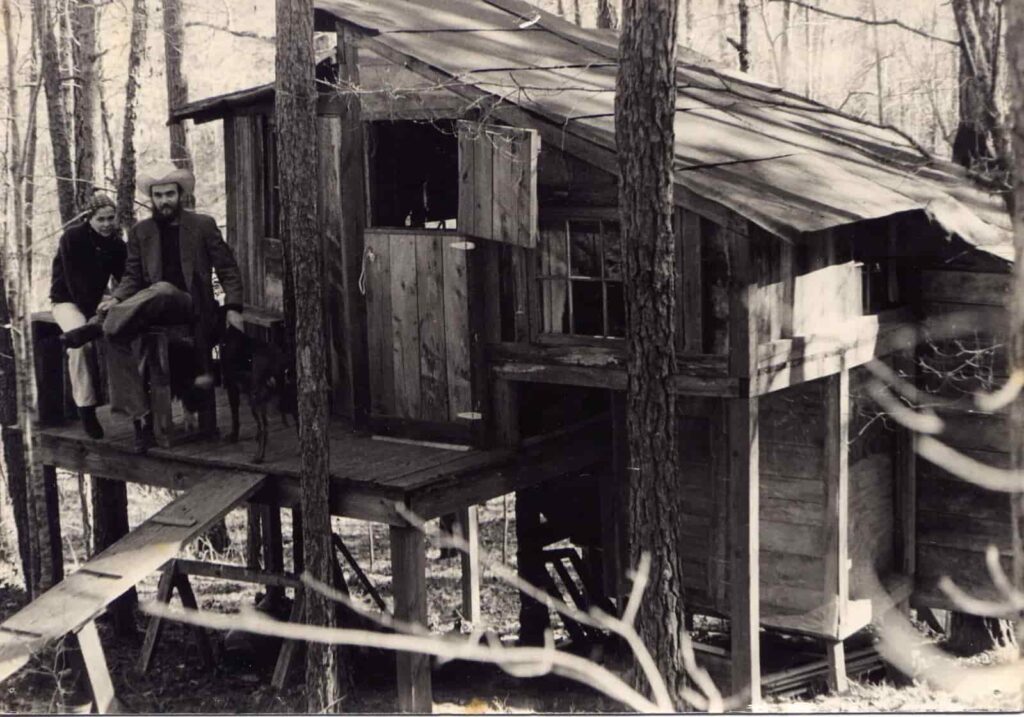
A Song of Freedom and Fragile Happiness Beneath the Georgia Trees
When Blaze Foley is mentioned, the story often arrives before the song. Yet with “Livin’ in the Woods in a Tree”, the music and the myth are inseparable. The track, recorded in the mid 1970s and later officially released on the archival collection The Dawg Years (1975–1978) in 2010, did not chart upon release. It was never designed for commercial radio, nor did it enter Billboard rankings. Instead, it lived quietly in homemade tapes and word of mouth, circulating among devotees of Texas songwriting long before the broader world began to understand what it represented.
The song dates back to a peculiar and tender chapter in Foley’s life, when he was still performing under the playful alias “Deputy Dawg.” During that period, he lived with Sybil Rosen in a treehouse they built together in rural Georgia. The structure was modest, improvised from salvaged wood, more symbolic than practical. But in “Livin’ in the Woods in a Tree,” Foley sings of it not as hardship, but as liberation. The lyric is disarmingly simple. There is no bitterness, no self pity, no grand philosophical declaration. Instead, there is an almost childlike delight in stepping outside convention and choosing love over stability.
It is important to place this song in context. The mid 1970s were not kind to artists who rejected polish. Country music was navigating between the Nashville establishment and the Outlaw movement emerging from Texas. Figures like Willie Nelson and Waylon Jennings were pushing boundaries, but even they worked within professional frameworks. Foley, by contrast, seemed constitutionally incapable of compromise. He recorded at home, on inexpensive equipment. His voice wavered, unguarded and intimate. There was no studio sheen to soften his edges. That rawness, once considered a liability, is precisely what makes the song endure.
The 2010 release of The Dawg Years (1975–1978) brought these early recordings into sharper focus for a new generation of listeners. By then, Foley’s tragic death in 1989 had already sealed his legend. His influence had been acknowledged by fellow songwriters, most notably Townes Van Zandt, who often praised Foley’s gift for capturing ordinary moments with extraordinary clarity. Yet for many, hearing “Livin’ in the Woods in a Tree” for the first time in its restored form was like opening a time capsule. The recording sounds as if it were made yesterday, and fifty years ago all at once.
The song’s narrative is deceptively lighthearted. Foley describes daily life in the treehouse with humor and warmth. There is a sense of mischief in the delivery, as if he knows how improbable it all sounds. But beneath the playful surface lies something deeper. The treehouse becomes a metaphor for voluntary exile from a world obsessed with accumulation. It is a statement about love chosen freely, about finding dignity in simplicity. Foley does not romanticize poverty. Rather, he reframes it as autonomy. He sings not of what is missing, but of what is present: companionship, sky, wind, the creak of wood in the branches.
Listening now, decades removed from that moment in Georgia, the song carries a gentle ache. One hears the fragility of that happiness. Those who know Foley’s later struggles understand that the treehouse was not a permanent sanctuary. Life pressed in, as it always does. But that is precisely why the recording feels so vital. It captures a fleeting season when possibility seemed limitless and the world could be reduced to two people suspended above the ground.
In musical terms, the arrangement is spare. Acoustic guitar leads the way, accompanied by Foley’s unvarnished vocal. There is no elaborate instrumentation, no attempt at grandeur. The rhythm sways casually, almost conversationally. This intimacy creates the illusion that he is singing directly to one listener at a time. The absence of polish becomes a form of honesty. It is the sound of someone unwilling to disguise the truth of his circumstances.
Today, “Livin’ in the Woods in a Tree” stands not merely as a charming anecdote set to melody, but as a document of artistic integrity. It reminds us that some of the most meaningful songs are not the ones that climb charts, but the ones that preserve a human moment intact. In the quiet laughter woven through its verses, we hear a young songwriter believing, perhaps against reason, that love and freedom were enough. And for a brief, shimmering interval among the Georgia trees, they were.
 Oldies Songs