
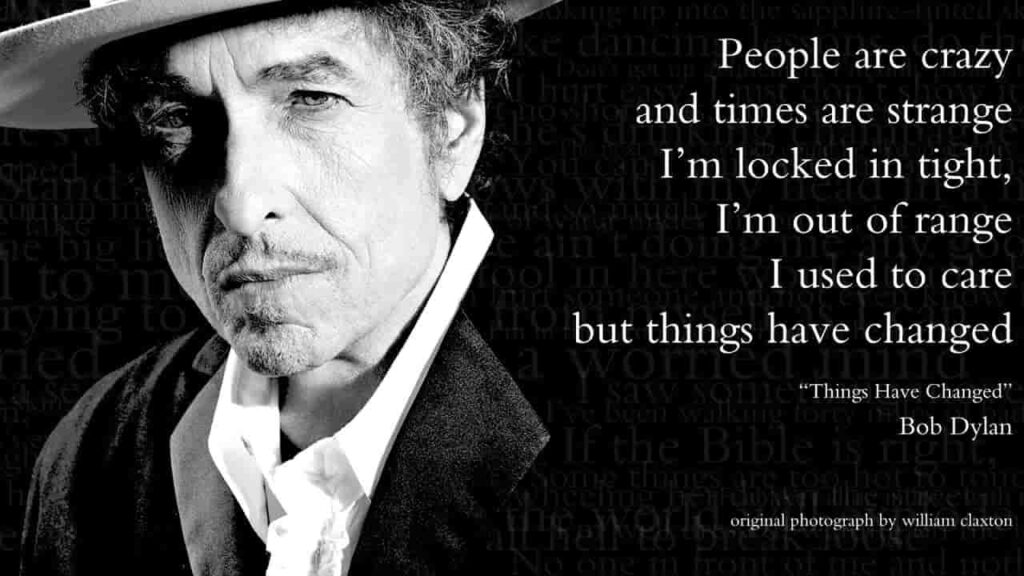
A Late-Career Reckoning with the World and the Self, Where Change Is Accepted Rather Than Resisted
Released on May 1, 2000, “Things Have Changed” arrived quietly yet decisively at the dawn of a new century, carrying with it the unmistakable voice and worldview of Bob Dylan at nearly sixty years old. Written for the film Wonder Boys and performed entirely by Dylan himself, the song marked a rare cultural moment when a veteran artist did not attempt to sound young, relevant, or fashionable, but instead chose honesty, distance, and hard-earned clarity. It was a song that felt like a final report from a restless observer who had seen too much to be surprised anymore.
Commercially, “Things Have Changed” was not designed as a chart-dominating single, yet it made a meaningful impact. In the United Kingdom, it reached No. 27 on the UK Singles Chart, a respectable showing for a song driven by irony rather than melody. In the United States, it did not enter the Billboard Hot 100, but this absence was almost beside the point. The song’s real success lay elsewhere. In 2001, it won the Academy Award for Best Original Song and the Golden Globe Award for Best Original Song, making Bob Dylan one of the few artists to receive Hollywood’s highest honors without altering his voice or worldview to suit cinematic expectations.
Placed early in any discussion of Dylan’s later career, “Things Have Changed” functions as a manifesto. Musically sparse and lyrically sharp, the song rejects idealism with a shrug rather than a scream. The opening lines immediately establish its posture: a narrator who once cared deeply about causes, movements, and moral absolutes now steps back, not out of bitterness, but out of understanding. The repeated refrain, “Things have changed,” is neither complaint nor celebration. It is a statement of fact, delivered with weary acceptance.
The song’s connection to Wonder Boys, a film centered on disillusioned intellects and stalled creativity, is more than incidental. Dylan did not write a plot-driven song. Instead, he offered a philosophical companion piece. The narrator drifts through a world where personal codes have eroded and certainty has become suspect. There is humor in the lyrics, but it is dry, almost defensive. References to love, politics, and morality are filtered through a lens of survival rather than belief. This is not the defiance of youth, but the self-protection of experience.
By the time “Things Have Changed” was released, Bob Dylan had already reinvented himself multiple times. From the protest anthems of the early 1960s to the electric controversy, from country introspection to gospel fervor, Dylan’s career had been defined by motion. What makes this song distinctive is its stillness. The narrator no longer feels compelled to explain himself. He is done standing in the center of the storm. He watches from the edges now.
The song’s legacy has only deepened with time. Its inclusion in major retrospective collections such as The Essential Bob Dylan, The Best of Bob Dylan, and Dylan confirms its status as a late-career cornerstone rather than a soundtrack footnote. It stands alongside works like Time Out of Mind as evidence that Dylan’s creative relevance did not fade with age, but sharpened into something more precise and unsettling.
Ultimately, “Things Have Changed” resonates because it articulates a feeling that many experience but rarely hear expressed so plainly. It acknowledges a world that no longer aligns with earlier hopes, yet refuses nostalgia as refuge. There is no plea for restoration, no longing for the past. Only a quiet reckoning with reality as it stands. In that sense, the song feels less like commentary and more like a personal letter left on the table, unsigned, but unmistakably familiar.
In the long arc of Bob Dylan’s career, this song does not shout for attention. It waits. And in doing so, it continues to speak with unsettling accuracy long after the applause has faded.
 Oldies Songs