
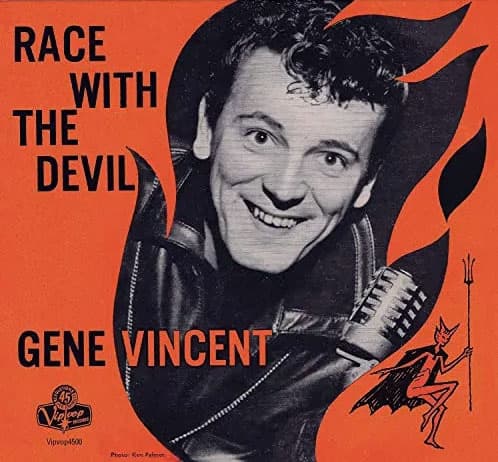
The Night Rock and Roll Turned Dangerous: Gene Vincent’s Race With the Devil
In August 1956, only weeks after Be Bop A Lula had turned a shy Navy veteran named Gene Vincent into a national sensation, Capitol Records rushed out its follow up. The title alone felt like a warning flare in the night: Race With the Devil. If Be Bop A Lula was rockabilly swagger, this was something darker, faster, and edged with menace.
Backed by His Blue Caps, Vincent did not soften his sound to please radio programmers. Instead, he leaned into the raw voltage of early rock and roll. The record opens with a sharp, urgent guitar figure, and suddenly the listener is pulled into a nocturnal chase. The lyrics tell a simple story of a late night drive, a mysterious black sedan, and a race that feels less like competition and more like confrontation. It captured the teenage imagination of the 1950s, when fast cars, lonely highways, and rebellion against the ordinary defined a new youth culture.
At the center of the storm stood Cliff Gallup. His guitar work on Race With the Devil remains one of the most studied performances in rockabilly history. Gallup’s rapid fire runs, fluid fingerwork, and expressive bent notes were not ornamental flourishes. They were declarations. Decades later, guitarists such as Eric Clapton and Jeff Beck would cite his phrasing and technique as formative influences. In 1956, though, it simply sounded futuristic, almost dangerous.
Vincent himself, still walking with a brace from a motorcycle accident that had shattered his leg years earlier, sang with a sharp, urgent tone that contrasted with the hiccupping cool of his earlier hit. There was tension in his voice, a sense that something real was at stake. That emotional edge separated Race With the Devil from countless other rock and roll singles of the era.
Though it did not eclipse Be Bop A Lula on the charts, the song cemented Vincent’s reputation as one of rock’s true originals. It showed that early rock and roll was not just dance music. It could be cinematic. It could be shadowed. It could feel like a midnight ride toward the unknown.
Nearly seventy years later, when that opening guitar line cuts through the speakers, it still feels like an engine turning over in the dark, daring you to press the accelerator.
 Oldies Songs