
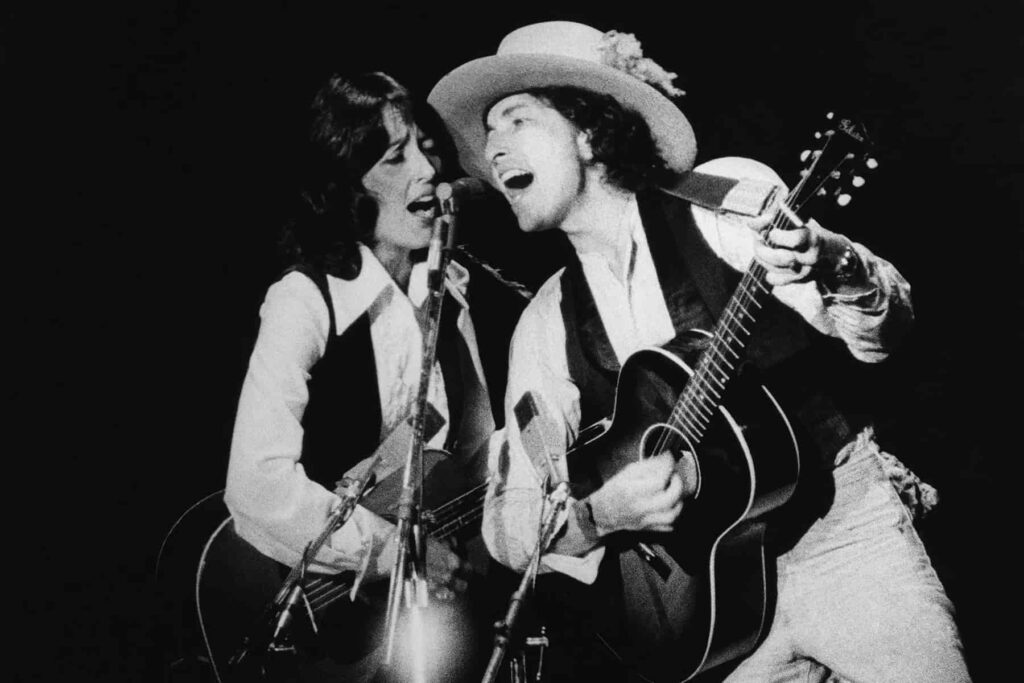
A Plea for Love and Fragility, Where Two Restless Voices Momentarily Found Shelter in the Same Song
When Bob Dylan and Joan Baez stepped onto the stage together during the opening leg of the Rolling Thunder Revue in 1975, their duet of Never Let Me Go carried a quiet weight that far exceeded its modest length. This was not a new song chasing chart success, nor a studio single engineered for radio. Instead, it was a revival of an old blues ballad, sung with the understanding that some emotions cannot be improved by polish, only revealed by restraint.
Never Let Me Go was originally written by Joseph Scott and first made famous by Johnny Ace in 1954. Ace’s recording became one of the defining R and B ballads of its era, reaching No. 2 on Billboard’s R&B Best Sellers in Stores chart. Released during a period when postwar America was learning how to articulate tenderness in popular music, the song stood out for its vulnerability. Johnny Ace’s soft, almost fragile delivery transformed a simple plea into a lasting confession. Tragically, Ace would die later that same year, giving the song an unintended aura of farewell that has followed it ever since.
By the time Dylan and Baez resurrected the song two decades later, both artists carried long histories, shared ideals, and unresolved personal tensions. Their partnership had once symbolized the moral voice of the early 1960s folk revival. By 1975, however, innocence had given way to complexity. The Rolling Thunder Revue itself was a traveling carnival of memory, masks, and reckoning. It was within this emotionally charged atmosphere that Never Let Me Go found its second life.
Their duet did not appear on any contemporary singles chart, nor was it released as a studio recording at the time. Yet it became one of the most talked-about moments of the tour. The performance would later be preserved officially on The Bootleg Series Vol. 5: Bob Dylan Live 1975, released in 2002, finally giving listeners a permanent document of what audiences witnessed firsthand. Its power lay not in technical perfection, but in the unspoken dialogue between two voices that knew each other too well.
Musically, the song is spare and restrained. Dylan does not attempt to dominate it, nor does Baez elevate it into a showcase of vocal clarity. Instead, they meet the song at eye level. Dylan’s voice, roughened by years of transformation, brings a weary honesty. Baez responds with a calm steadiness, not as a counterpoint, but as a quiet reassurance. The lyric itself is disarmingly simple. “Never let me go” is not a demand. It is a confession of dependence, fear, and hope folded into a single sentence.
In this context, the song becomes something more than a blues ballad. It becomes a moment of emotional truth between two artists who had traveled parallel roads and occasionally collided. There is no nostalgia for its own sake here. What listeners hear is acceptance. The knowledge that love, in any form, is fragile. That holding on does not always mean possession, but presence.
What makes this rendition endure is its humility. Never Let Me Go does not attempt to rewrite history or resolve past wounds. It simply allows them to exist. In a tour filled with theatrical flourishes and political symbolism, this song stood quietly apart. It reminded listeners that beneath personas, movements, and legacies, there remains the same human plea Johnny Ace once whispered in 1954.
And perhaps that is why this performance still resonates. Not because it was new, or charting, or definitive. But because, for a few minutes on stage in 1975, two voices set aside the noise of the world and trusted an old song to say what neither could say alone.
 Oldies Songs