
A Tender Meditation on Loneliness, Aging, and the Quiet Dignity of Human Connection
When “Hello In There” is mentioned, it is impossible not to think first of John Prine, the gifted American songwriter who composed it at the astonishingly young age of 24. The song originally appeared on his self-titled debut album John Prine in 1971. Although it was never released as a major charting single and therefore did not enter the Billboard Hot 100 at the time of its release, its cultural impact far exceeded any numerical ranking. Over the decades, it became one of Prine’s signature compositions—widely regarded as one of the most poignant reflections on aging and isolation in American folk music.
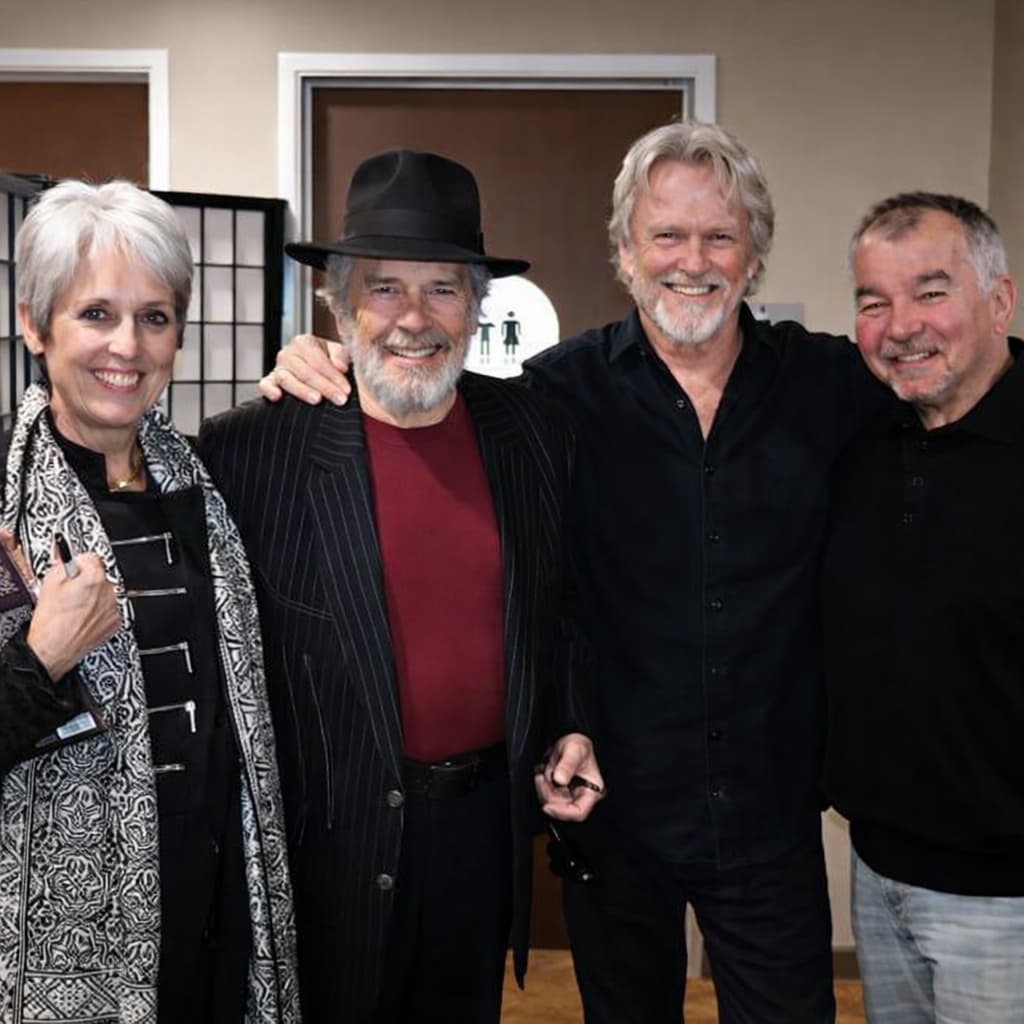
When Joan Baez and Kris Kristofferson brought their voices to “Hello In There,” they did not merely cover a song—they inhabited it. Their association with the piece came during a period when both artists were deeply embedded in the American folk and country-folk revival of the late 1960s and 1970s. Baez, long established as the crystalline conscience of the folk movement, and Kristofferson, the rugged poet-songwriter behind classics like “Me and Bobby McGee,” shared a musical and ideological kinship that made this collaboration feel organic and heartfelt.
At its core, “Hello In There” tells the story of an elderly couple, isolated by time and loss, their children grown and gone, their friends buried one by one. The narrator pleads with the listener to offer a simple greeting—“hello in there”—to those who remain unseen and unheard. It is an appeal for basic human acknowledgment, something so small yet so profound. Prine once explained that he was inspired by observing older people who seemed invisible in public spaces—particularly while working as a mailman in Chicago, where he would see widows and widowers living quiet, solitary lives.
Musically, the song is understated. Its gentle acoustic structure leaves room for the lyrics to breathe. In the hands of Joan Baez, the melody becomes almost hymnal, her soprano carrying a fragile ache that feels suspended in time. Kris Kristofferson, with his weathered baritone, adds gravity and earthiness. Together, their interpretation feels less like performance and more like remembrance—an intimate conversation shared across a kitchen table long after sunset.
The song’s emotional weight lies not in melodrama, but in restraint. Lines about children moving away, about birthdays that no longer bring celebration, about days that blend quietly into one another—these are not grand tragedies. They are the ordinary passages of life. That ordinariness is precisely what gives the song its power. There is no spectacle, no soaring chorus engineered for radio glory. Instead, there is recognition. There is truth.
In an era dominated by louder, more flamboyant productions, “Hello In There” stood apart as a quiet masterpiece. Though it did not boast impressive chart statistics upon release, it has endured far longer than many number-one hits of its time. It has been covered by numerous artists, yet the emotional authority of Baez and Kristofferson gives the song a lived-in authenticity. Their voices carry the accumulated weight of experience—political struggles, personal losses, the passage of decades.
The meaning of the song extends beyond aging. It speaks to anyone who has ever felt overlooked, dismissed, or quietly fading from the center of attention. It reminds us that time moves swiftly, that youth is fleeting, and that the final chapters of life deserve dignity and companionship. The simple act of acknowledging another person becomes a moral imperative.
Listening to “Hello In There” today feels different than it might have in 1971. With each passing year, its message resonates more deeply. The spaces between the notes seem longer. The silences heavier. The lyrics no longer sound like distant observation—they feel personal, immediate, almost prophetic.
In the grand tapestry of American songwriting, John Prine’s composition remains one of the most humane and compassionate works ever written. Through the voices of Joan Baez and Kris Kristofferson, it becomes something even more enduring—a reminder that no matter how loud the world becomes, there is still immeasurable power in a gentle greeting, in looking someone in the eye, and simply saying, “Hello in there.”
 Oldies Songs