
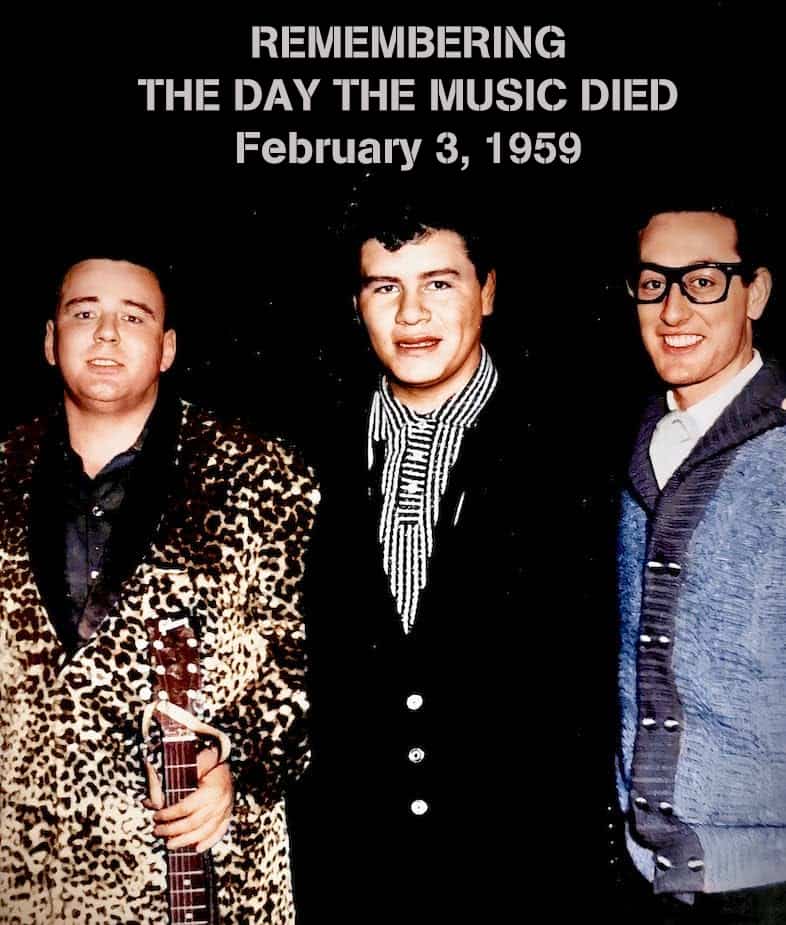
A single winter night when youth, promise, and rock and roll innocence were forever interrupted, yet its echo still shapes how we listen and remember.
On February 3, 1959, a small Beechcraft Bonanza aircraft crashed into an Iowa cornfield shortly after takeoff, killing Buddy Holly, Ritchie Valens, J.P. Richardson The Big Bopper, and pilot Roger Peterson. The tragedy would later be remembered as The Day the Music Died, a phrase immortalized years later in Don McLean’s American Pie. Yet long before that lyric was written, the impact of this loss was already being felt deeply across the musical world. It was not simply the death of three performers. It was the sudden silencing of three distinct voices who stood at the heart of rock and roll’s formative years.
At the time of his death, Buddy Holly was only 22, yet he had already reshaped popular music. With The Crickets, he scored multiple chart successes, including That’ll Be the Day, which reached No. 1 on the Billboard Hot 100 in 1957, and Peggy Sue, which peaked at No. 3 later that same year. His songwriting, clear vocal phrasing, and use of a self contained band setup influenced countless artists, from The Beatles to Bob Dylan. Holly’s 1958 self titled album Buddy Holly was not merely a collection of hits, but a blueprint for how rock artists could write, arrange, and perform their own material. When he boarded that plane during the grueling Winter Dance Party tour, he was already thinking beyond singles, toward a more expansive musical future that would never arrive.
Video
Ritchie Valens, just 17 years old, represented something equally revolutionary. As one of the first Mexican American rock stars to achieve mainstream success, his presence carried cultural weight far beyond the charts. His song La Bamba, a rock adaptation of a traditional Mexican folk tune, reached No. 22 on the Billboard Hot 100 in early 1959. On the same double sided single, Donna climbed to No. 2, proving Valens could balance youthful tenderness with rhythmic daring. His career had barely begun, yet he had already opened doors for generations of Latino artists who followed.
Video
Then there was The Big Bopper, a charismatic radio personality turned performer whose humor and theatrical flair added another dimension to early rock and roll. His novelty hit Chantilly Lace reached No. 6 on the Billboard Hot 100 in 1958, driven by playful spoken interjections and an infectious beat. Beneath the humor, however, was a sharp understanding of entertainment and audience connection. Richardson was 28, older than his fellow passengers, and thinking seriously about stability and family when his life was cut short.
Video
The crash occurred because of exhaustion, harsh winter conditions, and the relentless pace of touring. Musicians traveled by bus through freezing Midwestern nights, often without adequate rest. Seeking warmth and sleep, Holly chartered the plane, unknowingly sealing a moment that would mark music history forever.
The meaning of The Day the Music Died lies not only in loss, but in interruption. These artists were not fading figures. They were ascending, still shaping their sound, still surprising audiences. Their deaths forced a young genre to confront mortality far earlier than expected. Rock and roll, once seen as carefree rebellion, suddenly carried sorrow, reflection, and a sense of fragility.
Yet the legacy endured. Their records continued to sell. Their songs continued to be played on jukeboxes, radios, and later, on turntables in living rooms where listeners grew older alongside the music. Each replay became an act of remembrance. The music did not die. It matured.
For those who lived through that era or discovered it later in life, February 3, 1959 remains a date etched in memory. Not as an ending, but as a reminder that great music does not depend on longevity. It depends on truth, feeling, and the rare ability to speak to the human heart. And in that sense, Buddy Holly, Ritchie Valens, and The Big Bopper are still very much with us, singing softly across the decades, refusing to be forgotten.
 Oldies Songs