
A Moment of Grace and Strength: “Oh, Pretty Woman” as a Song That Outlived Its Own Era
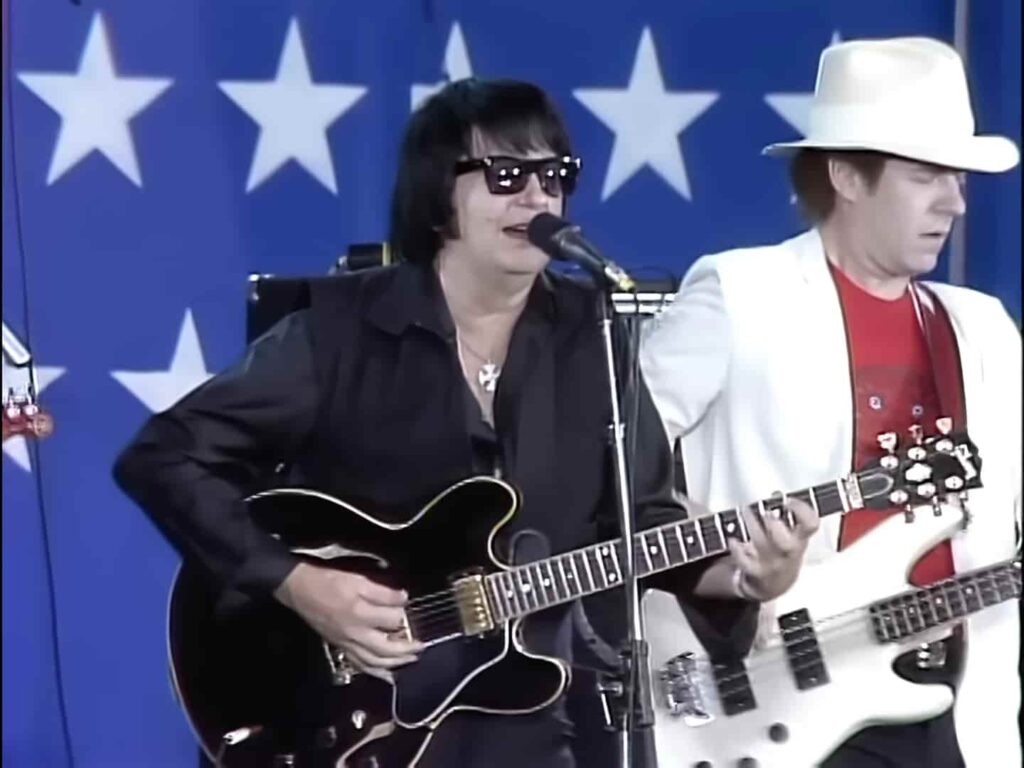
When Roy Orbison stepped onto the stage at the inaugural Farm Aid concert in Champaign, Illinois, on September 22, 1985, he carried with him far more than a guitar and a familiar melody. He brought a song that had already lived several lifetimes. “Oh, Pretty Woman”, first released in August 1964, had reached No. 1 on the Billboard Hot 100, holding that position for three consecutive weeks, and had also topped the charts in the United Kingdom and several other countries. From the very beginning, it was not merely a hit. It was a cultural event, a defining moment in popular music that helped secure Orbison’s place among the most distinctive voices of the twentieth century.
Written by Roy Orbison and his longtime collaborator Bill Dees, “Oh, Pretty Woman” was famously inspired by an everyday moment. Dees recalled Orbison’s wife walking past, prompting Orbison to remark on her beauty, which quickly evolved into the song’s central refrain. What followed was a composition unlike most love songs of its time. Instead of pleading or swaggering, the narrator observes, waits, and hopes. The structure is unusual, built around tension and release, silence and sudden uplift. The famous guitar riff opens the door, but it is Orbison’s voice, controlled, aching, and impossibly clear, that carries the listener through the song’s emotional arc.
By the time of its inclusion on the album Orbisongs, released in 1965, the song had already become inseparable from Orbison’s identity. Yet its meaning deepened over the years. At Farm Aid 1985, the performance arrived during a period when Orbison was no longer a constant presence on the charts but was increasingly revered as an artist’s artist. The concert itself, organized by Willie Nelson, Neil Young, and John Mellencamp, was devoted to supporting American family farmers. It was a setting rooted in realism and resilience rather than spectacle, which made Orbison’s appearance particularly striking.
On that stage, “Oh, Pretty Woman” sounded less like a youthful anthem and more like a reflection. Orbison did not attempt to modernize the song or reshape it for the era. He stood almost still, dressed in black, his dark glasses hiding nothing of the emotional weight in his voice. The performance underscored what had always set him apart. While many of his contemporaries relied on bravado or rebellion, Orbison sang from a place of vulnerability. In this song, admiration borders on longing, and longing nearly turns into resignation before hope unexpectedly returns in the final verse.
The meaning of “Oh, Pretty Woman” has often been misunderstood as simple or superficial. In truth, it is a meditation on distance and chance. The woman is admired from afar. The singer does not assume he will be seen, let alone chosen. That emotional restraint is central to the song’s enduring power. It speaks to moments in life when one waits quietly, uncertain whether recognition will come. At Farm Aid, surrounded by an audience attuned to struggle and perseverance, the song resonated not as nostalgia alone but as a reminder of patience and quiet dignity.
Musically, the song remains a masterclass in economy. The arrangement leaves space for Orbison’s voice to rise and fall naturally, culminating in that soaring final passage that feels earned rather than imposed. Even decades after its release, few recordings match its balance of simplicity and emotional depth. The performance in 1985 reaffirmed that greatness in music does not depend on reinvention but on truth sustained over time.
In the years that followed, “Oh, Pretty Woman” would continue to find new listeners through films, covers, and revivals. Yet the Farm Aid performance stands apart. It captures Roy Orbison not as a relic of the past, but as a living voice, still capable of commanding silence and attention with a song written more than twenty years earlier. In that moment, the song ceased to belong to a single decade. It became something rarer, a shared memory that continues to echo, quietly and unmistakably, long after the final note fades.
 Oldies Songs