
A Dark Ballad of Love and Consequence, Driven by Strings That Refuse to Look Away
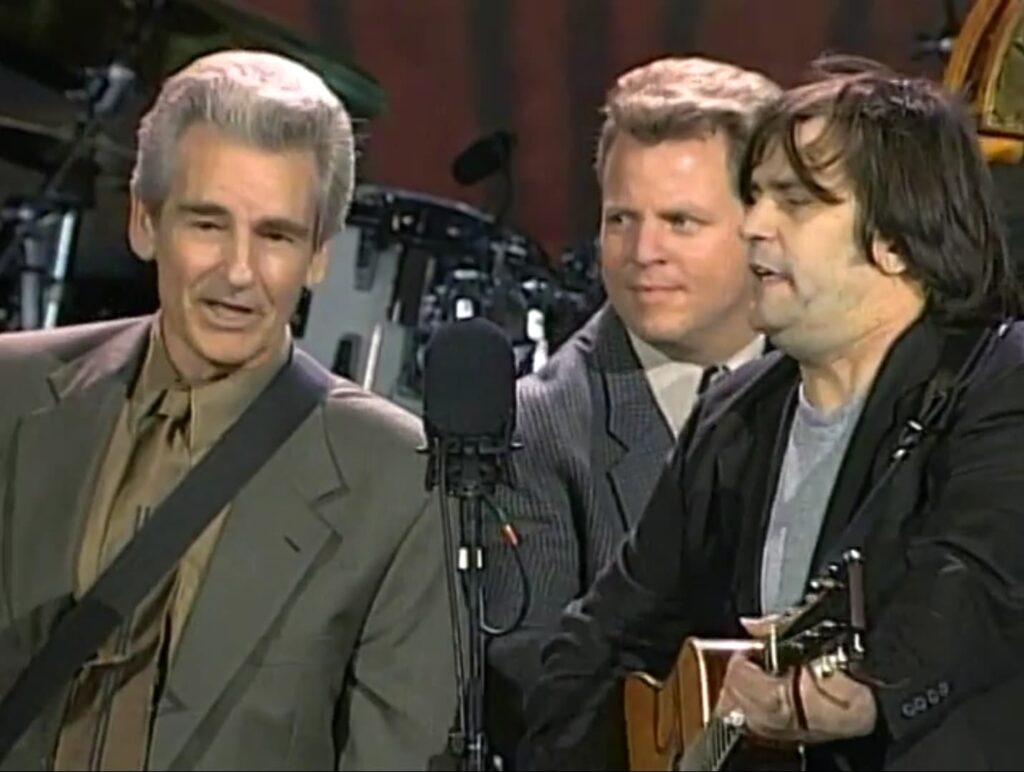
On October 3, 1998, at the Farm Aid 1998 in Tinley Park, Illinois, Steve Earle joined forces with Del McCoury Band to deliver a gripping live performance of “Carrie Brown.” Introduced with a half-joking warning about writing a “real-life bad tooth hillbilly murder ballad,” Earle set the tone for what would become one of the most intense moments of the set.
From the first lines, the song moves quickly into familiar Appalachian territory. Love, obsession, and violence intertwined in a narrative that feels as old as the hills themselves. But what separates this performance is its urgency. Backed by the driving precision of the Del McCoury Band, the story does not unfold slowly. It charges forward, carried by rapid-fire picking and tight harmonies that leave little room to breathe.
Steve Earle’s vocal delivery is raw and direct. He does not romanticize the character at the center of the story. Instead, he presents him plainly. A man consumed by emotion, unable to escape the consequences of his actions. The repeated line, “I believe I’d rather die,” becomes less of a statement and more of a fate already sealed.
Instrumentally, the performance is relentless. The mandolin chops, the fiddle cuts through, and the guitar lines chase one another in a constant forward motion. It mirrors the narrative itself. There is no turning back once the story begins. Every note pushes it closer to its inevitable conclusion.
What makes “Carrie Brown” resonate in this live setting is its authenticity. This is not a polished studio interpretation. It is a lived-in performance, where the rough edges enhance the emotion rather than distract from it. The crowd’s energy, the band’s interplay, and Earle’s storytelling all merge into something immediate and unfiltered.
There is also a deep respect for tradition embedded in the performance. Murder ballads have long been part of American folk and bluegrass history. Here, Steve Earle does not reinvent the form. He steps inside it, adding his own voice while honoring its roots.
As the final notes ring out and the applause rises, what lingers is not just the story of Carrie Brown, but the feeling of having witnessed something timeless.
A reminder that some songs are not meant to comfort, but to confront.