
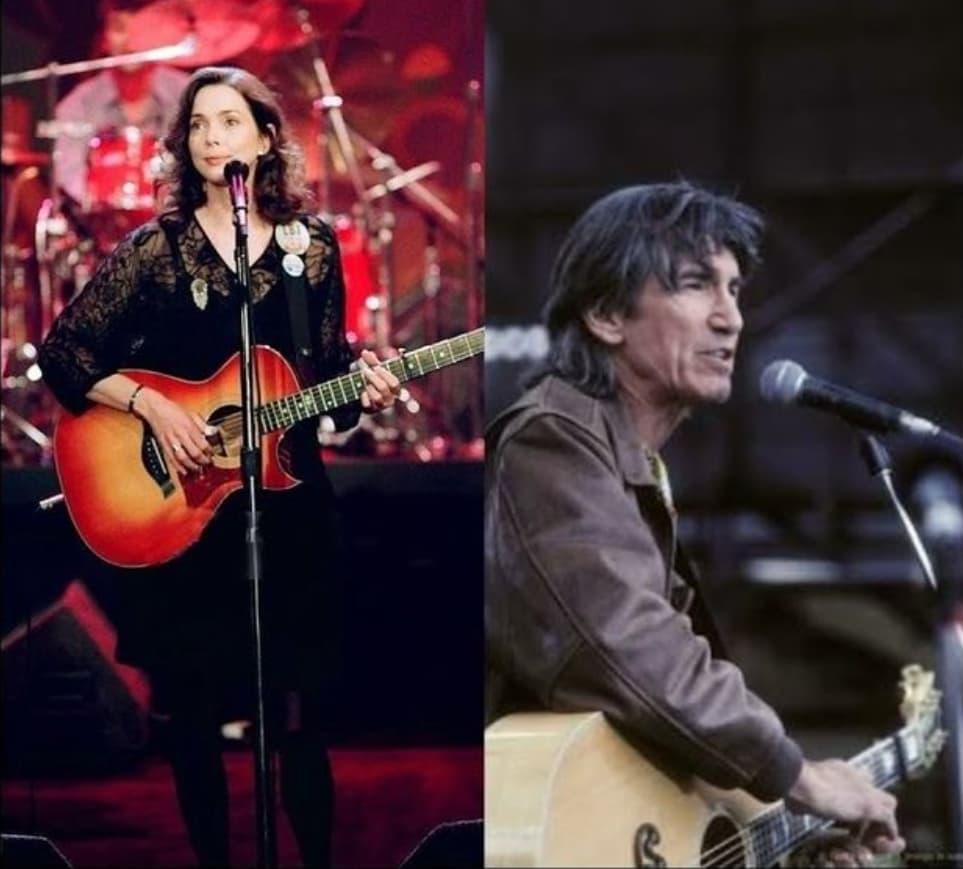
Pancho and Lefty — a folk ballad where friendship, betrayal, and time quietly pass judgment
When Townes Van Zandt and Nanci Griffith stepped onto the stage in 1993 to perform “Pancho and Lefty” live, the moment carried a weight far beyond a simple duet. It was not merely a performance of a well-known song; it was a meeting of kindred spirits, bound by reverence for storytelling, for truth stripped of ornament, and for the fragile moral questions that linger long after the final chord fades.
To understand the power of this live rendition, it is important to begin with the song itself. “Pancho and Lefty” was written by Townes Van Zandt in the early 1970s and first appeared on his 1972 album The Late Great Townes Van Zandt. Although Van Zandt’s own recording did not chart upon release, the song slowly grew into one of the most respected and reinterpreted compositions in American folk and country music. Its greatest commercial success came more than a decade later, when Willie Nelson and Merle Haggard recorded it in 1983, taking it to No. 1 on the US country charts and cementing it in the mainstream canon.
Yet even with that chart-topping success, many listeners have always felt that the song truly belongs to Townes himself — not because of sales or rankings, but because of the way the story breathes in his presence. The 1993 live performance with Nanci Griffith restores the song to that quieter, more contemplative space.
The story behind “Pancho and Lefty” is deceptively simple. Pancho, a romantic outlaw figure inspired loosely by the Mexican revolutionary Pancho Villa, lives fast and dies young. Lefty, his companion, survives — not through bravery, but through compromise. He “left” Pancho, whether through betrayal or quiet withdrawal, and lives on with the burden of that choice. Townes himself was famously evasive when asked to explain the song’s meaning, once remarking that it was about “aging.” And perhaps that is the truest reading of all.
In the 1993 live duet, this theme of aging becomes almost tangible. Townes Van Zandt, his voice already worn thin by life’s hardships, sings with a resigned calm, as though he has made peace with the song’s unanswered questions. Nanci Griffith, by contrast, brings a clear, compassionate tone — not to soften the song, but to illuminate it. Her harmonies feel like empathy itself, standing beside Townes rather than over him.
This performance is striking precisely because it refuses drama. There is no grand arrangement, no attempt to impress. The two voices move carefully around each other, leaving space for silence, for reflection. When Townes sings “All the federales say / They could have had him any day,” it no longer sounds like a lyric — it sounds like a quiet observation about how the world rewrites its stories once the dust has settled. And when the song ends with Lefty growing old in Cleveland, Ohio, the line lands not as irony, but as quiet tragedy: survival without peace.
For listeners who have lived long enough to see ideals tested by time, this performance resonates deeply. It speaks to the compromises made in order to endure, to the friends lost along the way, and to the uneasy question of whether survival itself is a kind of victory. The live setting in 1993 adds another layer: both artists already carried their own histories, their own scars, and that knowledge seeps gently into every note.
Unlike the famous chart-topping version of the song, this rendition does not aim for closure. It leaves the listener sitting with uncertainty — with the realization that life rarely hands out clear heroes or villains. In this sense, “Pancho and Lefty” becomes less a ballad of outlaws and more a meditation on conscience, memory, and the slow passage of years.
In the end, the 1993 live performance by Townes Van Zandt & Nanci Griffith feels like a shared understanding whispered between two old souls. It reminds us that songs do not age the way people do — they deepen. And when sung by those who truly understand their weight, they become mirrors, quietly reflecting the lives we have lived and the choices we still carry.
 Oldies Songs