
A Restless Man Between the Bottle and the Horizon, Searching for Meaning in the Quiet Hours
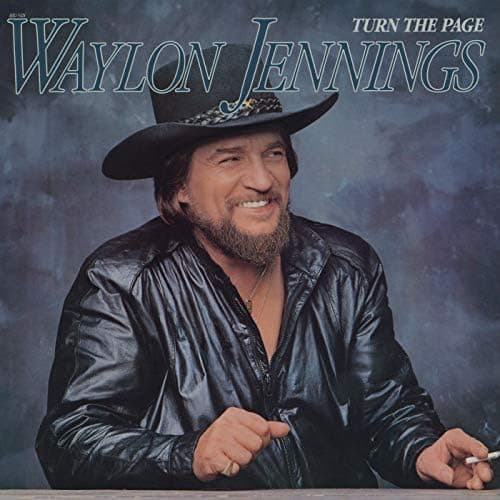
When Waylon Jennings released “Drinkin’ and Dreamin'” in June 1985, it did not merely arrive as another single on country radio. It emerged as a reflective statement from one of the architects of the outlaw movement, a man who had spent more than two decades wrestling with fame, freedom, and his own hard living. Issued as the first single from the album Turn the Page, the song climbed to No. 2 on the Billboard Hot Country Singles & Tracks chart, confirming that even in the mid 1980s, Jennings remained a commanding presence in country music.
Written by Troy Seals and Max D. Barnes, two craftsmen who understood the emotional vocabulary of country song, “Drinkin’ and Dreamin'” fits seamlessly into the narrative arc of Jennings’ career. By 1985, Waylon was no longer the defiant young renegade challenging Nashville conventions in the early 1970s. He was a seasoned artist who had survived industry battles, personal excess, and shifting musical trends. His voice carried more gravel, more memory. The outlaw had become reflective, but not tamed.
The production on Turn the Page reflected that maturity. The sound was polished enough for contemporary radio yet anchored in the steady pulse of traditional country instrumentation. The rhythm section moves with an unhurried confidence, steel guitar lines drift like late night thoughts, and Jennings’ baritone sits at the center, unforced and conversational. There is no theatricality in his delivery. He sings as if he has lived every word.
Lyrically, “Drinkin’ and Dreamin'” captures a familiar country tableau: a man alone with his thoughts, a glass in his hand, and memories that refuse to stay buried. But beneath its surface simplicity lies something deeper. This is not a celebration of excess. It is an admission of restlessness. The protagonist is caught between two impulses. One is escape through the bottle. The other is longing through dreams. The song acknowledges that neither truly satisfies.
That tension mirrors Jennings’ own biography. By the early 1980s, he had begun confronting the consequences of years spent on the road and entangled in substance abuse. The wildness that once defined the outlaw image had exacted a price. When he sings about drinking and dreaming, there is no romantic haze. There is weariness. There is self awareness. Listeners who had followed him since the days of Honky Tonk Heroes or Dreaming My Dreams could hear the evolution in his phrasing. He does not reach for high drama. He leans into truth.
Commercially, the song’s ascent to No. 2 on the country chart reaffirmed Jennings’ enduring bond with his audience. In a decade when country radio was increasingly shaped by smoother production and younger faces, Waylon’s presence near the top of the charts spoke to loyalty built over years. It also proved that authenticity never goes out of fashion. His fans recognized themselves in the song’s quiet confessions.
The album Turn the Page itself suggested transition. The title hinted at renewal, perhaps even reckoning. Jennings was moving forward, yet he carried the past with him. “Drinkin’ and Dreamin'” became one of the emotional anchors of that project. It stood not as a triumphant anthem, but as a moment of pause. A man taking stock.
Listening today, decades removed from its chart run, the song resonates differently. Time has a way of softening judgment and sharpening empathy. The melody feels like a slow drive down an empty highway after midnight. The lyrics feel like thoughts spoken into the dark when no one else is listening. There is comfort in its honesty.
In the end, “Drinkin’ and Dreamin'” endures not because it reached No. 2, though that achievement matters. It endures because Waylon Jennings sang it without pretense. He allowed vulnerability to sit beside strength. He allowed the listener to hear the man behind the myth. And in doing so, he reminded us that sometimes the most powerful country songs are not about rebellion, but about reflection.
 Oldies Songs
  Oldies Songs