
A Defiant Promise of Freedom and Fate in a Restless American Life
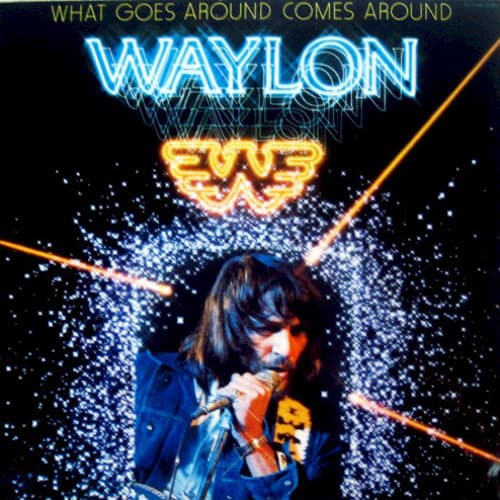
In 1979, Waylon Jennings carried a hard lived confession to the top of the charts with “I Ain’t Living Long Like This”, a song that became his eleventh No. 1 on the Billboard Hot Country Singles chart. Included on the album What Goes Around Comes Around, the single confirmed once more that Jennings was not merely a country star but one of the defining architects of the outlaw country movement. By the time it climbed to No. 1, he had already rewritten the rules of Nashville. Yet this record felt different. It sounded less like rebellion for its own sake and more like a man measuring the miles he had traveled and the toll they had taken.
Though many listeners associate the song solely with Jennings, it was written by Rodney Crowell, first recorded by Crowell in 1977 on his debut album. When Jennings chose to interpret it two years later, he did not simply cover the song. He inhabited it. Under the production of Richie Albright, the track gained a muscular urgency. The rhythm section drives forward with a steady, almost relentless pulse, while the Telecaster lines cut clean and sharp. Over it all, Jennings’ baritone carries both swagger and weariness, the voice of someone who has seen enough trouble to recognize it from a distance.
The late 1970s were a period of transition in country music. The outlaw movement that Jennings, Willie Nelson, Tompall Glaser, and others had ignited earlier in the decade was no longer insurgent. It had become commercially dominant. Yet success did not soften Jennings’ persona. In “I Ain’t Living Long Like This”, the lyrics sketch a life on the run. There are allusions to jail, to romantic entanglements gone wrong, to the law closing in. But beneath the outlaw imagery lies something more intimate. The repeated line is not a boast. It is a realization. A man cannot continue at this pace without consequence.
Jennings’ own biography gives the performance added resonance. By 1979, he had endured legal troubles, struggles with substance abuse, and the intense pressures of fame. He had survived the 1959 plane crash that killed Buddy Holly, an event that marked him for life. When he sang about not living long like this, it did not feel theatrical. It felt autobiographical. That authenticity is what carried the record to No. 1 and kept it there for a week, while it spent multiple weeks within the Top 10.
The album What Goes Around Comes Around itself did not aim for glossy production or crossover polish. Instead, it leaned into the grit that defined Jennings’ sound. Steel guitar, firm backbeat, and his unmistakable phrasing formed the backbone. In an era when some country artists were edging toward pop sensibilities, Jennings doubled down on narrative clarity and rhythmic insistence. The result was a single that sounded urgent but controlled, rebellious yet reflective.
What gives the song enduring power is its emotional duality. On the surface, it is a tale of defiance. A man acknowledges danger but refuses to surrender his independence. Yet listen closely and one hears a plea for change. The title itself carries fatalism. It suggests awareness of mortality, of limits, of time running shorter than one would like to admit. Jennings delivers the refrain not as a threat but as a confession. There is gravity in his tone. He understands the cost of living too fast.
For those who remember country radio in 1979, this song arrived like a familiar friend speaking uncomfortable truths. It did not preach. It did not dramatize. It simply told the story of a man confronting the consequences of his own choices. That honesty is what separates it from countless other outlaw anthems. It stands not just as a chart topper but as a moment of introspection from an artist who rarely flinched.
Today, “I Ain’t Living Long Like This” remains one of the signature recordings in Waylon Jennings’ catalog. It captures a precise intersection of commercial success and personal reckoning. The outlaw had become an institution, yet he still sang as though the road stretched endlessly before him, uncertain and demanding. And in that tension between bravado and vulnerability, the song continues to echo with unmistakable truth.
 Oldies Songs
  Oldies Songs