
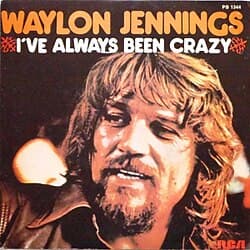
A Defiant Confession and a Hard-Won Peace from the Heart of Outlaw Country
Released in 1978, “I’ve Always Been Crazy” stands as one of the most revealing and self aware recordings in the long and turbulent career of Waylon Jennings. It is both a song and the title track of his studio album I’ve Always Been Crazy, issued at a moment when Jennings had already secured his place as a central architect of the Outlaw Country movement. Upon its release as a single, the song rose to No. 1 on the Billboard Hot Country Singles chart, where it remained for three consecutive weeks, becoming the sixth solo chart-topper of Jennings’ career. Those facts alone mark it as a commercial triumph. Yet its true importance lies not in sales or chart statistics, but in its unflinching honesty and emotional clarity.
By the late 1970s, Waylon Jennings was no longer merely pushing against Nashville conventions. He had lived through the consequences of that rebellion. Years of relentless touring, public defiance of industry control, and a well documented struggle with substance abuse had left deep marks on both his music and his personal life. “I’ve Always Been Crazy” emerged from this period not as a boast, but as a reckoning. Jennings wrote the song as a direct confrontation with himself, stripping away myth and bravado to reveal a man taking responsibility for his contradictions.
The opening lines immediately establish the song’s reflective tone. There is no attempt to justify the chaos of the past, nor to romanticize it. Instead, Jennings acknowledges the costs of his choices with a weary calm that can only come from experience. The now legendary line, “I’ve always been crazy, but it’s kept me from going insane,” has endured precisely because it captures a truth many recognize but rarely articulate. It is not a celebration of recklessness, but an admission that individuality and survival often come at the same price.
Musically, the song is deceptively simple. The arrangement is restrained, built around a steady rhythm and understated instrumentation that allows Jennings’ voice to carry the weight of the narrative. His delivery is measured, almost conversational, marked by the gravelly warmth that had become his signature. There is no urgency here, only reflection. Each phrase feels considered, as though spoken by someone who has already paid for every word.
Within the broader context of the album I’ve Always Been Crazy, the song functions as a thematic anchor. The record explores themes of regret, endurance, and emotional reckoning, moving away from the outlaw posturing of earlier years toward a more introspective maturity. This shift did not signal retreat. Rather, it represented growth. Jennings was no longer fighting to prove his independence. He was defining it on his own terms.
The cultural impact of “I’ve Always Been Crazy” has only deepened with time. For listeners who came of age alongside Jennings, the song resonates as a mirror held up to decades lived with intensity and consequence. It speaks to careers built through risk, relationships tested by stubborn pride, and the quiet understanding that survival itself can be an act of defiance. The song’s honesty invites reflection without nostalgia for its own sake, offering something rarer: acceptance.
In the landscape of classic country music, Waylon Jennings remains a figure of rare authenticity, and “I’ve Always Been Crazy” may be his most distilled self portrait. It is not the sound of rebellion in full flame, but of embers still glowing with truth. For those who have walked long roads and learned their lessons the hard way, the song continues to feel less like a performance and more like a conversation remembered late at night, when the noise fades and clarity finally arrives.
 Oldies Songs
  Oldies Songs