
A Quiet Ballad of Home, Distance, and the Love That Outlives the Road
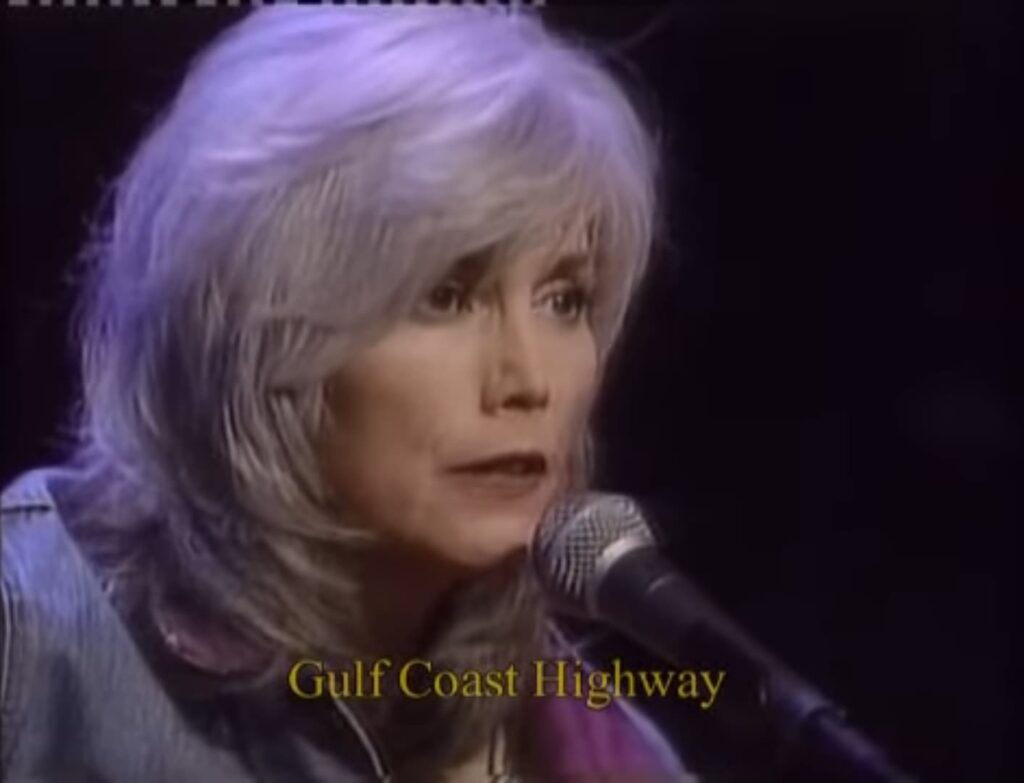
In a performance that felt less like a concert and more like a shared remembrance, Emmylou Harris and Dave Matthews stood side by side to sing “Gulf Coast Highway”, a song that has long carried the hush of open skies and the ache of lives shaped by work, weather, and waiting. The duet, widely circulated through a live recording cherished by fans, brought renewed attention to a composition first written by Nanci Griffith, later recorded by Harris for her 1990 album Duets.
From the opening lines, the atmosphere was unadorned and reverent. No spectacle, no grand orchestration. Just two voices leaning into a story about a Texas coastal road where refineries glow at night and families build their hopes between tides and paychecks. The song has always been about more than geography. It is about inheritance, about promises made under hard skies, about the quiet bravery of ordinary love.
Emmylou Harris, already revered for her crystalline soprano and interpretive grace, approached the song not as a showpiece but as testimony. Her voice carried the patina of time, soft yet unwavering, as if each lyric had been lived rather than sung. Opposite her, Dave Matthews offered a textured counterpoint. Known primarily for his work with the Dave Matthews Band, he restrained his usual rhythmic exuberance and instead chose stillness. The result was striking. His earthy timbre grounded the song, giving weight to its images of oil fields, front porches, and weathered hands.
The lyrics unfold like a letter written at dusk. A couple looks back on years spent working along the Gulf Coast, dreaming of land to call their own. They speak of children who will one day scatter, of the inevitability of change, of death itself approached without melodrama. There is no bitterness in the narrative. Only acceptance. When the chorus returns to the image of the highway stretching along the water, it feels less like a road and more like the passage of a lifetime.
What made this particular performance unforgettable was its restraint. The arrangement allowed silence to breathe between phrases. The audience listened with the kind of attentiveness rarely found in larger venues. You could almost sense memories rising in the room. Listeners who once worked long hours, who once watched their own children leave home, who once stood on porches counting distant lights, recognized themselves in the melody.
Originally appearing on Duets, where Harris collaborated with artists such as Roy Orbison and Linda Ronstadt, “Gulf Coast Highway” has endured because it refuses to dramatize hardship. Instead, it honors endurance. In this later collaboration with Dave Matthews, the song seemed to gain another dimension. Two generations of musicians, different backgrounds, different audiences, met in the same emotional landscape.
There was a moment near the final verse when Harris’ voice lifted gently above Matthews’ harmony. It was not powerful in volume, but in meaning. The line about being buried beneath Gulf Coast soil carried a stillness that felt sacred. Not tragic. Simply complete.
Long after the last chord faded, the image lingered. A stretch of highway beside quiet water. Refinery lights glowing in the dark. A couple holding on to each other while seasons change. In an era of speed and spectacle, Emmylou Harris and Dave Matthews reminded listeners that some songs are meant to be sat with, not rushed through.
“Gulf Coast Highway” remains what it has always been. A hymn to work, to marriage, to children, to the dignity of staying. And in that shared performance, it felt as though time itself slowed down, allowing everyone present to walk that long road once more.