
“Sing Me”: When a Song Becomes a Voice Crying to Be Heard Again
Few songs in the long career of Neil Sedaka carry such a quietly revealing message as “Sing Me”—originally titled “I’m a Song (Sing Me)”. Released in 1971 as the opening track of Sedaka’s album Emergence, the piece was written by Sedaka together with his lifelong collaborator Howard Greenfield, the lyricist who helped shape many of his early classics. The album itself arrived during a difficult transitional moment in Sedaka’s career, a time when the charts that once embraced him seemed to have moved on. Although Emergence did not achieve notable chart success in the United States, it later developed a devoted following among listeners who recognized its emotional honesty and musical sophistication.
At first glance, “Sing Me” sounds playful—almost whimsical. The song is written from the unusual perspective of a melody itself, patiently waiting for someone to bring it to life. Yet beneath that clever concept lies something deeper, something almost autobiographical. The lyrics plead: “I’m a song and I’ve waited so long for someone to come and sing me.” In those words, many listeners have heard Sedaka speaking not only about music, but about himself—an artist waiting for the world to listen again.
To understand the emotional undercurrent of the song, one must remember the moment in which it was created. Neil Sedaka had been one of the brightest stars of early 1960s pop, with hits such as “Oh! Carol,” “Calendar Girl,” and “Breaking Up Is Hard to Do.” But when the British Invasion reshaped popular music in the mid-1960s, the polished Brill Building style that Sedaka represented suddenly seemed old-fashioned to record executives and radio programmers. For several years his commercial success faded, even though his songwriting talent never did.
It was during this uncertain period that Emergence was recorded in New York and released by RCA Records in September 1971. The album represented a hopeful attempt at a comeback. Sedaka himself later described it as one of his favorite works, filled with songs that he believed were among the best he had written in nearly two decades. Yet despite the effort, the album and its singles—including “I’m a Song (Sing Me)”—received little promotion and failed to make a commercial impact in the United States.
Ironically, that disappointment would soon lead to one of the most remarkable second acts in pop history. After the album’s muted reception, Sedaka relocated to the United Kingdom, where he would rebuild his career with the help of emerging musicians who later formed the band 10cc. Within only a few years he returned to the charts with major hits such as “Laughter in the Rain,” “Bad Blood,” and “Solitaire.” In hindsight, “Sing Me” now sounds almost prophetic—as if the song itself predicted that his music still had life left in it.
Musically, the track is classic Sedaka: piano-driven pop enriched with lush orchestration and warm vocal harmonies. The arrangement gives the melody room to breathe, allowing the chorus to rise gently but confidently. Sedaka’s voice—clear, expressive, and unmistakably sincere—carries the song with a mixture of optimism and vulnerability. It feels less like a performance and more like a conversation between an artist and the music that has defined his life.
More than anything, “Sing Me” reminds us of the strange relationship between a songwriter and time. Songs are written in moments of inspiration, but their true lives often unfold years later—sometimes decades later—when someone, somewhere, presses play and hears them anew. In that sense, the song’s central plea is timeless: music only truly exists when it is heard, shared, and remembered.
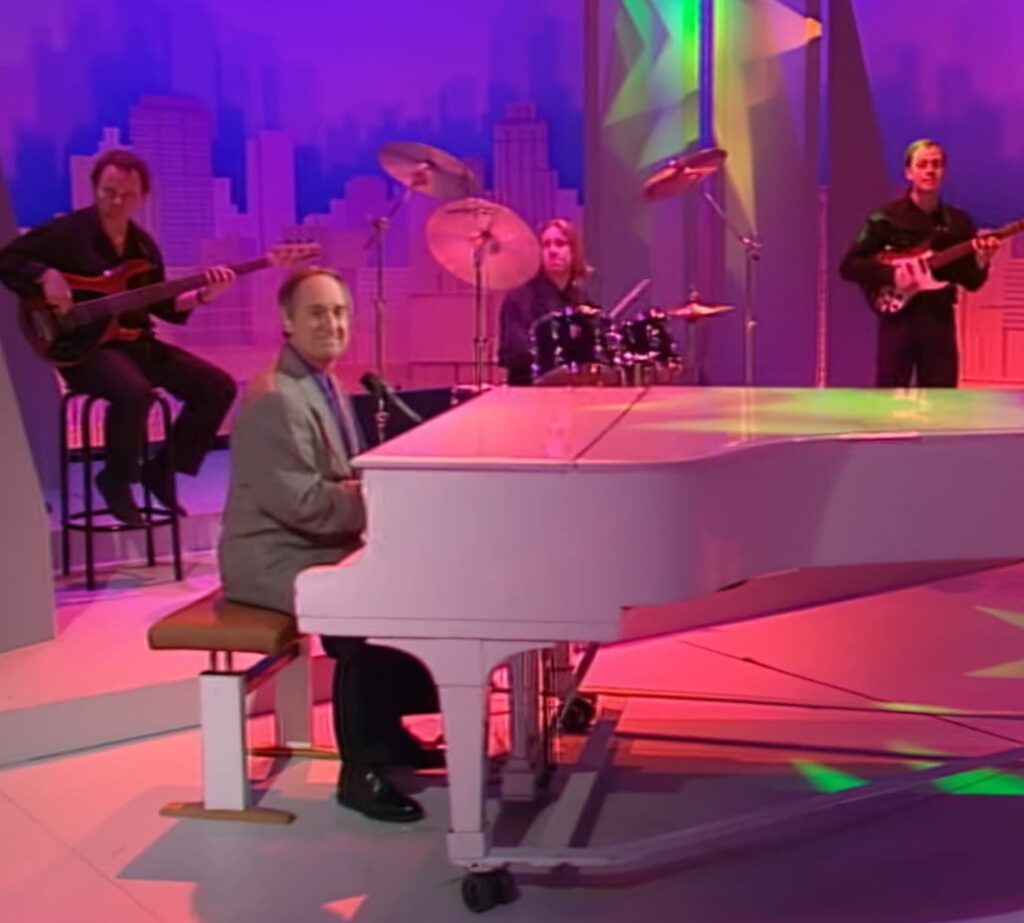
The 1992 performance on the British television program Pebble Mill, where Neil Sedaka revisited the piece with the calm confidence of a seasoned artist, carries an especially touching resonance. By that point, the man who once wondered if anyone would “sing” his songs again had already proven that melodies have long memories.
And so “Sing Me” stands today not simply as a track from an overlooked album, but as a gentle declaration of faith in music itself. A song asking to be sung—patiently waiting until someone, somewhere, listens closely enough to hear its quiet voice.
 Oldies Songs