
A Rock and Roll Anthem Reimagined Through Harmony and Television History
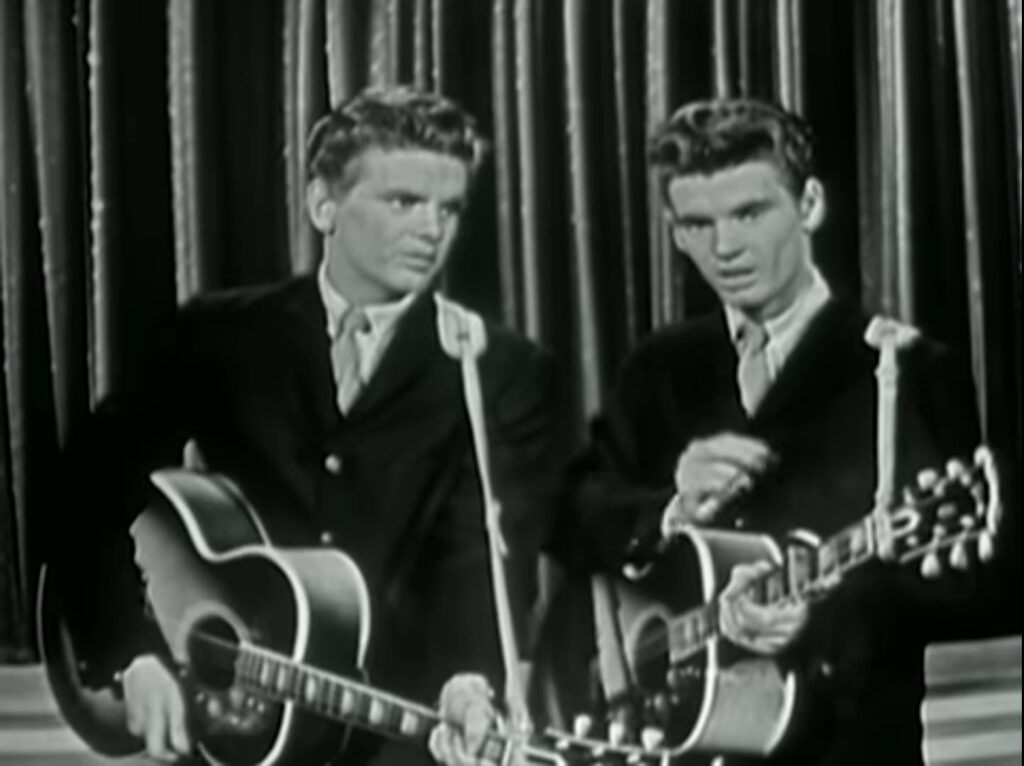
In the early years of American television, few stages carried as much cultural weight as The Ed Sullivan Show, where emerging sounds met living room audiences across the nation. When The Everly Brothers stepped into that spotlight to perform “Be-Bop-A-Lula”, they were not merely revisiting a rockabilly standard made famous by Gene Vincent in 1956. They were reframing it through their own unmistakable vocal blend, softening its rough edges while preserving its youthful pulse.
Originally released as a defining rock and roll single, “Be-Bop-A-Lula” had already secured its place in music history. By the time The Everly Brothers brought it to television, their careers were built on tight harmonies and crossover appeal, bridging country roots with pop sensibility. Their interpretation leaned less on swagger and more on melodic clarity, allowing the song’s simple declaration of affection to resonate with a different kind of sincerity.
The performance itself unfolded with an effortless charm. From the opening line, their voices locked together with precision, turning repetition into something hypnotic rather than redundant. Lines like “she’s my baby” and “I don’t mean maybe” carried a warmth that felt conversational, almost intimate, despite the national broadcast setting. The arrangement remained faithful to the original structure, yet the emotional tone shifted. Where Gene Vincent projected rebellious energy, The Everly Brothers offered reassurance and romantic steadiness.
Audience response, captured in the closing applause, reflected more than appreciation for a familiar tune. It spoke to a broader moment in entertainment history, when television served as a conduit between generations and musical styles. Performances like this allowed songs rooted in youthful rebellion to evolve into shared cultural memory, accessible to families gathered around a single screen.
Looking back, this rendition of “Be-Bop-A-Lula” stands as a subtle but meaningful reinterpretation. It illustrates how great songs endure not only through originality but through adaptation. In the hands of The Everly Brothers, a rock and roll anthem became something gentler yet no less enduring, echoing across time with the same simple promise carried in its chorus.