
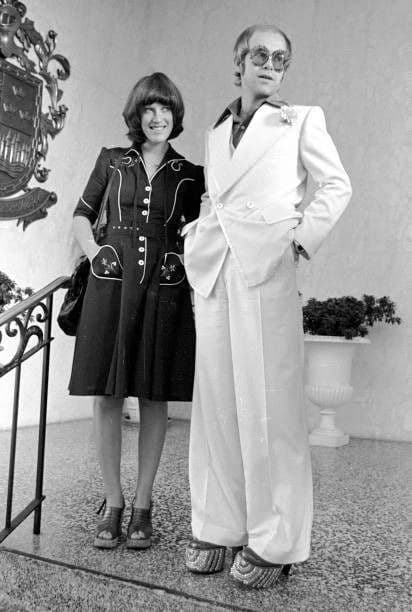
A tender revival of timeless romance—“True Love” reminds us that even the most classic sentiments can feel new again when sung with sincerity and grace.
Released in 1993 as part of the album Duets, “True Love” by Elton John and Kiki Dee is a delicate reimagining of a song first made famous by Bing Crosby and Grace Kelly in the 1956 musical film High Society. From the very beginning, the track carried with it a sense of nostalgia—yet in the hands of Elton John and Kiki Dee, it was not merely a revival, but a gentle resurrection of a bygone elegance. Upon its release, the single achieved notable success, reaching No. 2 on the UK Singles Chart and earning a Grammy nomination for Best Pop Collaboration with Vocals—an affirmation that even in the early 1990s, there remained a deep longing for songs that spoke plainly and honestly of love.
What makes “True Love” particularly special is not just its melodic charm, but the reunion it represents. Elton John and Kiki Dee had already etched their names into pop history with the spirited 1976 hit “Don’t Go Breaking My Heart.” That earlier duet sparkled with youthful exuberance, full of playful energy and irresistible hooks. But “True Love” finds them in a different emotional landscape—more reflective, more restrained, yet perhaps more profound. Their voices, matured by time, blend with a quiet intimacy that feels almost conversational, as though two old friends are reminiscing about something precious they’ve both come to understand more deeply.
The song itself, originally written by Cole Porter, is deceptively simple. Its lyrics speak of devotion without complication—no grand metaphors, no dramatic heartbreak, just a steady, unwavering affirmation of love’s purity. In a musical era increasingly dominated by electronic production and shifting trends, Elton John made a deliberate choice to preserve the song’s classic orchestration. The arrangement leans gently on soft strings and subtle piano, allowing the vocals to remain at the forefront. It is a sound that feels almost untouched by time, evoking memories of candlelit evenings, vinyl records spinning quietly, and a slower, more deliberate pace of life.
There is also something deeply human in the way Kiki Dee delivers her lines. Her voice carries a warmth that complements Elton’s slightly wistful tone, creating a balance that feels both comforting and sincere. Together, they do not try to reinvent the song; instead, they honor it. And in doing so, they remind us that sometimes the most powerful interpretations are those that resist the urge to overcomplicate.
Behind the scenes, Duets was a project born out of collaboration and reflection for Elton John. By the early 1990s, he had already lived through decades of extraordinary success, personal struggles, and artistic reinvention. This album, filled with partnerships across genres and generations, felt like a gathering of voices—a celebration of connection. Within that context, “True Love” stands out as one of its most emotionally resonant moments, precisely because of its simplicity.
The enduring meaning of “True Love” lies in its quiet assurance. It does not shout or demand attention; it simply exists, steady and unwavering. In a world that often feels hurried and uncertain, the song offers a gentle reminder of something constant—something that does not fade with time or fashion. Listening to it now, one might find themselves transported not just to the early 1990s, but further back still, to an era when love songs were written as promises rather than declarations.
And perhaps that is why “True Love” continues to resonate. It is not merely a duet between two accomplished artists; it is a conversation across generations, a bridge between past and present. In its soft harmonies and unadorned lyrics, it carries the echo of countless memories—moments that may have passed, but are never truly lost.