
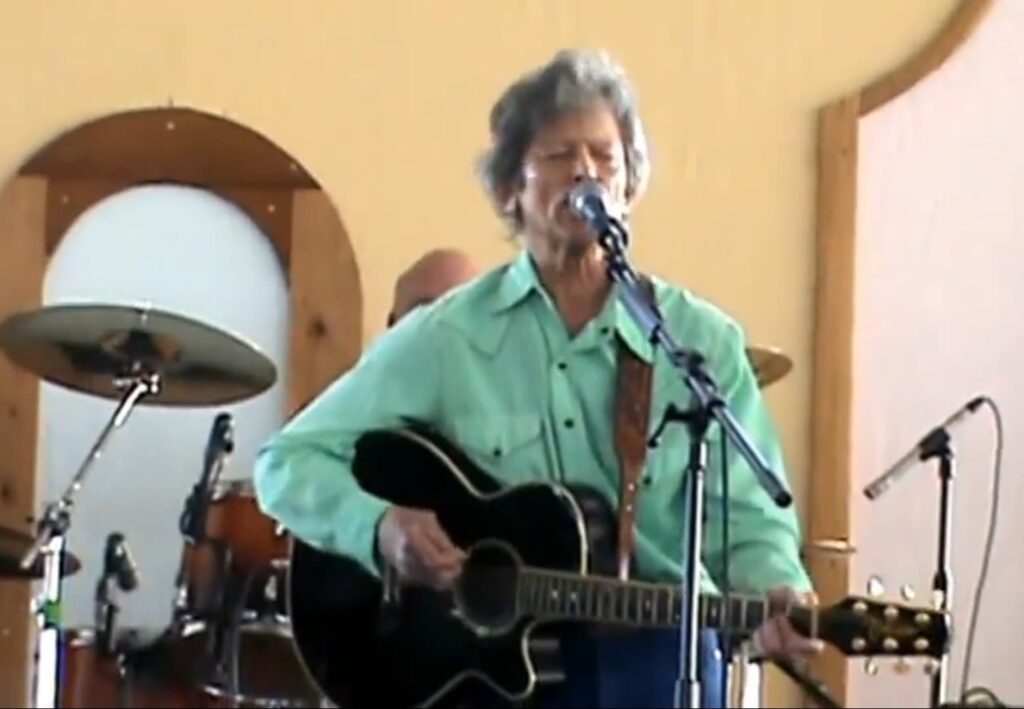
By 2014, Johnny Rodriguez Wasn’t Singing About Heartbreak Anymore. He Was Remembering It.
At Trader’s Village in San Antonio, “How Could I Love Her So Much” no longer sounded like a young man’s sorrow. It sounded like a lifetime trying to understand the past.
When Johnny Rodriguez stepped onto the stage at Trader’s Village in San Antonio in January 2014, there was nothing glamorous about the setting. No massive arena lights. No carefully choreographed production. Just a modest open-air stage, a close Texas crowd, and one of classic country music’s most quietly influential voices standing before people who had likely carried these songs with them for decades.
That simplicity became the performance’s greatest strength.
Because “How Could I Love Her So Much” did not need spectacle to hurt.
Originally, the song carried the familiar ache of traditional country heartbreak. In the hands of a younger singer, the lyrics might sound filled with fresh wounds, romantic confusion, or emotional desperation. But by 2014, Johnny Rodriguez sang the song differently. Age had transformed its meaning.
Now it sounded reflective.
Almost philosophical.
The title itself no longer felt like a complaint directed at a lost lover. It sounded more like a man quietly questioning his own past:
“How could I love her so much…”
Not with anger.
Not even with regret.
But with the strange disbelief that arrives when enough years have passed and memories begin to feel like another lifetime entirely.
That emotional shift is what makes the performance so moving. Johnny Rodriguez does not oversell the pain. He never turns the song into dramatic theater. Instead, he sings with the calm weariness of someone who has lived long enough to understand that heartbreak rarely disappears completely. It simply grows older alongside the people carrying it.
And his voice tells that story beautifully.
By 2014, Johnny’s vocals no longer possessed the youthful smoothness that helped make him one of Nashville’s most successful country stars during the 1970s. Time had added roughness, fatigue, and weathered texture. But rather than weakening the song, those imperfections made every lyric more believable. When he stretches certain phrases or slightly lingers behind the beat, it feels less like performance technique and more like memory interrupting the music.
Those moments hit especially hard for longtime country audiences because Johnny Rodriguez always brought a different emotional quality to traditional country music. Unlike the heavier anguish of artists such as George Jones or the hard-edged realism of Merle Haggard, Rodriguez often carried a softer loneliness in his voice. His Texas roots and subtle Tex-Mex influences gave his phrasing warmth and vulnerability that set him apart inside Nashville.
And historically, his importance reaches far beyond this performance.
Johnny Rodriguez became one of the first major Hispanic stars to break through in mainstream country music during the early 1970s. At a time when Nashville remained deeply traditional and culturally narrow, Rodriguez quietly opened doors simply by succeeding on his own terms. He never seemed interested in forcing attention toward himself. He simply sang with honesty and allowed the songs to connect naturally.
That honesty still fills the Trader’s Village performance.
The setting itself adds another layer of emotion. The relaxed crowd, the daylight atmosphere, the community feeling of the venue. Everything about it recalls an earlier era when country music still belonged primarily to ordinary people gathering together rather than massive entertainment industries chasing spectacle.