
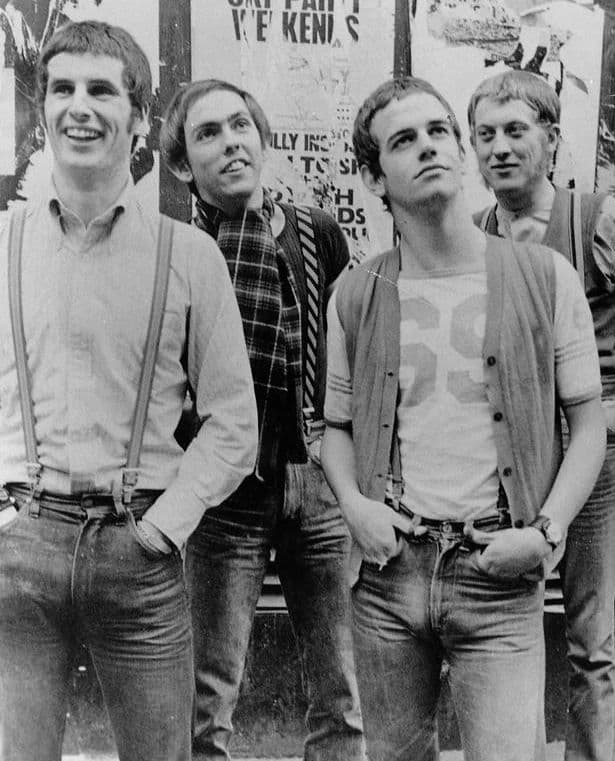
A raw beginning before the glory — when Slade were still searching for their true voice and identity
Long before the thunderous stomps of “Cum On Feel the Noize” or the glitter-drenched triumphs that would define an era, there was a very different version of Slade—a band still in formation, still experimenting, and still carrying the rough edges of late-1960s British youth culture. Their early television appearance in 1969, often remembered under the name Skinhead Slade, captures a fleeting but fascinating moment in rock history—one that many listeners today revisit with a mixture of curiosity and deep nostalgia.
At that time, the group had not yet achieved chart success. In fact, their debut album Beginnings (released in 1969) failed to chart significantly in the UK, and their singles from this period did not make an impact on the major charts either. Commercially, they were still unknown. But artistically, something was quietly taking shape beneath the surface.
The “Skinhead” image they briefly adopted was not merely a gimmick, but a reflection of a specific working-class subculture in Britain during the late 1960s. Managed by Chas Chandler, who had previously guided Jimi Hendrix to fame, the band was encouraged to embrace this tough, street-level identity in hopes of standing out in a crowded music scene. Boots, cropped hair, braces—this was a far cry from the flamboyant glam rock aesthetic they would later perfect.
Watching that early TV performance today, one cannot help but notice the rawness. Noddy Holder’s voice, even then, carried that unmistakable grit—powerful, unpolished, and deeply human. The band played with urgency rather than precision, driven more by instinct than refinement. There is a certain honesty in that performance, a sense that they had not yet learned how to “perform” in the polished sense, but were simply playing as they felt.
What makes this moment particularly meaningful is the contrast it provides to what came later. Within just a few years, Slade would reinvent themselves, shedding the skinhead image and stepping boldly into glam rock. By 1971–1972, with hits like “Get Down and Get With It” (UK No. 16) and “Coz I Luv You” (UK No. 1), they had found both their sound and their audience. But in 1969, none of that was guaranteed.
The story behind this early appearance is, in many ways, a story about trial and error—about a band willing to experiment, even at the risk of failure. It reminds us that success in music is rarely immediate. Behind every chart-topping anthem lies a period of uncertainty, of missed opportunities, and of quiet perseverance.
There is also something deeply evocative about revisiting such footage today. For those who remember the late 1960s, it brings back the texture of the era—the transition from mod culture to something grittier, more grounded. For others, it offers a glimpse into a world where rock music was still evolving, still finding its language.
Perhaps the most poignant aspect of this early Slade moment is how unaware they were of their future. They could not have known that they would go on to become one of Britain’s most beloved rock bands, shaping the sound of the early 1970s and influencing generations to come. In 1969, they were simply four young men trying to be heard.
And yet, listening closely, you can already hear it—the beginnings of that unmistakable Slade spirit. The loudness. The defiance. The sense of joy buried beneath the rough exterior.
It is not a polished memory, nor a triumphant one. But it is an honest one. And sometimes, it is these early, imperfect chapters that resonate the longest, because they remind us not of what was achieved—but of how it all began.