
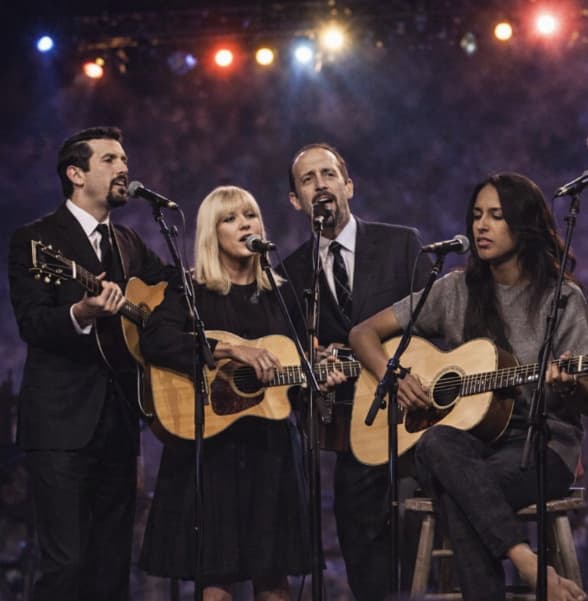
A timeless question carried on the wind—how truth, justice, and freedom echo through “Blowin’ in the Wind”
Few songs in modern history have carried such quiet authority and enduring resonance as “Blowin’ in the Wind”, written by Bob Dylan in 1962 and released on his 1963 album The Freewheelin’ Bob Dylan. Though Dylan’s original version did not storm the commercial charts upon its release, the song found its wider audience when Peter, Paul and Mary recorded it later in 1963. Their rendition climbed to No. 2 on the Billboard Hot 100, becoming one of the defining anthems of its era. In time, the song would be embraced and performed by voices like Joan Baez, The Freedom Singers, and Pete Seeger, each adding their own emotional shading to its universal message.
The origins of the song are deceptively simple. Bob Dylan, still in his early twenties, was deeply immersed in the American folk tradition, drawing inspiration from older spirituals and protest songs. It is widely acknowledged that the melody was influenced by the African American spiritual “No More Auction Block,” a song rooted in the painful history of slavery. From this foundation, Dylan crafted lyrics that did not shout slogans, but instead posed questions—gentle, persistent, and impossible to ignore.
“How many roads must a man walk down…”—the opening line feels less like a statement and more like an invitation to reflect. The song never offers direct answers. Instead, it leaves them “blowin’ in the wind,” a phrase that has since entered the cultural lexicon. This poetic ambiguity is precisely what gives the song its enduring power. It speaks not only to the civil rights struggles of the early 1960s, but to every generation that finds itself searching for fairness, peace, and understanding.
When Peter, Paul and Mary brought the song into the mainstream, their clean harmonies and measured delivery made it accessible to a broader audience. Their version became a staple on radio stations and helped cement the song’s place in popular culture. At the same time, artists like Joan Baez carried it onto the stages of rallies and protests, where its questions took on a more immediate urgency. Meanwhile, The Freedom Singers, closely tied to the civil rights movement, infused the song with a communal spirit that echoed through churches and gatherings across America.
There is something remarkable about how “Blowin’ in the Wind” avoids anger while still confronting injustice. It does not accuse; it asks. It does not dictate; it wonders. And in doing so, it allows each listener to arrive at their own understanding. Perhaps that is why the song has never felt confined to a single moment in history. Its questions remain as relevant today as they were in 1963.
Behind its gentle melody lies a quiet courage. Bob Dylan was not merely writing a song—he was capturing a mood, a turning point, a collective longing for something better. The early 1960s were a time of change, uncertainty, and hope, and this song became a kind of compass, pointing not toward easy answers, but toward deeper reflection.
Over the decades, countless artists have revisited “Blowin’ in the Wind”, each interpretation adding another layer to its legacy. Yet the essence of the song remains untouched. It is still a conversation between the singer and the listener, between the past and the present.
Listening to it now, one cannot help but feel a sense of quiet nostalgia—not just for a particular era, but for a time when music carried the weight of questions that truly mattered. The wind, after all, has not stopped blowing. And the answers, as ever, are still out there—waiting to be heard by those willing to listen.