
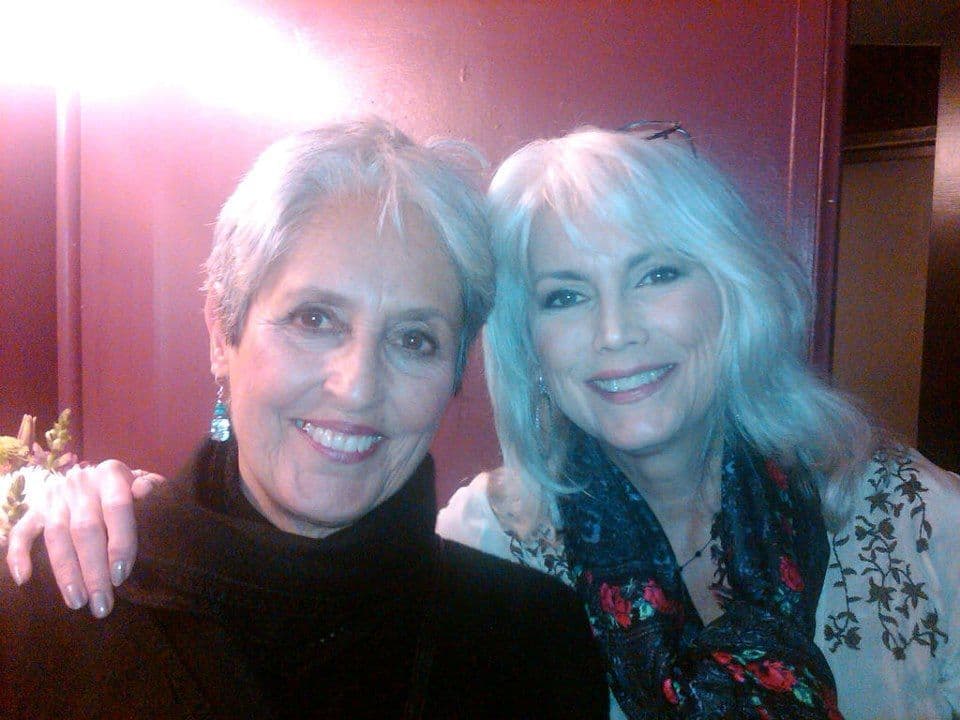
A Timeless Plea for Compassion in Difficult Times, Reimagined by Two Voices of American Folk Tradition
A reflective revival of “Hard Times Come Again No More”, where Joan Baez and Emmylou Harris breathe new emotional depth into a 19th-century lament about hardship, memory, and human endurance.
When Joan Baez and Emmylou Harris came together in a 2016 live performance to sing “Hard Times Come Again No More”, they were not simply revisiting an old folk standard—they were reopening a historical wound that has never truly healed. Written in 1854 by American composer Stephen Foster, the song has long existed outside the boundaries of conventional chart history. It did not debut on any modern commercial chart upon its 2016 performance, nor does it belong to the competitive landscape of pop rankings. Instead, its “chart position,” if one can call it that, lives in a far more enduring place: within the collective memory of folk tradition, where songs are measured not in sales or rankings, but in longevity, resonance, and emotional truth.
The performance itself feels like a quiet conversation between two eras of American music. “Hard Times Come Again No More” has always carried a sense of sorrowful dignity, but in the voices of Joan Baez and Emmylou Harris, that dignity becomes almost sacred. Baez, with her crystalline clarity and decades of protest-song heritage, brings an air of solemn witnessing—as if she has seen too much of the world’s suffering to sing it any other way than truthfully. Harris, whose voice often feels like a soft wind moving through forgotten landscapes, adds a fragile warmth that softens the edges of despair without ever denying its existence.
What makes this 2016 rendition so powerful is not technical reinvention, but emotional alignment. The song itself was originally written during a period of intense social and economic struggle in the United States, yet its message transcends its time of origin. It speaks to laborers, families, migrants, and anyone who has ever felt the weight of survival pressing heavily upon daily life. In this live performance, that historical context feels startlingly present again. The lyrics—pleading for relief from suffering—echo across centuries with unsettling relevance, as though the song has been quietly waiting for voices like theirs to carry it forward once more.
There is something profoundly reflective about hearing Joan Baez and Emmylou Harris together. Their collaboration does not rely on spectacle or arrangement complexity. Instead, it rests on restraint. Every phrase feels carefully held, as if the singers understand that too much ornament would diminish the honesty of the message. The silence between the lines becomes as important as the notes themselves. In those pauses, listeners are invited to reflect on their own understanding of “hard times”—not as abstract history, but as lived experience, passed down through generations.
The emotional gravity of the performance also lies in its absence of resolution. The song does not promise that hardship will disappear; instead, it offers a quiet wish that suffering might ease, even briefly, for those burdened by it. That humility is perhaps why “Hard Times Come Again No More” has endured for more than a century and a half. It does not age because human difficulty does not age. Each generation finds new reasons to understand its plea.
For listeners familiar with the long careers of Joan Baez and Emmylou Harris, this duet also feels like a meeting point of legacies. Baez, a defining voice of the American folk revival and protest movement, and Harris, a bridge between country, folk, and Americana storytelling, represent two complementary traditions of musical honesty. Their collaboration in 2016 is less about revisiting the past than about reaffirming continuity—that music rooted in truth does not fade; it simply changes voices.
In the end, the performance leaves behind a lingering stillness. It does not demand applause so much as reflection. It asks the listener to sit with the idea that “hard times” are not anomalies in human history, but recurring chapters in an ongoing story. And yet, within that recognition, there is also comfort: as long as there are voices willing to sing these truths—voices like Joan Baez and Emmylou Harris—there will also be understanding, remembrance, and a quiet hope that compassion might someday ease the burden.
 Oldies Songs