
When Harmony Becomes Memory: Phil Everly Looks Back on a Sound That Shaped a Generation
In a warm and quietly revealing television moment, Phil Everly sits down with Dutch host Willem Duijs, revisiting not only a remarkable career but an entire era of popular music shaped by The Everly Brothers. By the time of this interview, the music had already traveled far beyond its American roots, finding devoted audiences across Europe, including the Netherlands, where harmony-driven duos like the Blue Diamonds carried echoes of that unmistakable Everly sound.
What makes this conversation especially moving is not the statistics, though they are staggering. Thirty-two million records sold in just three years is the kind of success that belongs to myth more than memory. Yet Phil speaks of it with a kind of gentle detachment, almost as if the numbers matter less than the experience itself. There is gratitude in his voice, a sincere acknowledgment of the listeners who made that journey possible, and a quiet pride in having been part of something so enduring.
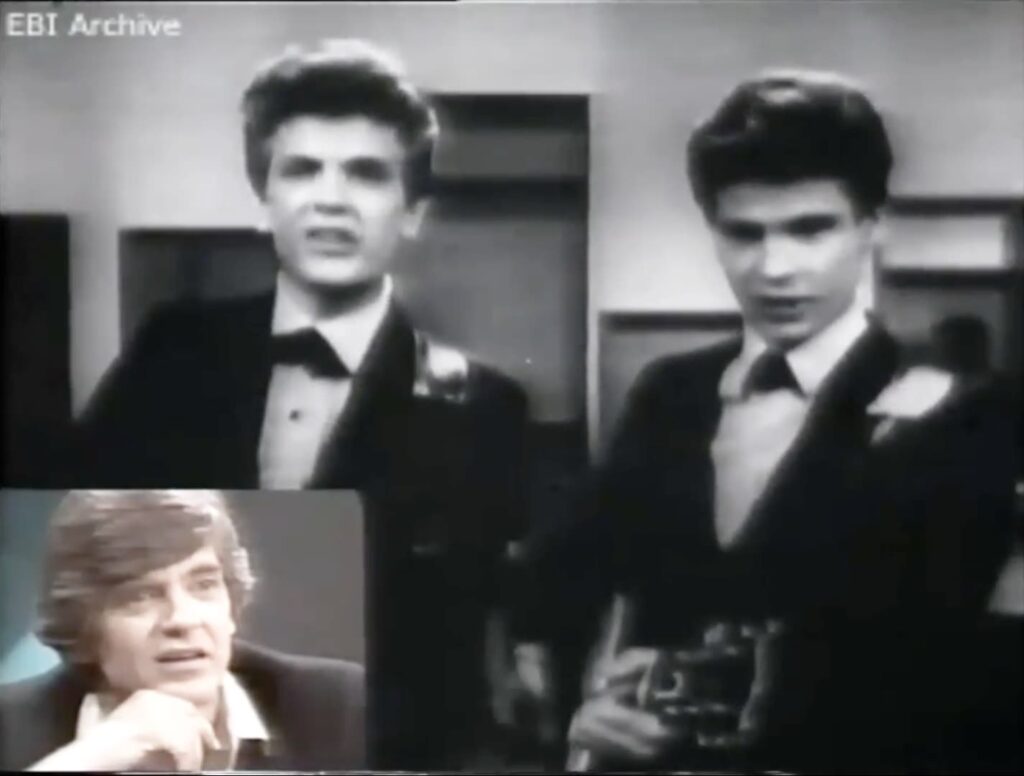
The true highlight comes when he is shown archival footage of performances like “Walk Right Back”, and for a moment, time folds in on itself. Watching his younger self, Phil reacts not with vanity, but with curiosity and a touch of humor. He notices the high harmonies he once carried so effortlessly, the youthful energy, even the height his hair seemed to add. There is a subtle astonishment in his tone, as if he too is discovering that voice again from a distance.
In describing the musical foundation of The Everly Brothers, Phil points to their upbringing in country music. That influence, he explains, shaped the melodic clarity and emotional accessibility that set their records apart from the harder edges of early rock. It is a crucial observation. Their music did not shout for attention. It invited listeners in, wrapped in close harmonies that felt both intimate and universal.
Perhaps the most revealing moments come when he speaks about his brother, Don. There is humility there, almost disarming in its honesty. Phil credits Don as the anchor, the one he watched for cues, the one who guided the structure of their performances. It is a reminder that behind the seamless blend of voices was a relationship built on trust, instinct, and years of shared experience that began in childhood.
Even when touching on the eventual separation of the duo, Phil remains measured. He does not dwell on conflict, choosing instead to acknowledge the length and depth of their collaboration. More than thirty years of making music together is no small thing. It is, in itself, a lifetime.
By the end of the conversation, what lingers is not just the legacy of hit songs, but the humanity behind them. Phil Everly does not present himself as a legend, though history clearly does. He appears instead as a man looking back with quiet appreciation, aware that the harmonies he once sang have become something larger than himself. They have become memory, shared and carried forward by those who still hear them, even now.