
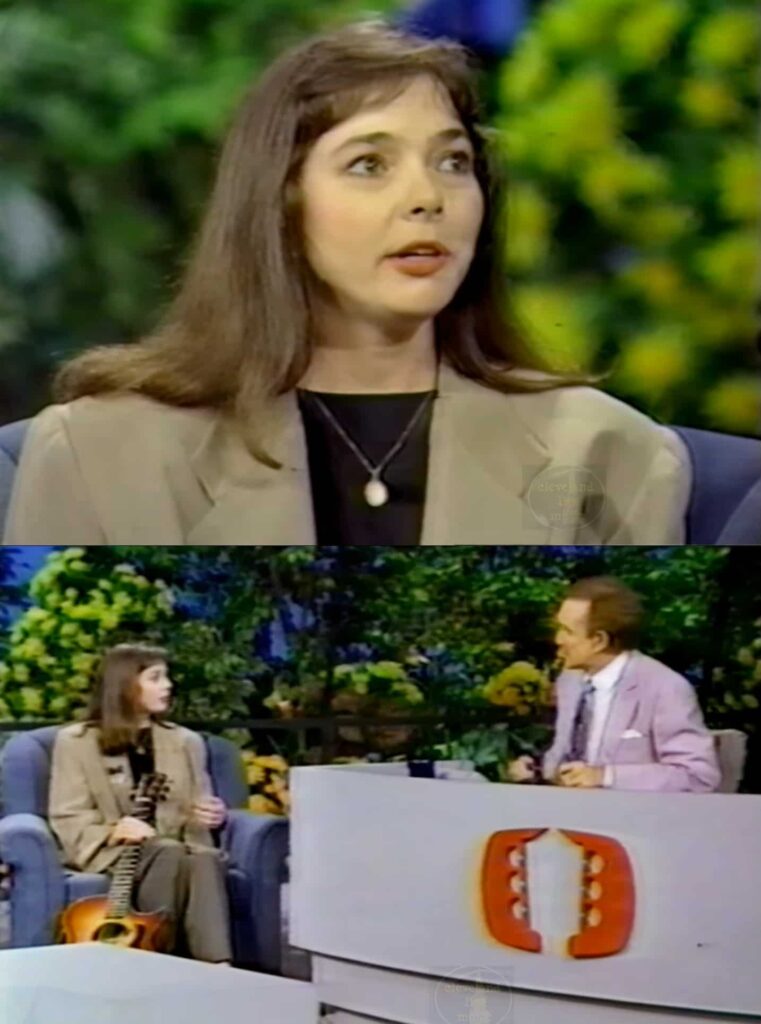
A Quiet Evening in Nashville Where A Songwriter Spoke Softly and Let Her Truth Be Enough
On June 14, 1990, Nanci Griffith appeared on the live television program Nashville Now, hosted by the ever-charismatic Ralph Emery, with Lorrie Morgan sharing the couch. It was not a performance built on spectacle or grand staging, but rather a gentle, revealing conversation that allowed viewers to see Griffith as she truly was: thoughtful, humble, and deeply rooted in the art of storytelling. For audiences who grew up with traditional country and folk music, this moment feels like a return to a quieter era, when an artist’s voice and words carried more weight than any production could.
From the very beginning, there was a warmth in the way Ralph Emery spoke to her. His admiration was unmistakable, not in a loud or exaggerated way, but in the careful attention he gave to her answers and the respect he showed her craft. Nanci Griffith, in turn, responded with a soft-spoken honesty that made the entire exchange feel personal, almost as if it were taking place in a living room rather than on national television.
What stood out most during the interview was Griffith’s self-awareness. When asked about her musical identity, she famously described herself as “Hines 57,” a blend of styles that refused to fit neatly into one category. Folk, country, pop, all of it lived inside her music. Yet when pressed on how she wished to be perceived, her answer was disarmingly simple. She wanted to be known as a songwriter. That answer alone tells you everything about her priorities. Fame was secondary. The song was always first.
Her reflections on “Love at the Five and Dime”, a piece she wrote and that later became a defining hit for Kathy Mattea, revealed the quiet, almost accidental nature of her success. It was born from a short story she had written years earlier, shaped out of necessity for a workshop, and then carried into the world by chance. There was no sense of calculation in the way she told the story. Only gratitude, and perhaps a hint of disbelief that something so personal could resonate so widely.
The conversation also drifted into her musical upbringing, where she credited her father and the harmonies of The Everly Brothers for shaping her voice. There was a tenderness in the way she spoke about family, especially when her father appeared and expressed his pride. It reminded viewers that behind every artist is a long road of quiet encouragement and unseen sacrifices.
Looking back now, this appearance captures Nanci Griffith at a moment when her career was blossoming, yet her spirit remained unchanged. There is no trace of ego here. Only a woman who understood the power of a well-written song and trusted it to find its way into people’s lives. For those who remember that era, it feels less like an interview and more like a memory gently revisited.