
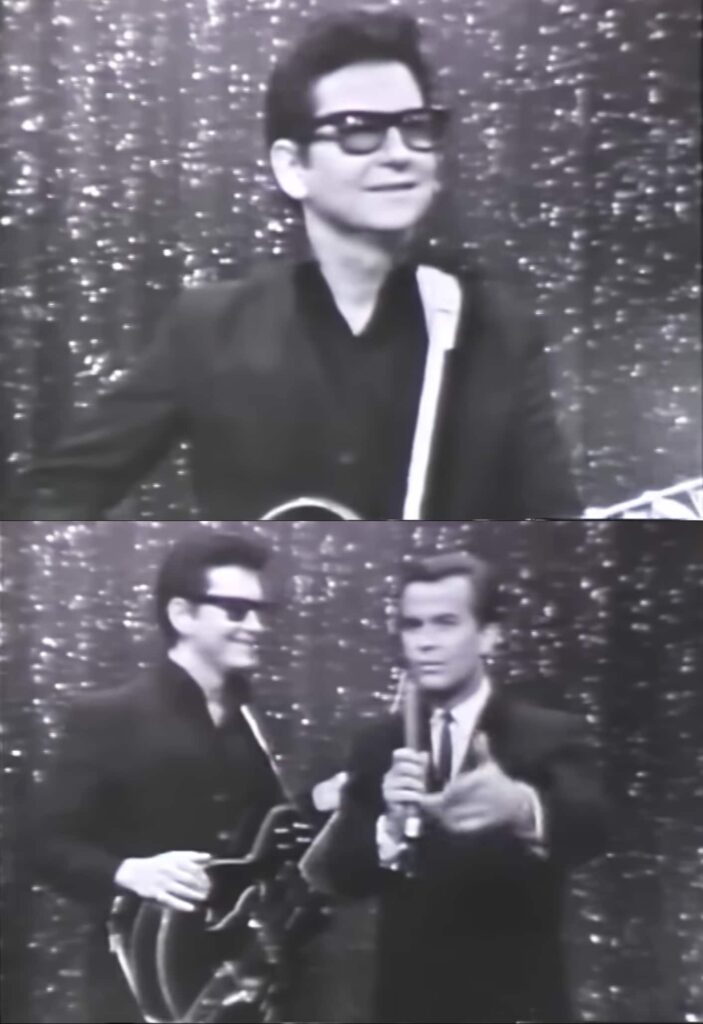
A Timeless Encounter Between Desire and Innocence on a Television Stage
On June 5, 1966, American television audiences witnessed a moment that felt both effortless and unforgettable when Roy Orbison appeared on American Bandstand, hosted by the ever-gracious Dick Clark. By that time, Orbison was already a towering figure in popular music, with a string of hits that had defined the early 1960s. Yet, among all those songs, one stood above the rest in capturing both his mystique and his emotional clarity: “Oh, Pretty Woman”. Originally released in 1964 as a standalone single, the song had already climbed to No. 1 on the Billboard Hot 100, becoming one of the most recognizable recordings of its era.
What makes this televised performance so enduring is not spectacle, but restraint. Orbison did not move much. He rarely needed to. Standing there in his signature dark suit and sunglasses, he allowed the song itself to carry the weight of the moment. His voice, rich and unwavering, moved through the lyrics with a kind of quiet authority that few singers could command. For older listeners especially, there is something deeply familiar in that delivery. It recalls a time when charisma did not require excess, and emotion did not need to be exaggerated.
“Oh, Pretty Woman” begins with a simple, almost conversational observation, a man noticing a woman walking down the street. But as the song unfolds, it reveals something more vulnerable beneath its catchy rhythm. There is admiration, certainly, but also doubt and longing. Lines like “I don’t believe you, you’re not the truth” carry a subtle ache, suggesting that beauty can sometimes feel too distant to be real. Orbison had a unique ability to balance strength and fragility within the same breath, and this performance captures that duality perfectly.
The setting of American Bandstand adds another layer of nostalgia. In the 1960s, the show was more than just a platform for music. It was a weekly ritual for young Americans, a place where new sounds met familiar faces. Seeing Roy Orbison there, delivering “Oh, Pretty Woman” with such calm confidence, felt like witnessing a bridge between generations. He was not chasing trends. He was defining something lasting.
And then comes the quiet charm of the ending. As the song resolves with the woman turning back, there is a sense of gentle optimism. Not triumph, not grand romance, but a small, human victory. Decades later, that feeling still lingers. For those who remember that era, this performance is not just a song on television. It is a memory of a simpler moment, when music spoke softly, yet stayed with you for a lifetime.