
When a Quiet Voice Turned Fierce and Reminded the World He Never Lost His Fire
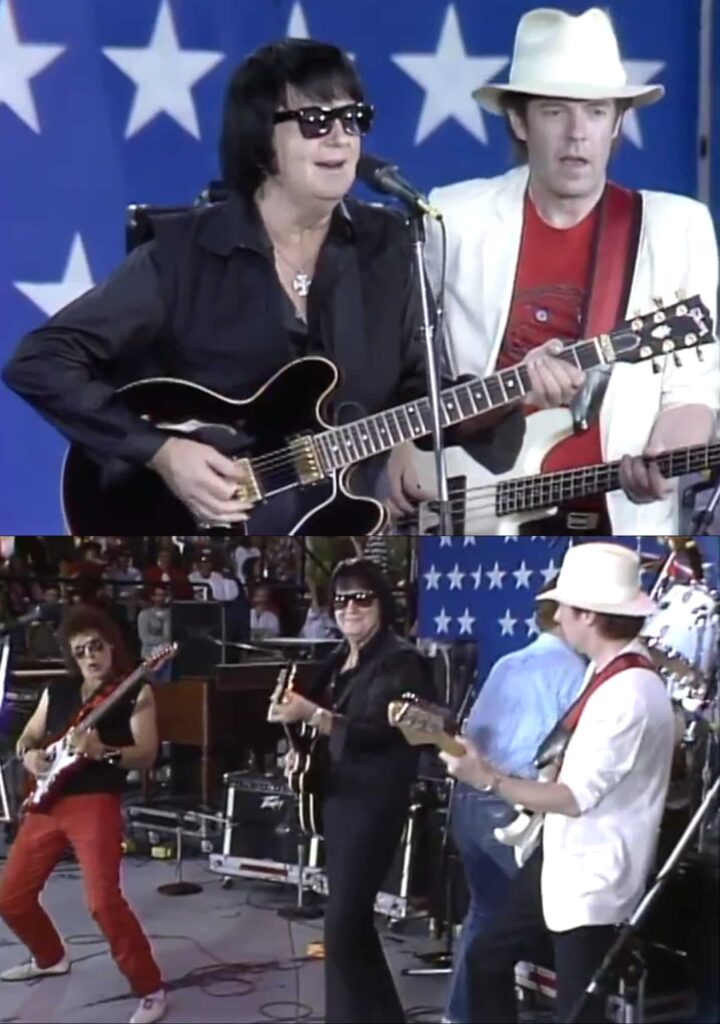
On September 22, 1985, at the Farm Aid concert in Champaign, Illinois, Roy Orbison stepped onto the stage and delivered a performance of “Mean Woman Blues” that felt both unexpected and deeply satisfying. Known to many as the master of heartbreak ballads, the man behind songs filled with longing and vulnerability, Orbison chose instead to revisit one of his earliest, most energetic recordings. The result was a moment that reminded audiences that beneath the dark glasses and still posture lived a performer with a powerful sense of rhythm and drive.
Originally recorded in the mid 1950s during his time at Sun Records, “Mean Woman Blues” carried the raw spirit of early rock and roll. By the time Orbison performed it at Farm Aid, nearly three decades had passed. The music world had changed, audiences had changed, and Orbison himself had endured personal and professional hardships that would have silenced a lesser artist. Yet here he stood, not trying to reclaim youth, but simply stepping back into a sound that had always belonged to him.
What makes this performance striking is the contrast. Orbison does not move much. He rarely did. There are no dramatic gestures, no attempts to dominate the stage physically. Instead, everything comes through the voice. And when he leans into the rhythm of “Mean Woman Blues”, there is a controlled intensity that builds line by line. His phrasing is tight, his timing precise, and there is a subtle grit that was not always present in his more polished recordings.
For listeners who had come to associate Roy Orbison with songs like “Crying” or “Only the Lonely,” this performance offered a fuller picture of the artist. It revealed his roots, his connection to the early days of rock and roll when the music was simpler, sharper, and driven by instinct rather than arrangement. You can hear echoes of that era in every note, yet it never feels dated. Instead, it feels grounded.
There is also something quietly defiant about this moment. By 1985, Orbison was not always at the center of popular conversation. But performances like this made it clear that his voice had not faded, and his musical identity had not been diluted. He did not need to reinvent himself. He simply needed a stage and a song that allowed him to remind people of where he came from.
In the end, “Mean Woman Blues” at Farm Aid is more than a performance. It is a reaffirmation. A reminder that great artists do not lose their essence with time. They carry it with them, waiting for the right moment to let it rise again. And on that night in Illinois, Roy Orbison did exactly that.