
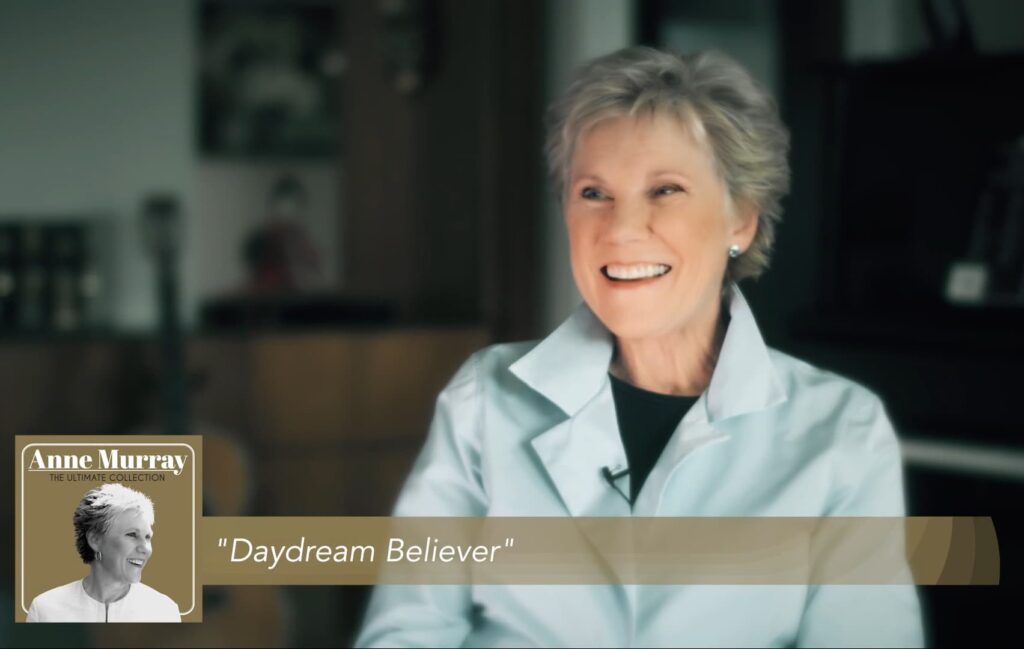
A Song She Borrowed Lightly, Only to Make It Her Own
There is something quietly remarkable about the way Anne Murray came to record “Daydream Believer”, a song forever associated with The Monkees and their bright, late-1960s optimism. In her own recollection, there was no grand plan, no calculated attempt to reinterpret a well-known hit. Instead, it began in 1968, when the song was already sitting comfortably at number one, echoing across radios and television screens. At the time, Murray was hosting the Canadian television program Let’s Go, a show built around performing the popular songs of the day. Like many young artists finding their footing, she sang what people loved. And she loved this song.
What stands out in her memory is how natural it felt. “Daydream Believer” was not chosen because it fit a strategy. It simply stayed with her. Years later, when Anne Murray began working closely with producer Brian Ahern on her albums, they often included what she casually calls “an oldie”. A familiar tune, something audiences might recognize, but filtered through her own voice. When the time came to choose one, this song returned to her almost instinctively.
She admits, with a kind of gentle honesty that defines much of her career, that she never expected it to become a hit again. And perhaps that is precisely why it worked. There is no sense of pressure in her version, no attempt to compete with the original. Instead, she leans into what she does best. A warm, grounded delivery that feels closer to conversation than performance. Where The Monkees gave the song a youthful brightness, Murray offers something steadier, more reflective, without losing its sense of joy.
Listening now, her version carries a different kind of nostalgia. Not just for the late 1960s, but for the era when songs could travel between artists, picking up new shades of meaning along the way. It reminds us that music does not belong to a single voice. It evolves, quietly, through those who choose to sing it.
For Anne Murray, “Daydream Believer” was never meant to be a defining statement. It was simply a song she liked, one she remembered, one she carried with her. And in the end, that unassuming choice became part of her own enduring story.