
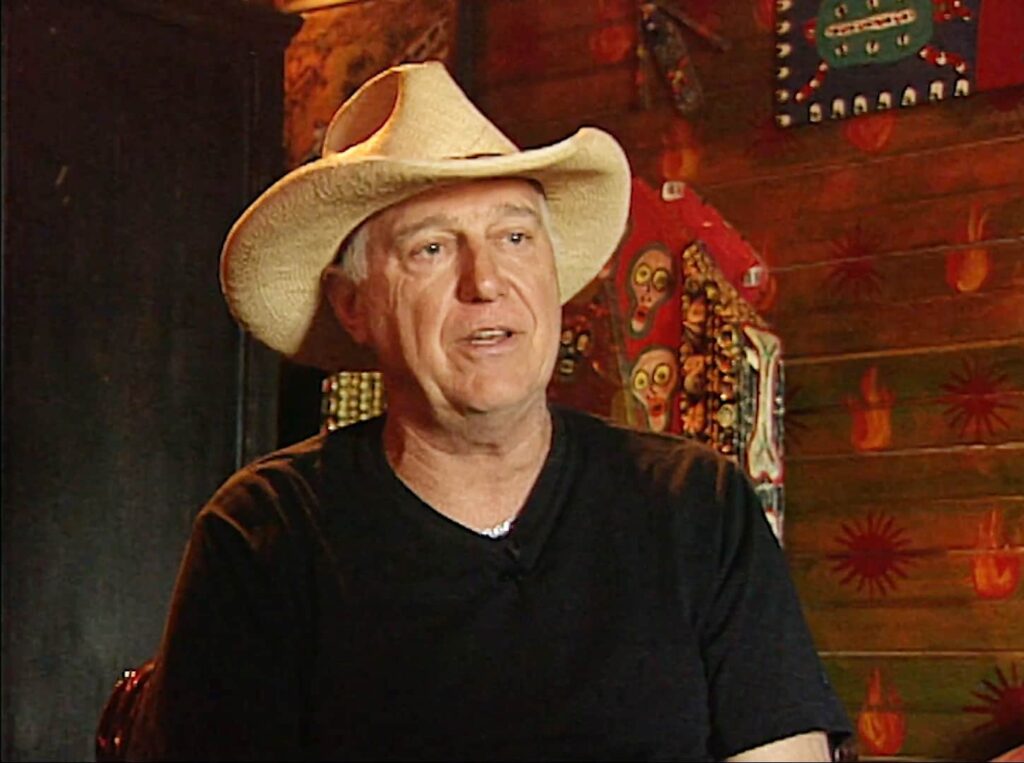
A Life Lived Between Highways and Songs, Where Freedom Meant Everything
In the year 2000, Jerry Jeff Walker sat down for an intimate conversation in what feels less like an interview and more like a fireside recollection of a life spent chasing songs across America. By that point, Walker was already a revered figure in the outlaw country and folk traditions, best known for writing “Mr. Bojangles”, a song that had long since passed into the fabric of American music. Yet what emerges most clearly in this interview is not the weight of his accomplishments, but the philosophy that guided him through decades of wandering, performing, and storytelling.
From the very beginning, Jerry Jeff Walker makes it clear that his career was never driven by ambition in the conventional sense. He did not set out to become famous. As a teenager in upstate New York, he simply wanted to leave. There is something almost timeless in that impulse. The need to see what lies beyond the horizon. He speaks of hitchhiking south, of landing in New Orleans in the early 1960s, where he learned as much from the streets as he ever would from a stage. It was there that he met the bluesman Babe Stovall, a figure who, in Walker’s telling, offered not just musical guidance, but a philosophy of living. You play when you need to. You leave when it feels right. You do not ride the moment to exhaustion.
That sense of freedom becomes the thread that ties his entire life together. Even at the height of his recognition, Walker resisted the machinery of the music industry. While others measured success in record sales and radio play, he measured it in miles traveled, songs written, and nights spent in honest connection with an audience. His move to Austin, Texas in the early 1970s proved pivotal. At the time, it was a city alive with possibility, inexpensive, unpolished, and filled with listeners who valued authenticity over image. There, Walker found not just a home, but a creative ecosystem that allowed him to write about real people and real lives. Bootmakers, bartenders, friends, family. The details that make a place breathe.
He does not romanticize everything. There are candid acknowledgments of excess, of years spent partying hard and living fast. By the late 1970s, he reached a turning point. A moment of reckoning shaped by personal responsibility, fatherhood, and the quiet realization that something had to change. What followed was not a reinvention, but a return. Stripping things back to just a guitar, a harmonica, and the truth of a song. In smaller rooms, closer to the audience, he rediscovered the clarity that had first set him on this path.
Perhaps most striking is his forward-thinking view of music itself. Even in 2000, Jerry Jeff Walker speaks about the internet as a space where songs could move freely, where listeners could choose what they love without interference. It is a perspective rooted in the same belief that guided him as a young street performer. Music belongs to the people who hear it.
Listening to him now, there is a quiet consistency in everything he says. Decades may have passed, trends may have shifted, but the core remains unchanged. A man with a guitar, a story to tell, and the understanding that the journey itself was always the destination.