
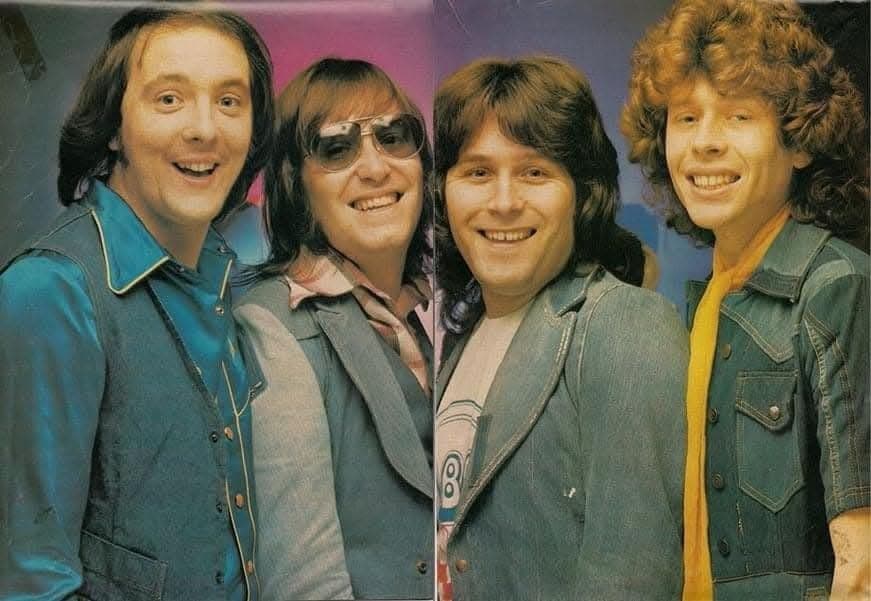
When the music fades, “The End Of The World” becomes less about apocalypse—and more about the quiet collapse of a broken heart.
Few listeners encountering “The End Of The World” by Mud expect the emotional weight hidden beneath its polished surface. Released in 1975 as part of the album “Mud Rock Vol. 2”, the song was not among the band’s biggest chart-toppers, especially when compared to their No.1 UK hits like “Tiger Feet.” In fact, “The End Of The World” did not achieve major chart success upon release, remaining more of an album deep cut than a commercial single. Yet, in retrospect, that may be precisely why it endures—quietly, intimately, and without the burden of mass expectation.
At a time when Mud were largely associated with upbeat glam rock and playful, radio-friendly hits, this song revealed a different shade of their musical identity. Produced under the guidance of the hit-making duo Nicky Chinn and Mike Chapman, the track carries the signature clarity and emotional accessibility that defined much of mid-70s British pop. But here, the gloss is thinner, the mood more reflective—almost fragile.
The title itself inevitably recalls the earlier 1962 classic by Skeeter Davis, a song that also explored heartbreak through apocalyptic imagery. However, Mud’s interpretation is not a cover—it is a reinterpretation of the same emotional idea, filtered through a different era and sensibility. Where Davis’ version leans into country-pop melancholy, Mud’s approach feels more restrained, almost conversational, as if the singer is quietly confiding in the listener rather than performing for them.
What makes “The End Of The World” particularly striking is its emotional paradox. The lyrics speak of devastation—the kind that makes the world feel like it has stopped turning—yet the arrangement remains composed, even gentle. This contrast mirrors a truth many come to understand over time: that the deepest heartbreaks are not always loud or dramatic. Sometimes, they arrive quietly, settling into the spaces between everyday moments.
Lead vocalist Les Gray delivers the song with a subtlety that stands apart from his more energetic performances. His voice does not strain for effect; instead, it carries a weary acceptance, as though the end has already happened, and all that remains is reflection. There is no grand climax here—only a slow, lingering realization.
Within the broader context of the mid-1970s music scene, the song also reflects a transitional moment. Glam rock, once vibrant and flamboyant, was beginning to soften at the edges, making room for more introspective expressions. Mud, often seen as part of that glittering movement, here step briefly out of its shadow to offer something more enduring: a meditation on loss that feels timeless rather than trendy.
In the years since its release, “The End Of The World” has gained a quiet appreciation among listeners who look beyond charts and radio rotations. It is the kind of song that reveals itself slowly—perhaps not on the first listen, but later, when its words find an echo in personal experience.
And that may be its greatest strength. Not its chart position, nor its place in a discography filled with hits—but its ability to sit with the listener in silence, long after the final note fades.