
The Last Voice at the Bar: How “Man in the Big Hat” Preserved the Cowboy Before He Disappeared
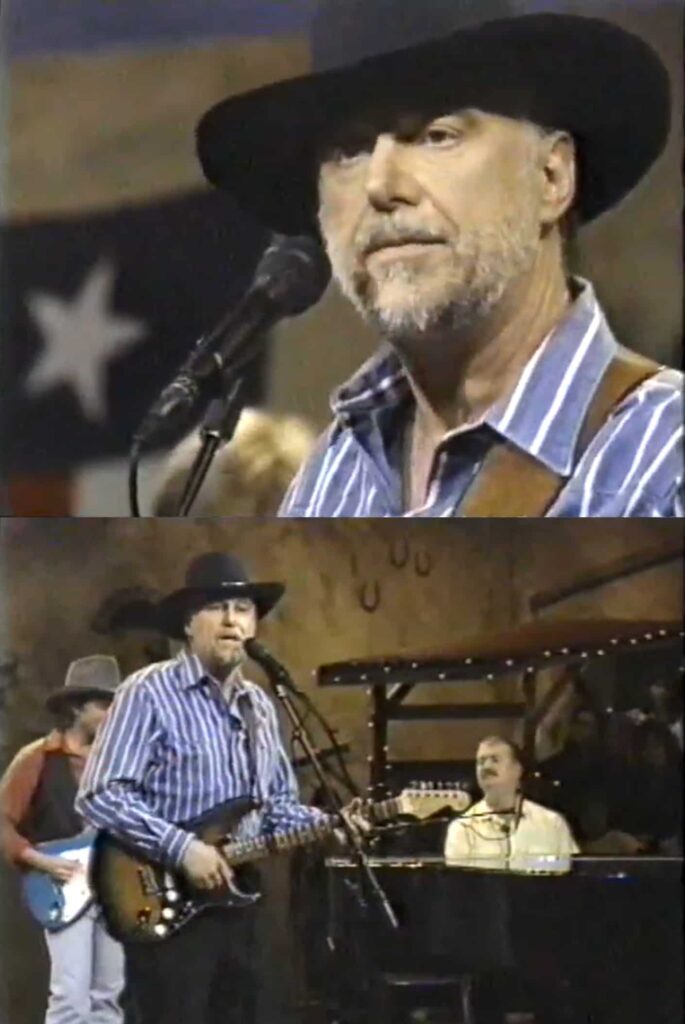
Around 1990, on Texas Connection, Jerry Jeff Walker performed “Man in the Big Hat” with the kind of quiet conviction that made his storytelling feel less like entertainment and more like memory being passed down. Unlike the carefree spirit of songs often associated with Walker, this performance carried a different weight. It was reflective, weathered, and deeply aware that an entire way of life was fading into history.
The song unfolds like an old conversation overheard in a roadside bar somewhere in Texas. A cowboy walks in from the heat, leans against the counter, and begins talking not about glory, but survival. Through vivid details, worn shirts, frozen boots, long cattle drives, and nights lit only by campfires, Walker reconstructs the reality behind the mythology of the American West.
What makes this performance remarkable is its restraint. Walker never romanticizes the cowboy figure too heavily. The man in the song is tired, scarred, and aware that the world around him is changing. When he says the “high lines chase the highway fences,” it becomes clear that modern America is slowly replacing the open range that once defined men like him.
Musically, the arrangement remains simple and unhurried. Acoustic instrumentation gives the lyrics space to breathe, allowing the storytelling to remain central. Walker’s voice, relaxed but textured by age and experience, gives the impression of someone who understands every mile described in the song. He does not sing about the cowboy life from a distance. He sings as though he has sat beside these men for years.
The repeated refrain, “drink up while the drinking is free,” carries more than camaraderie. It feels like a toast to disappearing traditions, to people whose labor shaped the American landscape but whose stories are increasingly forgotten. Beneath the easy rhythm lies a subtle melancholy.
The audience reaction reinforces the atmosphere. There is appreciation, but also attentiveness. The room listens carefully, understanding that the song is preserving something fragile. By the final verse, when the cowboy walks back out the door and disappears into the night, the performance takes on the feeling of a farewell.
Looking back, “Man in the Big Hat” stands as one of Walker’s most evocative narrative performances. Not because it is dramatic, but because it understands the quiet dignity of ordinary endurance.
And that is why it lingers. Because beneath the smoke, the barroom laughter, and the cowboy stories lies something far more human: the fear of becoming a memory in a world moving too fast to look back.